


Metal is no longer the only option for mission-critical structural integrity. In the high-stakes environment of aerospace engine bays and human orthopedic surgery, a specific polymer has emerged as the ultimate "titanium-replacement" champion. This is the domain of peek 3d printing. Polyetheretherketone (PEEK) represents the absolute zenith of 3d printing plastic materials, offering a continuous service temperature of 260°C and a tensile strength that allows it to survive where common engineering plastics simply melt. However, PEEK is not just another filament; it is a thermal beast that resists being shaped. Achieving success in PEEK additive manufacturing requires more than just a high-temperature nozzle—it requires absolute control over the material's molecular crystallization.

At JUCHENG, we recognize that PEEK is a material of technical liability. If the build environment is not maintained at a stabilized high temperature, the part will suffer from "thermal shock," leading to delamination and catastrophic failure in the field. We have engineered our facility to bypass the limitations of standard 3D bureaus, utilizing industrial-grade FDM systems equipped with actively heated chambers that reach 150°C. This guide moves past the basic definitions to explore the thermodynamics of the 400°C melt, the importance of crystalline homogeneity, and why JUCHENG’s integrated approach to high-performance polymers ensures your designs are as functionally sound as they are geometrically complex.
Efficiency in advanced polymer manufacturing is a struggle against localized cooling. You aren't just stacking layers; you are managing a phase-change event that defines the part’s mechanical soul. Whether you are building an ultra-lightweight satellite bracket or a patient-specific spinal implant, the logic of the heat is your primary governor. Let us examine the technical pillars of industrial PEEK and see how JUCHENG locks the integrity of your most ambitious designs into physical reality.
Thermal Sovereignty: Why the 150°C Chamber is Mandatory
Crystalline Integrity: Achieving the Golden Mechanical Ratio
Biocompatible Frontiers: Medical Implants and ISO 13485
Industrial Tiering: Why JUCHENG Defies Desktop Limitations
The Hybrid Decision: 3D Printing vs. CNC Machining
Technical Baseline: PEEK Mechanical Property Chart
Thermal Sovereignty: Why the 150°C Chamber is Mandatory
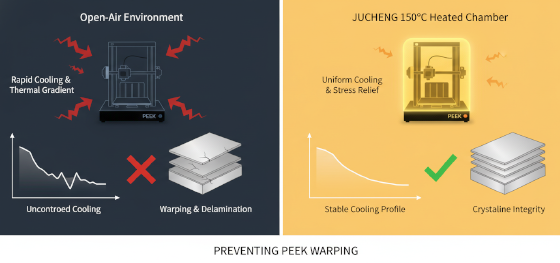
The primary enemy of peek 3d printing is the temperature gradient. PEEK filament requires a nozzle temperature of 380°C to 420°C to reach a flowable state. If this molten polymer is deposited into a chamber at room temperature, it experiences a violent contraction. The resulting internal stresses are so massive that the part will warp, lift off the build plate, or experience "Z-axis delamination"—where the layers physically split apart. This is why PEEK cannot be reliably printed on "prosumer" machines with simple heated beds.
At JUCHENG, we utilize industrial FDM platforms where the entire atmosphere is actively heated and circulated to maintain a constant 150°C. This environment ensures that the previously deposited layer remains at a temperature near its glass transition point (Tg), allowing the new molten layer to fuse at a molecular level. This "Thermal Sovereignty" eliminates the internal tension that plagues lower-tier services. We don't fight the expansion of the plastic; we stabilize it. This technical discipline is what enables us to deliver large, complex PEEK enclosures that maintain their dimensional accuracy across a multi-day build cycle. When you specify PEEK for an aerospace bracket or a subsea sensor housing, you aren't just paying for the material; you are paying for the thermal management that ensures that material doesn't destroy itself during the build.
Crystalline Integrity: Achieving the Golden Mechanical Ratio

PEEK is a semi-crystalline polymer, meaning its strength is derived from how its molecular chains organize themselves as they cool. A part that cools too quickly will stay "amorphous"—it will look dark and translucent, but it will be brittle and lack the material's legendary chemical resistance. A part that cools too slowly or unevenly will develop inconsistent crystallinity, leading to internal weak spots. The "Golden Ratio" for PEEK strength is a crystallinity of approximately 30% to 35%, which gives the part its characteristic tan or beige appearance.
JUCHENG’s master technicians manage this crystallization event through precise control of the "cooling ramp." By maintaining a high chamber temperature and controlling the air-flow dynamics around the nozzle, we ensure that the crystalline structure grows uniformly throughout the entire cross-section of the part. This homogeneity is vital for functional performance. If the crystallinity is uneven, the part will behave unpredictably under load, potentially cracking along grain boundaries. Our commitment to peek 3d printing excellence means we treat every layer as a metallurgical event, ensuring that the 3.6 GPa tensile modulus promised on the datasheet is the modulus delivered in your physical part. We bridge the gap between "printing a shape" and "engineering a structural solid."
Biocompatible Frontiers: Medical Implants and ISO 13485
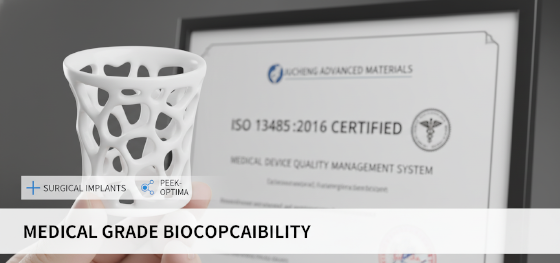
The most revolutionary application for PEEK is found inside the human body. Because PEEK has a modulus of elasticity that closely mimics natural bone, it avoids the "stress shielding" effect caused by rigid titanium implants—where the metal takes all the load and causes the surrounding bone to weaken. This has made PEEK the material of choice for spinal fusion cages, cranial plates, and dental abutments. However, peek 3d printing for medical use is a regulated minefield that requires an ISO 13485:2016 certified partner.
JUCHENG operates under strict cleanroom protocols to prevent cross-contamination during the additive process. We utilize high-purity, implantable grades of PEEK that are certified for long-term human contact. The primary advantage of 3D printing in this sector is "Geometric Customization." We can use a patient's CT scan to print an implant that fits their unique anatomy perfectly. Furthermore, we can integrate porous, trabecular structures into the PEEK surface that encourage osseointegration—allowing the patient's bone to grow directly into the plastic part. By combining anatomical precision with our verified quality management system, we provide surgeons with the tools to improve patient outcomes while ensuring the highest standards of chemical and biological safety.
Industrial Tiering: Why JUCHENG Defies Desktop Limitations

There is a dangerous trend in the market of "desktop" machines claiming to handle high-performance polymers. We are honest with our clients: PEEK is not a material for a part-time shop. A desktop machine might manage to extrude a PEEK-like substance, but it cannot manage the 3d printing plastic physics required for structural use. Industrial tiering is defined by the rigidity of the motion system and the intensity of the thermal enclosure.
At Jucheng Precision, our industrial FDM platforms utilize massive aluminum frames and liquid-cooled spindles to prevent the machine’s own components from warping under the 400°C nozzle heat. This mechanical stability is what allows us to hold tight +/- 0.1mm tolerances on large, complex PEEK components. We also implement "Dual-Extrusion" systems, utilizing specialized soluble support materials that can survive the 150°C chamber. This allows us to print geometries with internal hollows and complex undercuts that would be impossible to de-mold in a traditional casting or injection molding setup. When you choose JUCHENG, you are accessing a manufacturing tier that treats PEEK with the technical reverence it deserves, delivering industrial utility, not just a visual mockup.
The Hybrid Decision: 3D Printing vs. CNC Machining

One of the most frequent DFM questions we resolve is whether to print or machine a PEEK part. As a leader in CNC Machining PEEK, we offer an unbiased perspective. 3D printing is the champion of "Geometric Complexity." If your design features internal fluid channels, weight-saving lattices, or patient-specific curves, peek 3d printing is the only viable path. It allows for the consolidation of multiple parts into a single monolithic block, reducing the risk of seal failure and lowering assembly labor.
However, if your design requires a mirror-like surface finish (Ra 0.4) or sub-ten-micron tolerances on a bearing bore, CNC machining is the necessary partner. At JUCHENG, we often employ a "Hybrid Strategy"—we 3D print the bulk of the complex geometry and then use our 5-axis CNC centers to perform a secondary precision finish on the critical mating surfaces. This provides the best of both worlds: the lightweight freedom of additive and the surgical accuracy of subtractive manufacturing. We don't just sell a process; we sell a manufacturing roadmap that ensures your high-value PEEK components are optimized for both performance and price.
Technical Baseline: PEEK Mechanical Property Chart
To help you finalize your material audit, Jucheng Precision provides the following mechanical baseline for our industrial-grade PEEK. These values are representative of parts produced within our 150°C heated chambers and subjected to standardized post-cure protocols.
| Mechanical Property | Industrial Grade PEEK (Printed) | Comparative Aluminum 6061 |
|---|---|---|
| Tensile Strength | ~95-100 MPa | ~310 MPa |
| Tensile Modulus (Stiffness) | ~3.6 - 4.1 GPa | ~68.9 GPa |
| Heat Deflection (HDT) | 260°C | N/A (Softens ~200°C) |
| Density | 1.32 g/cm³ | 2.70 g/cm³ |
| Chemical Resistance | Superior (All Solvents) | Moderate (Susceptible to Acids) |
When you partner with JUCHENG, you aren't just buying a part; you are buying the engineered certainty that your high-performance plastic components are structurally stable and chemically inert. Our mastery of the 3D printing materials landscape allows us to deliver PEEK parts that perform in the lab and survive in the field. Whether you are building the next generation of satellite hardware or a life-saving orthopedic implant, our 5-axis and additive protocols clarify and elevate your vision. Contact Jucheng Precision today for a technical DFM review and see how our PEEK protocols can armor your next breakthrough.

