


Reliability in additive manufacturing is rarely achieved through the printer alone; it is born from the molecular integrity of the polymer bed. In the rapidly shifting landscape of the 3d printing plastic industry, one material family has transcended the boundary between "visual mockup" and "functional end-use part." This is the realm of nylon 3d printing. Polyamides represent the industrial workhorse of the 21st century, offering a combination of high tensile strength, chemical resistance, and the ductility needed to survive real-world mechanical stress. While resin-based systems chase aesthetics, nylon-based powder fusion technologies like SLS and MJF are engineering the structural "spine" of modern robotics, automotive engine bays, and medical instrumentation.
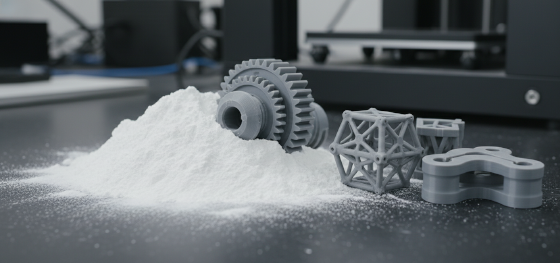
At JUCHENG, we recognize that an engineer’s primary fear is the "layer weakness" inherent in traditional 3D printing. We have centered our facility around technologies that mitigate this risk. By utilizing high-power CO2 lasers and infrared fusion lamps, we transform fine nylon particles into nearly isotropic solids—parts that possess nearly the same strength in the vertical Z-axis as they do in the horizontal plane. This guide moves beyond the standard sales pitches to explore the thermodynamic grit of powder bed fusion, the chemical divide between PA11 and PA12, and why JUCHENG’s focus on high-density MJF production is the definitive answer for those looking to bridge the gap between initial prototyping and full-scale injection molding.
Consistency in plastic manufacturing is a struggle against heat distribution and moisture management. You aren't just stacking layers; you are managing a phase-change event that defines the part’s mechanical soul. Whether you are building an innovative drone chassis or a series of complex fluid manifolds, the logic of the powder is your greatest asset. Let us examine the technical pillars of industrial nylon and see how it redefines the survival of your most ambitious 3D designs.
The Technology Divide: Sintering vs. Fusion
Chemical Resilience: Navigating PA11 and PA12 Performance
Reinforced Fortification: Glass and Carbon Infusion
Technical Data: Mechanical Performance Chart
JUCHENG’s Verdict: Prototyping vs. CNC Machining
The Technology Divide: Sintering vs. Fusion
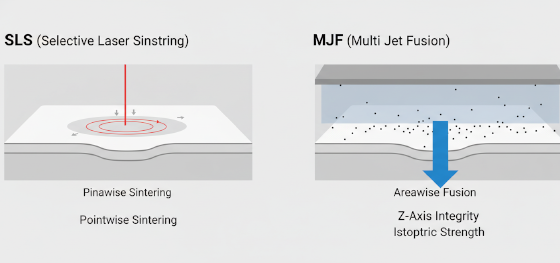
To master nylon 3d printing, you must first understand the two titans of the powder bed: Selective Laser Sintering (SLS) and Multi Jet Fusion (MJF). While both utilize a bed of nylon powder, their thermodynamic paths to a solid part are fundamentally different. SLS utilizes a single, high-precision CO2 laser to "trace" the geometry of a part, sintering the powder particles together at the point of contact. This method is the original workhorse of the industry, capable of producing parts with no support structures, allowing for the creation of complex, interlocking geometries that are physically impossible to manufacture via milling.
MJF, developed by HP, represents the next evolution in 3d printing materials processing. Instead of a laser point, it utilizes an inkjet array to apply a "fusing agent" across the entire surface of the bed, followed by an intense infrared lamp pass that melts the material in a single sweep. The result of this "area-fusion" is a part with superior density and more uniform mechanical properties. At JUCHENG, we heavily promote MJF for our clients moving into small-batch production (50 to 500 units). Because the infrared energy penetrates the material more uniformly than a laser, MJF parts exhibit higher isotropic strength—meaning the part won't snap along a layer line when subjected to torsion. For functional housing and high-pressure manifolds, the "fusion logic" of MJF provides a structural security that standard sintering often struggles to match.
Chemical Resilience: Navigating PA11 and PA12 Performance
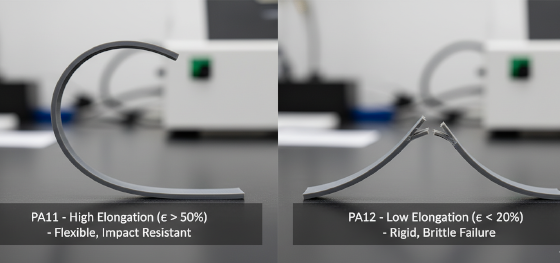
The naming convention of polyamides—11 and 12—is not arbitrary; it defines the number of carbon atoms in the polymer chain and, consequently, how that material will behave in your assembly. Nylon 12 (PA12) is the most common material in our facility. It is a material of balance. It offers excellent dimensional stability and absorbs significantly less moisture than standard nylons, ensuring that a bearing seat or a snap-fit remains in tolerance even in humid coastal environments. It is the king of the enclosure, providing a crisp, matte finish and predictable mechanical performance across thousands of cycles.
Nylon 11 (PA11) is the athlete of the family. Derived from sustainable castor oil, its polymer chains are longer and more flexible. This translates into a part with nearly double the elongation-at-break value of PA12. If your part is a living hinge that must fold a thousand times, or a protective bumper for a high-speed drone, PA11 is the only logical technical choice. It bends where PA12 snaps. At Jucheng Precision, we help our clients audit their load cases. We don't just ask about the strength; we ask about the fatigue. By matching the chemical resilience of the polymer to the mechanical destiny of the part, we ensure your "printed" components behave with the same reliability as their injection-molded counterparts.
Reinforced Fortification: Glass and Carbon Infusion
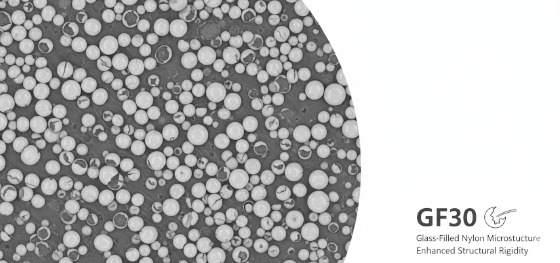
Sometimes, the raw polymer reaches its physical ceiling. When a design requires the stiffness of a cast metal but the weight of a plastic, we turn to "Composite Fortification." JUCHENG specializes in the processing of Glass-Filled (GF) and Carbon-Fiber (CF) reinforced nylon powders. In a GF-Nylon part, microscopic glass beads are infused into the polyamide matrix. This doesn't just increase the hardness; it dramatically increases the material's Heat Deflection Temperature (HDT), allowing the part to maintain its shape in automotive engine rooms or near high-intensity industrial lighting.
Carbon-Fiber Nylon takes this even further, providing a massive boost in tensile modulus. It turns a "plastic" part into a structural component capable of replacing aluminum brackets in non-critical aerospace assemblies. However, machining or finishing these composites is a technical high-wire act. The fibers are abrasive and can cause "fuzzing" on the surface if the fusion parameters are incorrect. JUCHENG utilizes high-resolution MJF processes to ensure that these fibers are perfectly encapsulated within the resin matrix. This prevents delamination and ensures that the structural benefit of the fiber is uniform throughout the entire volume of the part. We don't just add filler; we engineer a cohesive composite system that survives where standard polymers fail.
Technical Data: Mechanical Performance Chart
To simplify your material selection, Jucheng Precision provides the following technical baseline for our most common nylon grades. These numbers represent the as-printed state before secondary stabilization.
| Property | Nylon 12 (PA12) | Nylon 11 (PA11) | Glass-Filled (GF) |
|---|---|---|---|
| Tensile Strength | ~48 MPa | ~45 MPa | ~50 MPa |
| Elongation at Break | ~15-20% | ~35-45% | ~5-8% |
| Heat Deflection (0.45MPa) | 175°C | 180°C | 185°C |
| Surface Finish | Matte / Fine Grain | Satin / Smooth | Matte / Textured |
JUCHENG’s Verdict: Prototyping vs. CNC Machining
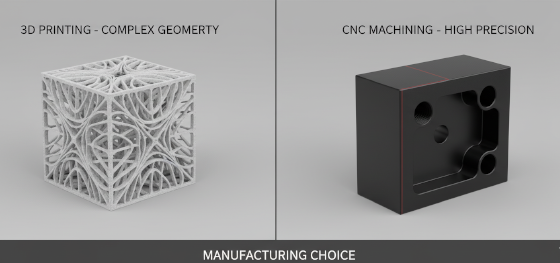
The final hallmark of a one-stop-shop like Jucheng Precision is the ability to tell you when not to use 3D printing. In the 3d printing materials world, nylon is a godsend for complexity, but it cannot always compete with the raw density and sub-micron accuracy of a 5-axis mill. When a design features a massive solid volume or requires an H7 bearing tolerance, we will steer you toward our CNC Nylon Machining cells.
We view these technologies as partners, not competitors. For a single assembly, we may print the complex, topologically-optimized outer housing via nylon 3d printing and machine the high-precision internal lock mechanisms via CNC. This hybrid approach ensures you get the lightweight benefits of additive and the functional precision of subtractive. We bridge the gap between design theory and real-world assembly. Whether you are building an innovative medical device or a mission-critical satellite mount, our expertise in high-fidelity polymers ensures your vision is delivered with absolute integrity. Contact Jucheng Precision today for a comprehensive technical DFM review and let our material protocols clarify and elevate your next manufacturing challenge.

