


Selecting the right polymer is often a choice between "good enough" and "engineered to excess." In the fast-moving world of prototyping and low-volume production, two materials dominate the conversation more than any others. They appear in everything from dashboard components to medical enclosures. This is the fundamental head-to-head of ABS vs Polycarbonate. One is the master of cost and surface versatility; the other is the champion of raw, unbreakable strength.
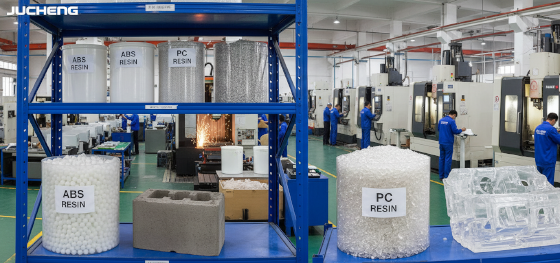
At Jucheng Precision, we specialize in high-precision abs cnc machining, but we frequently see projects where the lines between these two resins are blurred. Choosing correctly requires an understanding of how these molecules react to physical impact, thermal loads, and the sharp edge of a carbide tool. If you over-engineer with Polycarbonate (PC), you inflate your budget; if you under-engineer with ABS, your part may fail the first time it is dropped. This guide breaks down the technical and economic boundaries to ensure your choice aligns with the mission of your design.
Moving beyond the datasheet is essential. In the machine shop, a material's "feel" and its stability dictate the final yield rate. Whether you need a sleek consumer housing or a ruggedized industrial guard, the 1000-word journey through the physics of ABS and PC starts here.
Economic Realities: Performance vs. The Bottom Line
Mechanical Integrity: The Bulletproof Factor
Machining Behavior: Stability and Chip Control
Aesthetics and Plating: The Finishing Potential
Selection Matrix: JUCHENG’s Final Verdict
Economic Realities: Performance vs. The Bottom Line

The first filter for almost any commercial project is the financial one. In the ABS vs Polycarbonate debate, ABS is the perennial winner for budget-conscious engineering. Acrylonitrile Butadiene Styrene is an abundant commodity polymer. It is easy to refine and easy to source in vast quantities. In many cases, the raw material cost for an ABS billet is 30% to 50% lower than that of an equivalent block of Polycarbonate. For high-volume production runs or large-scale prototypes where "form and fit" are the primary goals, this cost gap represents a massive portion of the total project ROI.
However, the economic analysis must also include "Machinability Cost." ABS is a dream for high-speed CNC centers. It is stable, it does not melt as easily as PC at low feed rates, and it has a lower modulus of elasticity, which means it is gentler on cutting tools. We can often achieve faster cycle times with ABS, further driving down the price-per-part. Polycarbonate is a premium investment. You don't choose it to save money; you choose it as "insurance" for the functional life of the part. At Jucheng Precision, we advise our clients to start with abs cnc machining for initial design iterations to conserve capital, moving to Polycarbonate only when the mechanical requirements mandate its specific set of superpowers.
Mechanical Integrity: The Bulletproof Factor
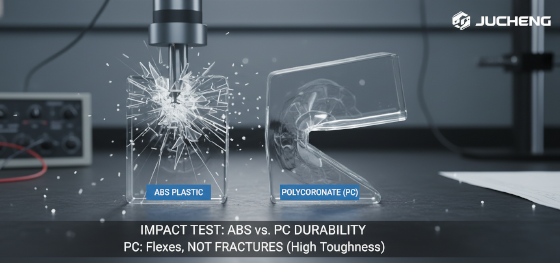
When the conversation shifts to survival, Polycarbonate dominates. It is the material of choice for bulletproof glass and safety visors for a reason. Its impact strength is legendary—nearly 250 times that of glass and 15 times that of ABS. In an Izod Impact test, an ABS part will eventually reach its limit and snap or shatter. A Polycarbonate part, even when notched, will typically dent, deform, or bend without losing its structural connection. This "toughness" is the result of long, entangled polymer chains that can absorb massive amounts of kinetic energy and dissipate it as heat.
For the engineer, this means that in the ABS vs Polycarbonate comparison, PC is the only logical choice for functional components in high-stress environments. Think of hand-held industrial scanners that might be dropped on concrete, or protective covers for high-speed robotic arms. ABS, while tough for a standard plastic, is still relatively brittle. It is susceptible to "notch sensitivity," where a sharp internal corner or a deep machining mark can become a starting point for a crack. If your design involves thin walls or complex load-bearing features, the superior tensile strength and impact resilience of Polycarbonate provide the safety margin needed for field use. JUCHENG’s technical reviews often point out these stress-failure risks, guiding you toward the durability of PC when your brand reputation is on the line.
Machining Behavior: Stability and Chip Control
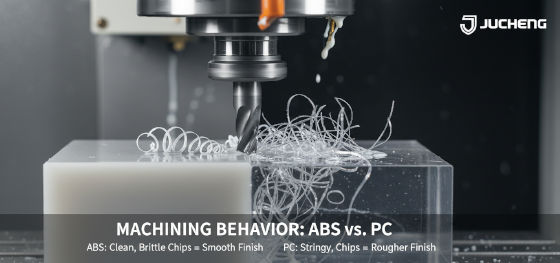
Inside the machine enclosure, the personalities of these materials diverge. abs cnc machining is a highly predictable process. The material is crisp; it shears cleanly under the tool, producing flakes that are easy to evacuate with standard high-pressure air or coolant. Because ABS has a relatively low glass transition temperature (~105°C), we manage heat carefully, but the material's stability means we can hold tolerances of +/- 0.05mm across large batches with almost zero dimensional drift. It is the perfect material for high-speed production where consistency is the primary metric.
Polycarbonate presents a "gummy" challenge. Because it is designed to absorb energy, it resists being cut. Instead of fracturing, PC wants to peel away in long, stringy ribbons. These ribbons can wrap around the spindle and trap heat, leading to localized melting that ruins the surface finish. To master PC milling, JUCHENG engineers utilize specialized single-flute "O-flute" bits and aggressive feed rates to ensure the heat is carried away in the chip. While PC is more difficult to machine than ABS, it offers better dimensional stability in high-temperature environments. ABS begins to soften at temperatures that PC easily ignores. If your part will live in a warm automotive engine bay or near a high-intensity light source, the thermal stability of Polycarbonate justifies the extra effort on the machine floor.
Aesthetics and Plating: The Finishing Potential
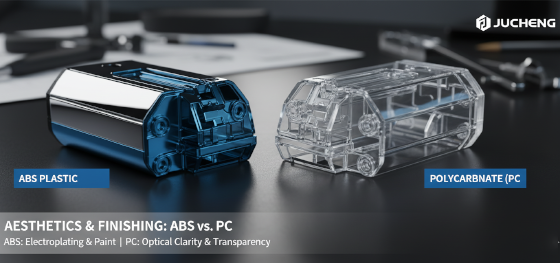
If the goal of your part is visual perfection, ABS is the king of the workshop. It has an almost unique chemical property: it is incredibly easy to plate and paint. Because ABS is a tri-polymer, we can chemically etch the butadiene rubber particles on the surface, creating microscopic "teeth" that grab onto electroplated nickel or chrome. This is why almost every metallic-looking plastic part on a luxury car—from the emblems to the door handles—is actually plated ABS. In the ABS vs Polycarbonate battle for aesthetics, ABS wins because it provides a perfect substrate for secondary finishes.
Polycarbonate, however, offers a finish that ABS can never achieve: transparency. While ABS is always opaque (usually a cream or light grey color), PC is naturally clear. Through advanced 5-axis machining followed by vapor polishing, Jucheng Precision can turn a block of PC into an optical-grade lens or a transparent fluid manifold. PC is also much harder to scratch than ABS. If your design calls for a high-gloss "piano black" finish that needs to remain pristine, the higher surface hardness of Polycarbonate is superior. But for parts that need to be painted in custom brand colors or electroplated to look like solid metal, ABS is the engineering standard. We work with our clients to determine if the "natural" look of the plastic is sufficient or if the superior finishing potential of ABS is required for the user experience.
Selection Matrix: JUCHENG’s Final Verdict
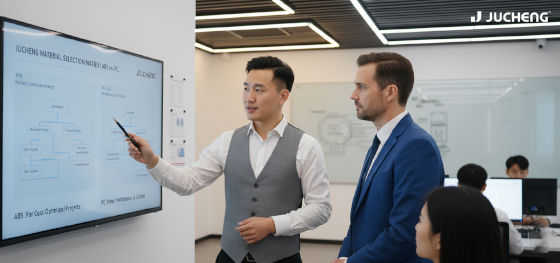
To simplify the decision, Jucheng Precision uses a definitive decision tree during our DFM reviews. We look at the intended environment, the required aesthetics, and the final budget to ensure the material matches the mission.
Choose ABS if:
• The project is in the early "form and fit" prototyping stage.
• You require a metallic finish (electroplating) or high-quality paint.
• The part will be used in an indoor, room-temperature environment.
• Budget efficiency is a primary constraint for large volume orders.
Choose Polycarbonate if:
• The part is a functional shield, guard, or enclosure that must survive impacts.
• Optical transparency or translucency is a design requirement.
• The operating environment temperature exceeds 80°C.
• High dimensional stability and structural stiffness are non-negotiable.
Jucheng Precision maintains a deep inventory of both materials to support our abs cnc machining and high-performance plastic services. We bridge the gap between design theory and manufacturing reality, ensuring your parts work exactly as they should. Contact our engineering team today for a technical consultation on your next plastic project.

