


I have lost count of how many times a frantic hardware startup has walked into our Shenzhen facility holding a beautiful ABS prototype, only to watch their budget crumble. Feeling the smooth, freshly painted surface, I would casually run my thumbnail across a sharp edge. The sickening, brittle sound of the topcoat flaking off like dead skin instantly revealed their fatal mistake. Applying basic acrylic paint on plastic without brutal industrial chemistry guarantees catastrophic delamination before the product ever reaches an investor pitch.

Relying on cheap, water-based hobby pigments to coat high-fidelity engineered polymers represents the ultimate false economy in hardware development. Smooth thermoplastics possess notoriously low surface energy. Spraying raw acrylic directly onto a freshly machined Delrin or polycarbonate chassis is like trying to paint a block of solid ice. The fluid simply beads up, refuses to bite into the substrate, and eventually dries into a fragile shell that shatters under the slightest kinetic vibration.
Fixing this adhesion nightmare requires decoupling from amateur tutorials and embracing hardcore surface science. True manufacturing survivability demands aggressive mechanical abrasion, hazardous chemical adhesion promoters, and heavily catalyzed clearcoats. Mastering these thermodynamic boundaries completely eliminates embarrassing paint failures and transforms a fragile 3D printed concept into a production-grade industrial master ready for rigorous [2026] field testing.
content:
Why Does Acrylic Paint Flake Off Raw Plastic Substrates?
How Do Adhesion Promoters Solve the Surface Energy Gap?
When MUST You Avoid Acrylic Paint in Prototype Assembly?
Acrylic Paint vs 2K Urethane: Which Cuts Manufacturing Costs?
What Mechanical Prep Prevents Paint Delamination Failures?
How Does Jucheng Ensure Flawless Paint Adhesion in Shenzhen?
What Are the Most Critical Plastic Painting FAQs?
Why Does Acrylic Paint Flake Off Raw Plastic Substrates?

Does water-based acrylic naturally bond to smooth thermoplastics? Absolutely not. Water-based resins completely lack the aggressive volatile solvents required to melt and fuse into high-surface-energy polymers like ABS or polycarbonate.
Walking into the finishing room, you can actually smell the difference between a proper industrial coating and a failed hobby attempt. Raw plastics repel fluids due to incredibly low dyne levels. When an operator sprays standard acrylic onto a freshly CNC-machined surface, the microscopic paint droplets experience massive surface tension. Instead of spreading out, the liquid pulls away from the edges.
Machinists understand that CNC milling leaves extremely smooth, non-porous surfaces. Without introducing harsh solvents to physically soften the top molecular layer of the plastic, the dried acrylic possesses zero mechanical interlock. The first time a client drops the prototype onto a boardroom table, the kinetic shock wave violently separates the paint film from the plastic core.
How Do Adhesion Promoters Solve the Surface Energy Gap?

Can you just spray standard primer directly over raw plastic? No. Generic primers will peel exactly like the topcoat. You must deploy a specialized chemical adhesion promoter designed to bridge the covalent bond between the polymer and the paint.
Handling an aggressive adhesion promoter in the booth requires heavy respirators. These transparent, solvent-heavy fluids smell intensely of xylene and toluene. When misted over a plastic chassis, these harsh chemicals intentionally attack the substrate. They microscopically melt the top few microns of the polymer, essentially opening up the pores of the plastic.
This chemical bridge acts like molecular double-sided tape. One end of the promoter permanently fuses into the melted plastic, while the other end provides a highly textured, porous anchor for the subsequent paint to bite into. Skipping this caustic step is the single most common reason hardware startups experience embarrassing cosmetic failures.
When MUST You Avoid Acrylic Paint in Prototype Assembly?

Deploying fragile acrylic coatings on snap-fit enclosures or highly flexible TPU components guarantees catastrophic cracking the moment mechanical stress forces the substrate to bend.
Single-component (1K) acrylics dry entirely through water evaporation, leaving behind a relatively rigid, un-cross-linked resin. If you assemble a painted plastic drone chassis and tighten the mounting screws, the localized compressive force will instantly shatter the acrylic ring around the screw hole. The paint lacks the chemical elasticity to absorb kinetic deformation.
You must immediately upgrade to a catalyzed 2K urethane system whenever the blueprint demands functional road testing. Furthermore, never use acrylics on low-friction engineering plastics like Teflon (PTFE) or Delrin (POM). These materials are physically designed to repel foreign substances; standard paints will slide off them like water off a duck's back.
Acrylic Paint vs 2K Urethane: Which Cuts Manufacturing Costs?
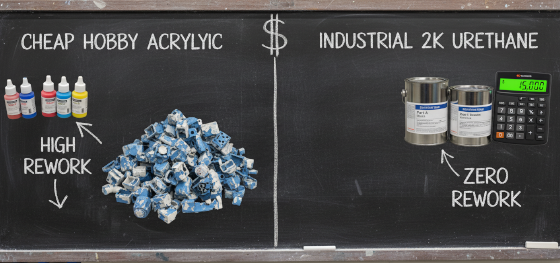
Procuring bottled acrylic paint minimizes your upfront bill of materials, but the agonizing manual rework required to fix peeling edges makes industrial 2K urethane drastically cheaper for volume production.
Paying a skilled technician to manually strip, re-sand, and re-paint a ruined prototype incinerates hundreds of dollars in lost labor hours. Rework is the silent killer of hardware budgets. True industrial urethanes bite aggressively into plastics with minimal surface promoter requirements. They flash off rapidly, allowing multiple coats in minutes.
Analyzing the true cost of coating failure proves that buying expensive, highly engineered chemical paints lowers the final per-unit price tag. The data below outlines the stark contrast between these two finishing ideologies during mid-volume bridge production.
| Coating Parameter | Standard Acrylic (1K) | Industrial Urethane (2K) | Manufacturing Impact |
|---|---|---|---|
| Raw Material Cost | Extremely Low | High (Requires hardeners) | Urethane demands a higher initial budget |
| Substrate Adhesion | Very Poor | Excellent (Chemical bond) | Acrylic requires intense mechanical prep |
| Curing Mechanism | Evaporation (Slow) | Chemical Cross-linking | Urethanes crush assembly bottleneck times |
| Rework Scrap Rate | High (Chipping/Peeling) | Near Zero | Rework costs destroy acrylic's savings |
What Mechanical Prep Prevents Paint Delamination Failures?

Physically abrading the polymer surface with 400-grit sandpaper creates deep microscopic valleys that force the liquid paint into an unbreakable mechanical interlock.
Rubbing a raw ABS enclosure with fine-grit abrasive transforms its slick, glossy finish into a dull, cloudy haze. The sound of sandpaper scratching the plastic is the sound of assembly insurance. By deliberately introducing thousands of chaotic scratches, you exponentially increase the total surface area of the component.
Following the abrasion process, technicians must aggressively scrub the part with industrial degreasers. Human fingerprints deposit microscopic layers of skin oil that invisibly repel paint. I have seen massive medical prototypes ruined because an operator handled the sanded part without nitrile gloves. Absolute surface purity dictates survival.
How Does Jucheng Ensure Flawless Paint Adhesion in Shenzhen?

Operating out of the Shenzhen precision manufacturing hub, Jucheng deploys rigorous ultrasonic degreasing, dedicated adhesion promoters, and automated robotic spraying to guarantee zero delamination.
Shipping a painted CNC plastic chassis across the globe invites catastrophic cosmetic failure if the paint isn't chemically locked down. Our 8000-square-meter facility merges hardcore 5-axis milling directly with climate-controlled, dust-free water curtain spray booths. We eliminate the volatile variables of third-party finishing vendors.
Before any prototype enters the booth, our engineers aggressively execute a cross-hatch adhesion test on a sacrificial piece of the exact same polymer batch. Supported by uncompromising ISO9001:2015 quality protocols, our Free DFM reviews identify high-risk masking zones before production starts. We offer aerospace-grade cosmetics without MOQ restrictions.
What Are the Most Critical Plastic Painting FAQs?
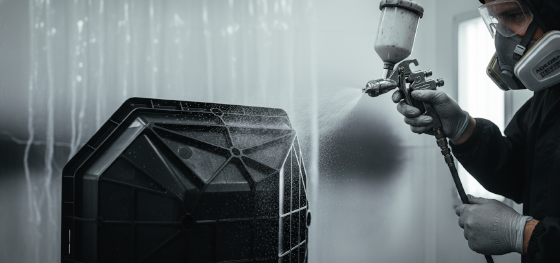
Resolving hardcore chemical compatibility issues prevents massive field recalls during the deployment of custom fabricated plastic enclosures.
What causes severe orange peel texture in acrylic topcoats?
Orange peel triggers when atomized paint droplets fail to flow and level completely before the rapid flash-off of chemical solvents. Shooting paint in heavily humid environments forces the liquid resin to seize up, locking in microscopic bumps that destroy optical clarity.
Why does paint remain sticky or tacky on 3D printed resin parts?
SLA resin parts often suffer from incomplete post-curing. If the core of the 3D print still contains uncured liquid resin, it constantly off-gasses microscopic fumes through the surface. These invisible fumes aggressively attack the overlying paint from underneath, chemically preventing it from drying.
Can you bake painted plastic parts in an oven to speed up curing?
Yes, but only under strict thermal limits. Most standard ABS or PLA prototypes will warp and melt if the curing oven exceeds 60°C (140°F). Industrial paint booths utilize specialized low-heat infrared lamps to safely accelerate the cross-linking process without destroying the CNC dimensional tolerances.

