


Don't ruin a five-hundred-dollar machined part with a five-dollar finish. It is a common mistake in procurement. You spend weeks perfecting the 5-axis tool paths, only to pick a coating that chips the moment it hits the assembly floor. In the world of industrial protection, the choice of powder coat vs paint is the most frequent crossroads engineers face. It is a decision that balances the raw armor of a fused polymer against the elegant versatility of liquid chemistry.

At Jucheng Precision, we integrate finishing into the heart of our CNC machining surface treatment strategy. We know that a coating is not just a color; it is a structural layer. If you choose the wrong one, you might find your precision-tapped holes clogged with plastic or your outdoor chassis rusting within six months. This guide breaks down the physics and the economics of both systems, helping you determine where to invest and where to save.
Success in finishing requires understanding how these materials bond to the metal. One creates a chemical skin; the other creates an adhesive shell. Let us explore the technical pillars that define professional industrial coating.
Durability Combat: Cross-Linking vs. Drying
Cost Efficiency: Scaling Batches vs. One-offs
Dimensional Impact: Managing Coating Thickness
Eco-System Reality: Solvent Elimination
Aesthetic Range: Custom Blending vs. Standard RAL
Final Decision: Selecting for Your Environment
Durability Combat: Cross-Linking vs. Drying

To settle the powder coat vs paint debate, you must look at the molecular level. Liquid paint relies on a solvent to keep the pigment and resin in a liquid state. When you spray it, the solvent evaporates into the air, leaving behind a thin film of plastic. This is an adhesive bond. It is essentially a sticker that dries onto the metal. While high-end urethanes are tough, they remain susceptible to "chipping." A sharp impact often causes the paint to crack and delaminate from the metal surface because the bond is purely surface-level.
Powder coating utilizes a completely different thermodynamic process. The dry powder is electrostatically attracted to the part and then placed in a curing oven at 200°C. In the heat, the powder melts and undergoes a chemical reaction called cross-linking. The polymer chains don't just sit on the metal; they bond to each other into a continuous, high-molecular-weight shield. This results in a coating that is significantly more flexible and impact-resistant. Think of it like a durable rubberized skin versus a thin glass coating. If you hit a powder-coated bracket with a hammer, the coating will often dent with the metal rather than shattering. For industrial equipment, mining tools, or automotive chassis components, this "cross-linked" resilience is the primary reason powder coating is the global standard for CNC machining surface treatment.
Cost Efficiency: Scaling Batches vs. One-offs

Economics usually dictate the winner in a commercial environment. The cost structure of these two finishes is inverted. Liquid paint has a very low "entry cost." You can buy a can of paint and a spray gun and be working in minutes. For a single prototype or a one-off custom part, liquid paint is often cheaper because there is no oven to heat and no specialized powder to source. However, liquid paint is labor-intensive. It requires multiple coats, sanding between layers, and long drying times (flashing). If you are manufacturing 500 parts, the labor cost of paint becomes astronomical.
Powder coating is built for the factory scale. Once the booth is set up and the oven is pre-heated, we can coat hundreds of parts per hour. The powder itself is also more efficient; any "over-spray" that doesn't hit the part can be collected and recycled, resulting in nearly 95% material utilization. In the powder coat vs paint ROI analysis, powder coating wins the moment you move past the prototype stage. At Jucheng Precision, we operate a dedicated in-house powder line. This allows us to pass these scaling efficiencies directly to our clients, delivering a superior, more durable finish for a lower per-unit cost than traditional liquid spraying.
Dimensional Impact: Managing Coating Thickness
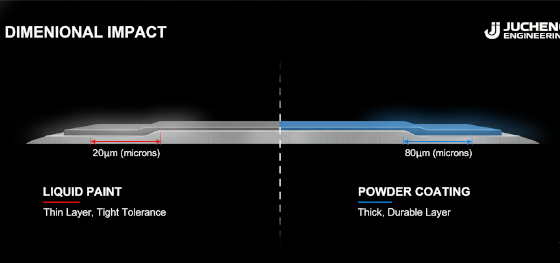
For a CNC machinist, thickness is the most dangerous variable. Liquid paint is thin—typically between 15 to 30 microns (0.0006" to 0.001"). This is often thin enough to ignore in all but the tightest aerospace assemblies. You can paint over a thread, and the screw will likely still fit. You can paint a bearing seat, and the bearing will likely still press-in. For parts with intricate engravings or delicate features, the thinness of liquid paint preserves the "geometric truth" of the machining.
Powder coating is a "thick-film" finish. A standard industrial coat ranges from 60 to 120 microns (0.002" to 0.005"). While this thickness provides the armor that makes it famous, it can ruin a precision part. If you don't account for this in the CAD phase, your parts won't fit together. Jucheng Precision manages this through two specialized strategies. First, we provide DFM advice on "Coating Allowance," where we machine the part slightly undersized to accommodate the powder. Second, we utilize precision masking. We plug threads and shield bearing bores with high-temp silicone before the powder hits. In the powder coat vs paint debate, if your part is high-precision and cannot be masked, paint may be the necessary evil. But if it can be masked, the protection of powder is usually worth the extra engineering effort.
Eco-System Reality: Solvent Elimination

Modern manufacturing is governed by environmental regulation. Liquid paint is a chemical cocktail. It contains Volatile Organic Compounds (VOCs) that are hazardous to breathe and require expensive filtration systems to vent into the atmosphere. The "wet" waste from paint shops is often classified as hazardous material, increasing the regulatory burden and the cost of the facility. As global brands move toward greener supply chains, liquid paint is increasingly seen as a liability.
Powder coating is the "green" champion of the CNC machining surface treatment world. Because it is a dry process, there are no solvents to evaporate. It is a zero-VOC process. As mentioned before, the over-spray is reclaimed and reused, meaning there is virtually no solid waste generated. For our clients in Europe and North America who must report on the carbon footprint and environmental impact of their vendors, JUCHENG’s powder coating line is a vital asset. It allows you to deliver a premium product that meets the environmental standards of the most demanding markets without compromising on the finish quality or the part's lifespan.
Aesthetic Range: Custom Blending vs. Standard RAL
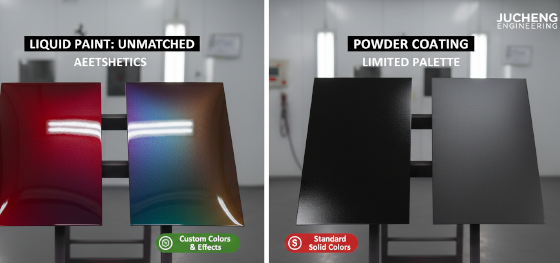
Despite the technical superiority of powder, liquid paint still holds one high-ground: aesthetic flexibility. Liquid paint is infinitely blendable. If you need to match the specific "pearl metallic" finish of a high-end luxury car, or if your brand requires a unique translucent "candy" finish over polished aluminum, liquid paint is the only way to achieve it. We can mix paint on-site to match any Pantone or custom swatch with perfect accuracy.
Powder coating colors are fixed. They are manufactured in large batches by the resin supplier. While there are thousands of RAL colors and textures available, you cannot "mix" two powders to create a new color—you will simply get a speckled "salt and pepper" finish. However, for 95% of industrial and commercial applications, the standard RAL library of powder provides everything needed. From high-gloss safety yellow to matte tactical black, powder coating delivers a "depth" of color that looks expensive and high-quality. At Jucheng Precision, we maintain a huge stock of standard powders for fast turnaround, reserving our liquid paint booth for the complex cosmetic prototypes that demand automotive-level color depth.
Final Decision: Selecting for Your Environment

The final selection in the powder coat vs paint battle comes down to the part's intended destiny. At Jucheng Precision, we don't just take your order; we ask about the environment. Where will this part live? How often will it be handled?
Choose Powder Coating if:
• The part is used outdoors or in high-vibration industrial environments.
• You are manufacturing in batches of 50 or more.
• Extreme durability and chip resistance are the primary goals.
• You want a textured finish (sand, wrinkle, or heavy matte).
Choose Liquid Paint if:
• You are making a single high-fidelity cosmetic prototype.
• The part has ultra-tight tolerances that cannot be masked.
• You need a specific, non-standard custom color match (e.g., metallic pearl).
• The part cannot be heated to 200°C (e.g., some plastics or thin-walled assemblies).
Jucheng Precision offers both technologies under one roof, managed by engineers who understand the nuances of CNC machining surface treatment. We ensure your parts arrive finished, verified, and ready to work. Don't leave your coating to chance. Contact our team today for a technical DFM review of your project's final layer.

