


Visual authority in consumer electronics is often decided by the "Piano Black" audit. For industrial designers, a high-gloss surface is the ultimate expression of luxury, yet it remains the most unforgiving finish in the injection room. In the uncompromising landscape of Injection molding surface finishes, traditional methods often produce parts marred by "Ghosting"—microscopic weld lines and flow marks that become glaringly obvious under specular reflection. When a project demands an SPI A-1 mirror finish without the cost and environmental burden of secondary painting, High gloss injection molding via Rapid Heat Cycle Molding (RHCM) is the mandatory engineering choice. This technology utilizes dynamic thermal management to eliminate surface defects at the source. Jucheng Precision operates as a high-fidelity cosmetic house, utilizing specialized steam and oil-heated tooling to ensure your housings, bezels, and display panels possess the crystalline soul and flawless reflection your brand requires to dominate the market.

Eliminating the "Weld Line Crisis" requires moving beyond static mold temperatures. Weld lines occur when two molten polymer fronts meet but fail to fuse perfectly due to a cold mold surface. This results in a microscopic V-notch that scatters light, creating a visible "scar" on the part. Jucheng Precision eliminates these manufacturing artifacts by utilizing RHCM technology—rapidly heating the mold surface above the resin's Glass Transition (Tg) point right before injection. This ensures the melt fronts fuse into a monolithic, seamless structure. Once the cavity is filled, the tool is flash-cooled to secure dimensional stability. This guide deconstructs the physics of the weld line, the thermal mechanics of rapid cycling, and why our technical advisory is the mandatory choice for hardware teams aiming for retail-ready aesthetics without the "Painting Tax."
Anatomy of Failure: Why Traditional Gloss Molds Fail
RHCM Dynamics: Mastering the Rapid Heat Cycle
Material Sovereignty: Choosing Resins for Specular Authority
Tooling Rigor: The Necessity of S136 Mirror Steel
Strategic Economics: Skipping the Paint Line Safely
JUCHENG Protocol: Zero-Defect High-Gloss Execution
Anatomy of Failure: Why Traditional Gloss Molds Fail
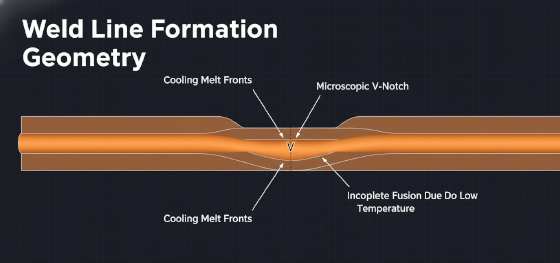
Molecular stagnation at the flow front is the primary architect of cosmetic rejection. In standard injection molding, the tool is maintained at a constant, relatively cool temperature to ensure fast cycle times. As the molten plastic—usually ABS or Polycarbonate—reaches the furthest extremities of the part, it begins to lose thermal energy. When two of these cooling flow fronts meet around a boss or an opening, they are too viscous to intermingle their polymer chains. They merely "touch," leaving a microscopic gap on the surface. For a matte part, this is invisible; for a high-gloss part, this "Knit Line" acts as a canyon that traps light, creating a permanent visual defect. Furthermore, traditional molding often results in "Flow Hesitation" marks where the plastic pauses briefly, leaving a ripple that no amount of machine pressure can flatten. High gloss injection molding demands a different physical logic—one where the mold surface is temporarily as hot as the melt itself, allowing for a "Stitch-Free" fusion that achieves absolute specular authority.
RHCM Dynamics: Mastering the Rapid Heat Cycle
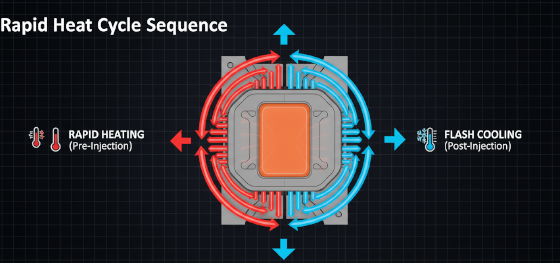
Thermal velocity dictates the success of mirror-like replication. Rapid Heat Cycle Molding (RHCM) eliminates the "Cold Tool" problem by utilizing a pulsating thermal strategy. Before the injection phase begins, Jucheng Precision technicians pump high-pressure steam or super-heated oil through the mold's internal channels, spiking the cavity surface temperature to 150°C in seconds. This prevents the plastic's "Skin" from freezing prematurely. The molten polymer enters a red-hot tool, flowing with the viscosity of water and replicating every micron of the SPI A-1 polish. Because the surface is molten, weld lines literally vanish. Immediately after the cavity is packed, the system switches to high-velocity chilled water, quenching the part to its solidification point. This "Thermal Snap" ensures that the part doesn't warp upon ejection. We don't just "mold parts"; we orchestrate a thermodynamic event that ensures your high-gloss housings emerge from the tool with a depth of color and surface perfection that traditional molding simply cannot replicate.
Material Sovereignty: Choosing Resins for Specular Authority
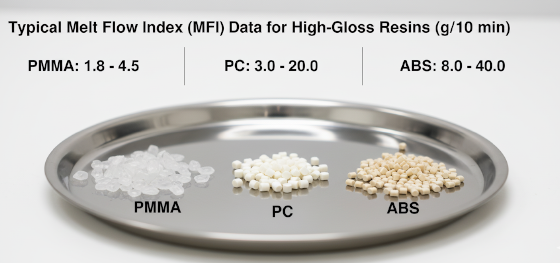
Chemistry defines the "Gloss Ceiling" of your component. Not all Injection molding materials are suitable for mirror finishes. Amorphous resins like ABS, Polycarbonate (PC), and PMMA (Acrylic) are the undisputed kings of the high-gloss world because they lack the crystalline structure that creates surface "haze." However, for RHCM to be effective, the material must possess a high Melt Flow Index (MFI). Jucheng Precision engineers partner with you to select specialized "High-Gloss" grades from leaders like Sabic or Covestro. These resins are formulated to resist "Shear Burning" at the high velocities required by the RHCM process. If your part is intended for an automotive interior, we might recommend a PC/ABS blend to balance high-gloss aesthetics with the necessary impact resistance. We ensure that your material choice supports the thermal cycle, preventing the "Silver Streaks" (splay) that plague amateur high-gloss operations.
Tooling Rigor: The Necessity of S136 Mirror Steel

Manufacturing a mirror is an exercise in steel purity. A High gloss injection molding tool is only as good as the steel's molecular consistency. Standard P20 tool steel contains microscopic impurities and "Pits" that prevent it from achieving a true optical shine. At Jucheng Precision, we exclusively utilize S136 through-hardened stainless steel for our RHCM high-gloss molds. S136 possesses the extreme hardness (up to 52 HRC) needed to resist the thermal fatigue of rapid heating and cooling cycles. More critically, it can be hand-polished to an SPI A-1 diamond buff finish, achieving a surface roughness (Ra) of less than 0.01µm. Our facility houses 150+ CNC machines and specialized polishing bays where our veteran model makers spend hundreds of hours ensuring your mold cavity is a perfect mirror. This tooling rigor is what ensures your parts emerge without a single blemish, providing the visual authority needed for premium consumer electronics and medical displays.
Strategic Economics: Skipping the Paint Line Safely

Sustainability is a byproduct of manufacturing efficiency. For decades, the only way to achieve a "Piano Black" finish was to mold a part and then send it to a secondary spray painting line. This process is expensive, has a high scrap rate due to dust inclusions, and generates significant VOC (Volatile Organic Compound) emissions. Utilizing High gloss injection molding via RHCM allows you to achieve that identical look "In-Mold." By eliminating the paint line, JUCHENG helps you reduce your total part cost by 20% to 30% and shortens your production lead time by weeks. Furthermore, an RHCM part is 100% recyclable because it lacks the contaminated layers of primer and paint. We provide the manufacturing insurance needed to secure a "Retail-Ready" look that is as economically sound as it is environmentally responsible. We don't just "cut costs"; we engineer waste out of the project.
JUCHENG Protocol: Zero-Defect High-Gloss Execution
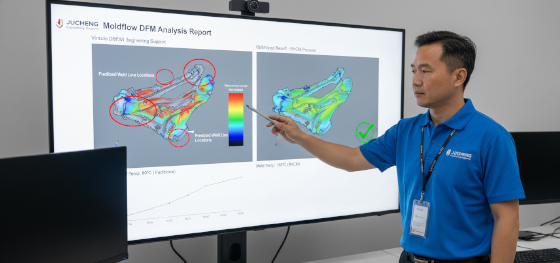
Engineering success at Jucheng Precision is built on the foundation of predictive simulation. We don't just "hope" your high-gloss parts look good; we verify them in the digital realm. When you upload a CAD file to our facility, our veteran engineers perform a comprehensive "Gloss Audit" using advanced Moldflow technology. We predict the exact locations of weld lines and "Jetting" risks, adjusting the gating and thermal cycle before the first block of steel is machined. Our integrated facility, equipped with over 150 CNC machines and specialized RHCM injection bays, ensures your hardware arrives retail-ready. Stop gambling your R&D budget on parts that require expensive paint to hide molding flaws. Not sure if your wall thickness is uniform or your material choice is optimal for a mirror finish? Upload your 3D CAD file to JUCHENG today for a Free DFM Review. Our experts will identify the optimal Injection molding surface finishes for your brand, ensuring your transition to production is seamless, beautiful, and profitable.

