


Missing a single planting window in the AgTech industry is not just a delay; it is a year-long catastrophic failure for market entry. In precision agriculture robotics, the hardware must be field-ready before the soil is turned. If the chassis cracks or a sensor mount vibrates loose during the critical three-week trial period, there is no second chance until the following season. This unrelenting pressure makes Agriculture robot prototyping the most time-sensitive phase of the entire product development lifecycle in [2026].
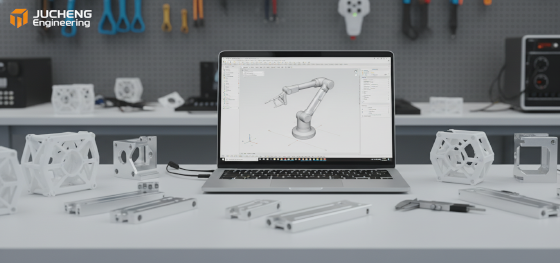
Prototyping for the farm is fundamentally different from prototyping for the consumer market. A farm robot must handle dirt, rain, and impacts immediately—3D-printed aesthetic models are useless here. Engineers require "functional prototypes" that utilize production-grade materials like 6061-T6 aluminum and high-impact polymers from day one. Jucheng Precision addresses this need by providing an integrated multi-process facility that turns CAD files into mud-ready hardware in a matter of days.
Operating out of the Shenzhen precision manufacturing hub, JUCHENG serves as the high-velocity engine for global AgTech startups. We combine the speed of industrial 3D printing with the raw strength of 5-axis CNC machining to deliver prototypes that can actually do the work. This guide explores the seasonal dynamics, multi-process strategies, and rapid tooling technologies required to ensure your autonomous fleet is ready for the field trial season.
The Seasonal Deadline: Why Speed is AgTech’s Survival Metric
Comparative Data: Prototyping Speed and Material Integrity
Multi-Process Iteration: Integrating CNC and 3D Printing
Rapid Tooling: Bridging the Gap to Pilot Production
JUCHENG: The 24/7 Iteration Hub in Shenzhen
FAQ: Hardware Iteration for Autonomous Farming
The Seasonal Deadline: Why Speed is AgTech’s Survival Metric
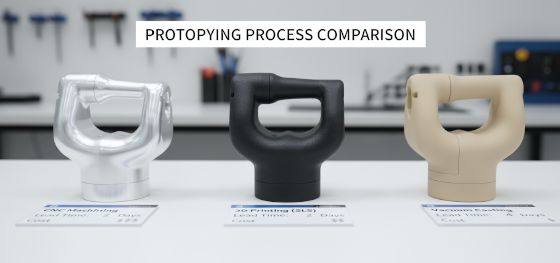
Agricultural development cycles are dictated by the sun and the soil, not by a project manager’s Gantt chart. In Agriculture robot prototyping, the "Window of Opportunity" is the few weeks when crops are at the specific stage required for testing. Whether it is a robotic fruit harvester needing a specific fruit ripeness or a weeding bot needing a certain weed height, being late by ten days can invalidate an entire year of R&D. JUCHENG understands this seasonal urgency, operating our facility 24/7 to ensure hardware arrives before the first seed is planted.
Iterative testing in the field reveals flaws that no simulation can predict. Soil density variations, unexpected humidity spikes, and the "dust factor" only manifest when the physical robot hits the mud. The faster an engineering team can get a version 1.0 into the field, the faster they can receive the "failure data" required for version 2.0. By providing lead times as fast as 3 to 5 business days for complex assemblies, JUCHENG allows teams to complete three or four iterative cycles within a single growing season.
Functional failure during a trial is a massive logistical expense. Flying a team of engineers to a remote farm only to have a motor mount snap on day one is a financial disaster. JUCHENG eliminates this risk by treating every prototype with production-grade rigor. We use real metals and industrial-grade resins to ensure the prototype performs exactly like the final machine. This "high-fidelity" approach to prototyping ensures that the data gathered in the field is valid and that the mechanical foundations are sound for the next phase of scaling.
Supply chain reliability in [2026] is the final component of the speed equation. Waiting weeks for a custom CNC part from a standard job-shop is a non-starter. JUCHENG’s "Bridge to Production" philosophy means we stock a massive range of Ag-rated materials, from UV-stable ASA to 316L stainless steel, allowing us to move from quote to machining in hours. This raw speed is what allows our clients to pivot their designs mid-season and still capture the critical harvest data they need for investor demos and commercial validation.
Comparative Data: Prototyping Speed and Material Integrity
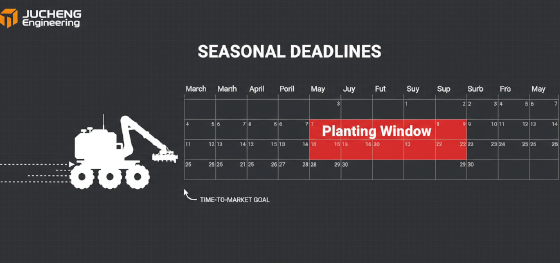
Choosing the right process for each component of a robot prototype is essential for balancing cost and performance. A plastic fender does not need the precision of a gear-box mount. Jucheng Precision provides multi-process consultations to help you choose the most efficient path for your Agriculture robot prototyping needs. The following table compares common processes used to build functional AgTech prototypes.
| Process | Lead Time | Material Strength | Typical Use Case |
|---|---|---|---|
| CNC Machining | 3 - 7 Days | Maximum (Metal/Plastic) | Drivetrains, Mounts |
| SLS 3D Printing | 2 - 4 Days | High (Nylon) | Internal Layout, Covers |
| Vacuum Casting | 10 - 15 Days | Moderate (PU Resins) | External Panels, Seats |
| Sheet Metal | 5 - 8 Days | High (Steel/Alu) | Chassis, Brackets |
CNC machining remains the gold standard for any component subject to torque, vibration, or friction. Because we use real extruded billets, the mechanical properties are 100% predictable. For precision agriculture robotics, this predictability is vital during the early "stress-testing" phase. If a CNC part fails, you know it was a design error; if a 3D-printed part fails, you don't know if it was the design or the weak layer adhesion of the printing process. JUCHENG prioritizes CNC for all load-bearing prototype components to eliminate this ambiguity.
Multi-Process Iteration: Integrating CNC and 3D Printing
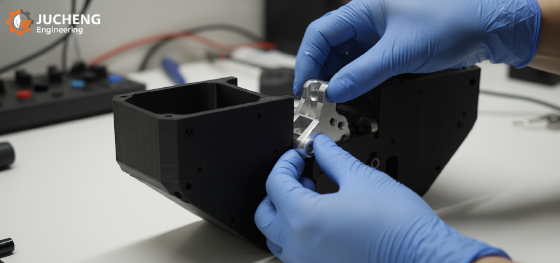
The most efficient prototypes are "hybrids" that use the best process for every sub-assembly. In Agriculture robot prototyping, JUCHENG often combines SLS (Selective Laser Sintering) nylon for complex, non-load-bearing internal ducts with CNC-machined aluminum for the primary motor mounts and drive pivots. This hybrid approach optimizes both the cost and the delivery speed. By using SLS for organic shapes that would be expensive to CNC, we save our clients thousands in unnecessary NRE while keeping the strength where it matters most.
DMLS (Direct Metal Laser Sintering) is utilized for high-complexity effector heads that require internal cooling or fluid channels. For robotic fruit harvesters, the grippers often require intricate bionic geometries that are impossible to machine. JUCHENG 3D prints these in 316L stainless steel or AlSi10Mg aluminum, providing a level of design freedom that accelerates the testing of new harvesting bionics. This "additive-first" approach for end-effectors allows for rapid design-and-pick cycles, where a new gripper can be designed, printed, and tested on the robot in under 72 hours.
Precision fitment between different processes is a hallmark of JUCHENG’s Agriculture robot prototyping service. A 3D-printed shell must fit perfectly onto a CNC-machined chassis. Because we manage both processes in one Shenzhen hub, we calibrate our 3D printers and CNC machines to the same global standard, ensuring that "tolerance stack-up" never ruins a field assembly. We perform pre-assembly checks on every multi-process prototype before it leaves our facility, identifying potential interference issues in the CAD vs. physical reality.
Durability testing of these hybrid assemblies is verified in-house. We subject prototype joints to cycle testing and salt-spray exposure to simulate the first few weeks of farm life. By identifying a "rubbing hose" or a "weak bracket" in the lab, we prevent the costly field failures that kill project momentum. JUCHENG’s goal is to deliver a prototype that doesn't just look like a robot, but behaves like a production machine under the unrelenting sun of the [2026] season.
Rapid Tooling: Bridging the Gap to Pilot Production
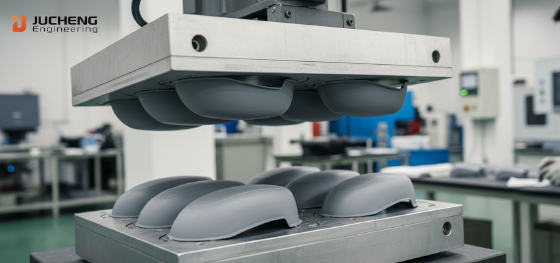
Once the design is validated via CNC and 3D printing, the next step is a "pilot run" of 10 to 50 robots for multi-site field trials. Standard production tooling is too slow and expensive for this stage. JUCHENG utilizes Rapid Tooling—aluminum molds for injection molding or vacuum casting—to deliver production-grade parts in 2 to 3 weeks. For Agriculture robot prototyping, this allows for the production of ruggedized fenders, battery enclosures, and sensor hoods in their final production materials like ASA or DCPD.
Vacuum casting is particularly effective for the "soft-touch" components of a harvester. We create a high-fidelity 3D-printed master and then cast silicone or TPU skins around a CNC-machined bone. This allows for the testing of different "grip hardnesses" during the harvest season without committing to expensive steel molds. By providing 50 sets of these bionic grippers in record time, JUCHENG enables our clients to gather massive datasets across multiple farms simultaneously, proving their technology's commercial viability.
Aluminum molds used in rapid tooling can often survive for 5,000 cycles, providing a cost-effective "Bridge to Production" for the entire first year of sales. Many AgTech companies never move beyond aluminum tooling, as their annual volumes remain within the sweet-spot of this process. JUCHENG manages the mold design, the injection cycle, and the final finishing, ensuring that your first 50 units are indistinguishable from the 5,000th unit. This level of quality is vital for maintaining investor confidence and securing early customer buy-in.
JUCHENG: The 24/7 Iteration Hub in Shenzhen
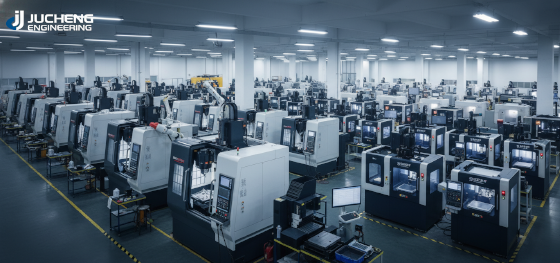
Dominating the [2026] AgTech market requires a partner that can scale as fast as the growing season. Jucheng Precision operates with a 24/7 manufacturing mindset in our Shenzhen precision manufacturing hub, delivering complex robot prototypes and pilot-run assemblies with lead times that standard vendors simply cannot match. We provide a bridge to production that allows you to scale from a single functional prototype to a fleet of commercial harvesters without ever worrying about part quality or seasonal deadlines.
Integrating your design with JUCHENG’s expertise ensures that your robot survives the "First-Field Season" and moves into mass adoption. We offer comprehensive DFM reviews within 24 hours, identifying potential fatigue points or weight-saving opportunities in your prototype design before they become field failures. Whether you are building an autonomous fruit harvester or a heavy-duty soil-tilling bot, Jucheng Precision provides the rapid-iteration hardware that keeps your innovation moving through the mud, the sun, and the years.
Our facility is equipped with 150+ CNC machines and dedicated 3D-printing and molding cells, allowing us to manage the entire prototype lifecycle in one location. We manage the complexity of multi-process manufacturing so your engineering team can focus on the AI, the autonomy, and the farm. By combining Shenzhen's speed with industrial-grade material verification, JUCHENG remains the preferred partner for the world's most aggressive AgTech hardware challenges. Contact us today to start your next project.
FAQ: Hardware Iteration for Autonomous Farming
What is the fastest way to get a functional chassis prototype?
CNC-machined aluminum or laser-cut steel. They offer production strength with no tooling lead time.
Can JUCHENG 3D print production-grade robot parts?
Yes. We use SLS Nylon and DMLS Metal 3D printing for complex, functional hardware.
Is rapid tooling cheaper than CNC for 50 parts?
Generally yes. Aluminum molds become cost-effective when part quantities exceed 20 to 30 units.
How do you ensure a 3D-printed part won't break in the field?
We utilize SLS Nylon with glass-filled additives for increased stiffness and impact resistance.
What are typical lead times for a complete robot prototype?
A complete mechanical assembly is typically delivered in 10 to 15 business days.
Prototypes that fail in the mud are the ultimate hardware killers in AgTech. Partnering with Jucheng Precision ensures that your functional iterations are built with the CNC-machined aluminum and rapid-tooling techniques the industry demands. Reach out to our Shenzhen manufacturing hub today for a complete DFM review and build the field-ready foundation your autonomous fleet requires.

