


Securing military-grade bulkheads, composite wing panels, and high-altitude cockpit skins demands an elite level of mechanical expertise. Partnering with a certified aircraft sheet metal assembler ensures that your aerospace structures survive the continuous, multi-directional stress of pressurized flight cycles without experiencing joint fatigue. This structural integration is the most critical phase of advanced sheet metal fabrication, directly determining whether your lightweight alloys can handle extreme dynamic loads.

Relying on loose, non-certified assembly techniques is an extreme safety risk on flight-hardware. When multi-panel wings or fuselages are assembled without planning for localized galvanic corrosion, thermal coefficient shifts, or rivet pitch variations, the material will crack under structural vibration. Moving to an AS9100-compliant partner completely eliminates these risk factors, delivering verified zero-defect assemblies.
Let's explore the strict quality benchmarks of aerospace assembly, analyze the mechanical trade-offs of using solid versus blind rivets in aircraft structures, and review how to fasten lightweight aluminum and titanium plates without material degradation.
The Strict Standards of Aerospace Sheet Metal Assembly

What makes aerospace sheet metal joining significantly stricter than standard industrial cabinet assembly?
Aerospace structures experience extreme cyclic stress and high-g vibrations, demanding absolute fatigue resistance, zero-tolerance rivet alignments, and complete material traceability.
Under aviation regulations, standard commercial tolerances are completely unacceptable. A minor deviation of 0.1mm on a rivet pitch can concentrate stress and initiate rapid, invisible micro-cracking along the grain lines, leading to catastrophic panel separation under high aerodynamic loads. Every single joint must be calculated to distribute shear loads uniformly.
To ensure maximum structural safety, our operators strictly manage the mechanical tolerances of every single hole. This high-precision execution includes deburring both sides of every single hole, verifying sheet flatness, and executing precise, cold-worked rivet expansion. This keeps the surrounding alloy free from residual stress, ensuring the finished aircraft skin survives continuous environmental stress.
Blind Rivets vs. Solid Rivets in Aircraft Structures
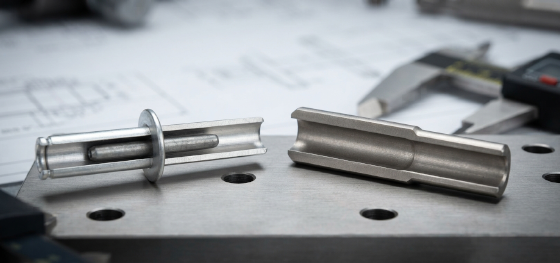
When does an aircraft sheet metal assembler analyze the structural load-paths of a wing rib, choosing the correct fastener is a critical safety step.
Solid rivets are the standard choice for primary, high-load structures due to their continuous metal shank, while blind rivets are reserved for secondary, enclosed panels with single-side access.
The selection of fasteners represents a core design decision. Solid shank rivets are the oldest, most reliable joining method in aviation. Installing a solid rivet requires a pneumatic hammer and a heavy bucking bar to compress and expand the entire solid body, completely filling the hole to maximize shear capacity. This permanent mechanical lock is mandatory for primary flight structures like spars and ribs.
Conversely, blind rivets (such as CherryMAX or pop rivets) are utilized in enclosed bulkheads where the back of the panel is physically inaccessible. Blind rivets expand using a central mandrel that snaps off when fully seated. While they offer high installation speed and require single-sided access, their hollow or multi-piece body has lower shear strength, restricting their application to secondary fairings or non-structural trim panels.
Lightweight Aluminum and Titanium Fastening Techniques

How do aircraft assemblers join lightweight aluminum and high-strength titanium without causing galvanic corrosion?
We install non-conductive barriers or apply protective zinc-rich chemical conversion primers to physically isolate the aluminum from the titanium fastener.
Bespoke aviation components rely heavily on combining different lightweight materials. To optimize strength-to-weight performance, designers utilize titanium fasteners to secure high-strength aluminum skins. However, joining these two metals directly in damp environments creates a galvanic cell, causing the softer aluminum to act as an anode and corrode rapidly.
To prevent this chemical degradation, our assembly team applies strict, certified isolation techniques. We coat all titanium fasteners in wet epoxy primers before installation or insert specialized non-conductive washers. This physical barrier prevents direct metal-on-metal contact, preserving the continuous oxide protection of both alloys and securing a reliable joint that can survive high-humidity coastal atmospheres.
Quality Traceability and Aerospace Compliance at Jucheng Precision
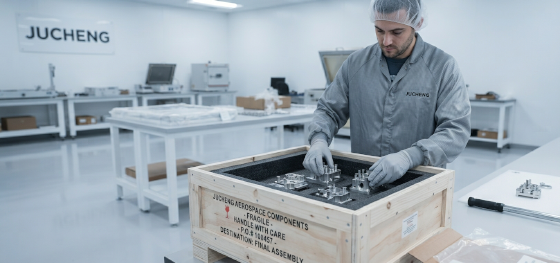
How does Jucheng Precision guarantee perfect compliance and traceability for aerospace components?
We run our aerospace-grade lines under strict AS9100, ISO 13485, and IATF 16949 quality systems, delivering full material lot traceability with every shipment.
Integrating these structural ribs, lightweight alloys, and solid rivets into your early sheet metal design cycle is the single most effective way to eliminate assembly bottlenecks. Jucheng Precision houses these advanced automated benders, laser cutters, and assembly lines inside our 8000-square-meter facility, ensuring that your parts are cut, folded, painted, and completely integrated under one roof with extreme quality control.
We process a wide range of materials, including lightweight aluminum, high-yield stainless steel, and easily formable carbon steel across our precision sheet metal fabrication and assembly lines. Our technical department provides a 24-hour free DFM analysis to check your CAD models, checking tolerances and tool clearances before production. Supported by our no MOQ policy and rapid delivery guarantee, we manage your project from initial flat pattern cutting to final, high-durability packaging and assembly.
FAQ: Critical Questions About Aircraft Sheet Metal Assembler
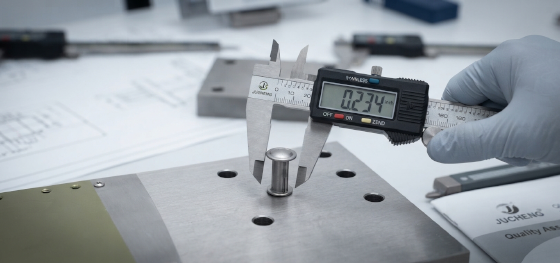
Our engineering team has compiled professional solutions to the most common quality and certification challenges faced during aerospace assembly runs:
What tolerances are typically expected in aircraft sheet metal assembly?
Aviation parts demand extremely tight tolerances, typically within ±0.1mm for linear dimensions and hole positions, and ±0.5 degrees for angular bends. Any hole offset or misalignment is strictly rejected, as forced assembly introduces pre-stress that can lead to rapid structural crack propagation under flight vibration.How do you inspect an installed solid rivet for quality and safety?
We perform non-destructive visual and mechanical testing. We measure the driven head diameter and height using specialized rivet gauges to ensure correct expansion, and conduct dye-penetrant testing (PT) to verify that no micro-cracks have formed along the outer rivet skin during the physical hammering process.Why is a rivet pitch and edge distance critical in aircraft skin designs?
A short rivet pitch or placing a hole too close to the panel edge concentrates physical shear loads, causing the thin metal skin to tear under stress. Standard aviation rules mandate a minimum pitch of 3 times the rivet diameter and an edge distance of at least 2 times the rivet diameter to distribute stress uniformly.What is the certified quality standard of Jucheng Precision as an aircraft sheet metal assembler?
We operate an AS9100 and AS9102 compliant metrology facility, utilizing advanced Zeiss coordinate measuring machines (CMM) to inspect every dimensional parameter against your CAD files. We deliver full material mill test reports (MTR), heat treatment certifications, and detailed First Article Inspection (FAI) reports with every single shipment.

