


Navigating the volatile transition from a single benchtop model to a fleet of field-ready machines is the most critical hurdle for any prototype robot project. In the [2026] robotics landscape, the ability to rapidly scale from 1 unit to 50 units determines whether a startup captures its first pilot customer or burns through its remaining capital. Engineering teams often underestimate the complexity of this leap, moving from hand-assembled "lab rigs" to hardware that must survive 24/7 autonomous operation without human intervention. Mastering Alpha and Beta robot build services is the strategic solution for managing this hardware maturity curve while maintaining iterative speed.
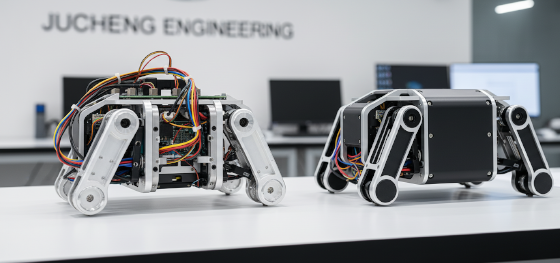
Hardware maturity is measured by the stability of the mechanical foundation. While the Alpha phase focuses on "Proof of Motion," the Beta phase demands "Proof of Reliability." If a sensor mount vibrates loose or a chassis cracks during a customer trial, the software data collected becomes invalid, and the brand reputation is permanently damaged. Jucheng Precision addresses these scaling bottlenecks by providing integrated manufacturing paths that bridge the gap between low-fidelity 3D prints and high-fidelity production-intent hardware.
Operating within the Shenzhen precision manufacturing hub, JUCHENG serves as the high-velocity assembly and fabrication partner for global robotics OEMs. 我们 transform complex CAD files into coordinated fleets of Alpha and Beta machines, ensuring that every unit performs with the same metallurgical and dimensional integrity. This guide explores the essential build standards for each phase, the technical data driving process selection, and the BOM optimization strategies required for Alpha and Beta robot build services that move your innovation from the lab to the real world.
Alpha Builds: Validating Kinematics and Fitment
Technical Data: Comparing Processes for 1 vs. 50 Units
Beta Builds: Scaling for Field Trials and Reliability
BOM Optimization: Preparing for Mass Production
JUCHENG: The Shenzhen Hub for Robotic Fleet Scaling
FAQ: Scaling Robot Prototypes from Lab to Field
Alpha Builds: Validating Kinematics and Fitment
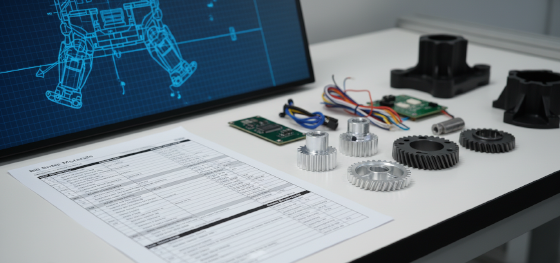
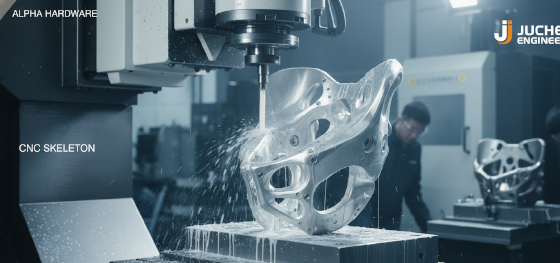
Kinematic validation is the primary mission of an Alpha prototype robot. During this phase, the engineering team needs to prove that the joint ranges, motor torques, and sensor placements work in harmony. The hardware is typically subjected to "controlled lab environments" where the priority is ease of modification. JUCHENG supports this stage by providing rapid CNC machining for the primary structural skeleton. We use high-strength 6061-T6 aluminum to ensure the frame is rigid enough to provide accurate feedback to the encoders, preventing the "mechanical noise" that can plague less stiff 3D-printed frames.
Internal fitment checks are a secondary goal of the Alpha build. As the first physical manifestation of the CAD, the Alpha unit reveals cable routing bottlenecks and sensor occlusions that were invisible on a screen. Alpha and Beta robot build services at JUCHENG include "Fast-Track" additive manufacturing for internal ducts and electronics mounts. This allows the assembly team to test various cable-management paths in a matter of hours, ensuring that when the design moves to the Beta phase, the internal architecture is as clean as the external shell.
Modular interfaces are emphasized during the Alpha phase to allow for rapid component swapping. JUCHENG machines standardized mounting patterns and "universal" sensor plates that allow the R&D team to test different LiDAR or camera models without redesigning the entire arm. This mechanical flexibility is vital for the [2026] market, where sensor technology is evolving faster than chassis designs. By building a "Kinematically Open" Alpha unit, we provide the ultimate sandbox for your software developers to refine their motion-control loops.
Dimensional verification at this stage focuses on the "Handshake" between high-precision components. Motor pilots, bearing seats, and encoder mounts are machined to +/- 0.01mm tolerances. JUCHENG understands that if the Alpha unit has mechanical "slop," the software team will write code to compensate for a flaw that shouldn't exist. Our precision ensures that the baseline data captured during the Alpha phase is a true representation of the robot's physical potential, providing a solid foundation for the subsequent scaling into the Beta fleet.
Technical Data: Comparing Processes for 1 vs. 50 Units
Transitioning from one prototype to fifty requires a shift in manufacturing technology to balance cost, speed, and durability. While CNC is perfect for a single Alpha unit, Vacuum Casting or Rapid Tooling often becomes more efficient for a Beta fleet. Jucheng Precision provides transparent cost-modeling to help you navigate this transition. The following table illustrates the typical process selection for Alpha and Beta robot build services in the Shenzhen hub for the [2026] cycle.
| Metric | Alpha Build (1-3 Units) | Beta Build (10-50 Units) | Pilot Production (100+) |
|---|---|---|---|
| Primary Process | CNC + 3D Printing | CNC + Vacuum Casting | Rapid Injection Molding |
| Material Target | Functional Integrity | Production Representative | Final Production Resin |
| Lead Time | 3 - 7 Days | 15 - 20 Days | 30 - 45 Days |
| Unit Cost | Maximum | Moderate (Tooling Amortized) | Lowest |
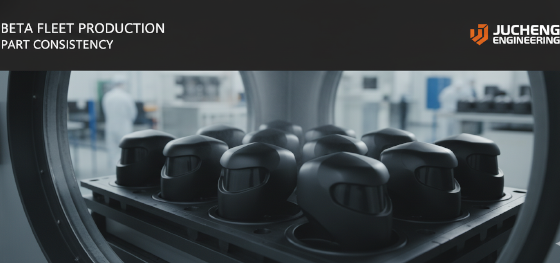
Vacuum casting is the unsung hero of Alpha and Beta robot build services. By creating a silicone mold from a CNC-machined master, JUCHENG can produce 20 identical robot enclosures that mimic the impact strength and aesthetic of injection-molded parts. This allows you to deploy a fleet of Beta robots for customer field trials that look and behave like finished products, but without the $20,000 to $50,000 NRE (Non-Recurring Engineering) cost of steel molds. This capital efficiency is essential for robotics startups looking to extend their R&D runway.
Beta Builds: Scaling for Field Trials and Reliability
The Beta phase is where the prototype robot meets the "Chaos of the Field." Unlike the Alpha unit, which is coddled in a lab, the Beta units must survive dust, moisture, and accidental impacts during multi-site trials. Alpha and Beta robot build services at JUCHENG prioritize ruggedization at this stage. We transition from simple bolted frames to integrated CNC chassis with hermetic sealing grooves for O-rings and gaskets. This ensures that your autonomy stack remains protected whether the robot is navigating a muddy vineyard or a high-traffic hospital ward.
Consistency across the fleet is vital for data integrity. If one robot in your 20-unit Beta fleet has a slightly different sensor mount angle than another, your ML (Machine Learning) models will receive inconsistent data. JUCHENG utilizes dedicated assembly jigs and 5-axis CNC matching to ensure that every Beta unit is a "Digital Twin" of the master design. We perform CMM verification on critical structural nodes for every unit in the fleet, providing a standardized hardware platform that allows your software team to focus on edge-case scenarios rather than mechanical hardware variance.
Environmental resilience is addressed through production-intent materials. For outdoor Beta trials, JUCHENG utilizes UV-stable ASA or chemically resistant HDPE for enclosures, machined or cast to final tolerances. We also apply industrial coatings—such as Type III Hard Anodizing or automotive-grade painting—to protect the structural joints from corrosion and abrasion. This level of finish is not just aesthetic; it prevents the premature hardware fatigue that can lead to field failures, ensuring that your Beta trial captures the full 1,000 hours of data required for commercial certification.
Predictive maintenance features are integrated into the Beta build. JUCHENG can machine recessed pockets for vibration sensors and thermal probes within the motor mounts and bearing housings. By monitoring the "pulse" of the hardware during the Beta trial, your team can identify component wear before it leads to a catastrophic failure. This "Smart-Hardware" approach is what makes JUCHENG a leading partner for the world’s most advanced autonomous system developers, providing the functional insights needed to finalize the design for mass production.
BOM Optimization: Preparing for Mass Production
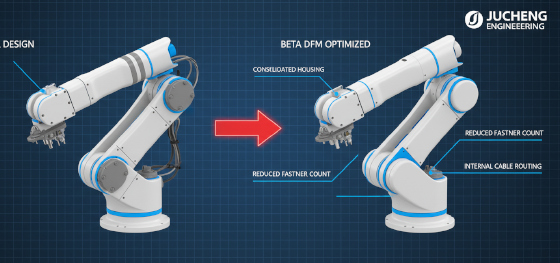
Beta builds are the final opportunity to optimize the Bill of Materials (BOM) before committing to production tooling. In Alpha and Beta robot build services, JUCHENG engineers perform a "DFM Audit" on every component in the assembly. We identify parts that are over-engineered or excessively expensive to machine and suggest production-friendly alternatives. For example, we might suggest consolidating three machined brackets into a single cast-aluminum part or replacing a complex titanium component with a high-strength reinforced polymer to reduce weight and cost.
Fastener consolidation is another area of focus. A prototype robot often features dozens of different bolt sizes and types, which increases assembly time and complexity. JUCHENG’s assembly team analyzes the Beta build process and suggests a "Universal Fastener" strategy, reducing the tool count required for field maintenance. This simplification of the assembly chain is what allows our clients to scale their manufacturing from 50 units to 5,000 units with minimal friction, providing a clear path to high-volume profitability in [2026].
Tolerance relaxation is the third pillar of BOM optimization. During the Alpha phase, engineers often apply tight tolerances to every dimension out of caution. JUCHENG utilizes the Beta trial data to identify which tolerances are critical for performance and which can be relaxed for production. By widening tolerances on non-critical features, we reduce the scrap rate and machining time for mass production, effectively lowering the unit cost of the industrial robot parts without compromising the machine’s reliability or accuracy.
Supply chain readiness is verified during the Beta phase. JUCHENG sources materials and components from production-ready suppliers to ensure that the hardware used in the field trials is identical to what will be used in the commercial launch. We manage the vendor relationships for motors, sensors, and exotic materials, providing a unified supply chain for your robotic fleet. This "Contract Manufacturing" mindset is what sets JUCHENG apart as more than just a prototype shop; we are the manufacturing engine that drives your transition from a startup to a market leader.
JUCHENG: The Shenzhen Hub for Robotic Fleet Scaling

Dominating the [2026] robotics market requires a partner that can scale as fast as your software team iterates. Jucheng Precision operates with a 24/7 manufacturing mindset in our Shenzhen precision manufacturing hub, delivering high-tolerance Alpha and Beta robot build services and structural components with industry-leading speed. We provide a "Bridge to Production" that allows you to move from your first functional Alpha unit to a commercial pilot run of 50 Beta units with consistent metallurgical and dimensional quality.
Integrating your scaling strategy with JUCHENG’s expertise ensures that your prototype robot survives the "First-Contact" with customers and moves into mass adoption. We offer comprehensive DFM reviews within 24 hours, identifying potential fatigue points or weight-saving opportunities in your design before they become field failures. Whether you are building an autonomous vineyard scout or a heavy-duty industrial mobile base, Jucheng Precision provides the rigid, precise foundations that keep your innovation moving through the high-speed cycles and the years of hard labor.
Our facility is equipped with 150+ CNC machines and dedicated assembly and testing cells, allowing us to manage the entire robotic fleet lifecycle in one location. We manage the complexity of multi-process manufacturing and material science so your engineering team can focus on the AI and the customer experience. By combining Shenzhen's speed with industrial-grade material verification, JUCHENG remains the preferred partner for the world's most aggressive robotics challenges. Contact us today to start your next scaling project.
FAQ: Scaling Robot Prototypes from Lab to Field
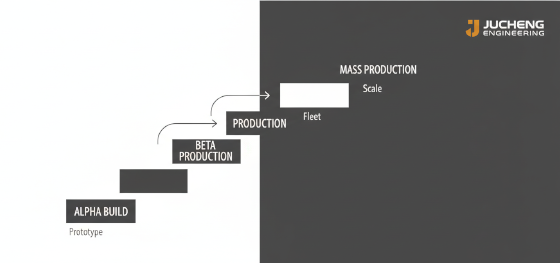
What is the difference between Alpha and Beta robot builds?
Alpha builds focus on internal kinematics and code validation; Beta builds focus on field reliability, aesthetics, and environmental sealing for customer trials.
How many units are typically produced in a Beta fleet?
A standard Beta fleet ranges from 10 to 50 units, providing enough hardware for multi-site testing and regulatory certification.
Is Vacuum Casting better than CNC for Beta builds?
For thin-walled enclosures and shells, Vacuum Casting is significantly more cost-effective for quantities over 10 units.
Can JUCHENG handle the full assembly of my robotic fleet?
Yes. We provide complete electromechanical assembly services, including wiring, motor integration, and final QC testing.
What is the lead time for a 20-unit Beta robot fleet?
Depending on complexity, a 20-unit fleet is typically manufactured and assembled in 3 to 5 weeks.
Scaling friction in the robotics sector is an absolute innovation killer. Partnering with Jucheng Precision ensures that your Alpha and Beta iterations are built with the strategic mix of CNC, casting, and Alpha and Beta robot build services the industry demands. Reach out to our Shenzhen manufacturing hub today for a complete DFM review and build the reliable foundation your autonomous fleet requires.

