


Let's be direct. You cannot vacuum cast aluminum. The process you are searching for, aluminum vacuum casting, does not exist in the way you might think.
This is one of the most common points of confusion in the world of prototyping. It is an understandable mistake. But continuing with this misunderstanding can lead you down a frustrating path of dead ends.
The good news? What you actually want to achieve—a small batch of aluminum-like parts, quickly and affordably—is absolutely possible. You just need a different, smarter path to get there. This guide will debunk the myth and show you the real solutions.
content:
A Common Misunderstanding
Uncovering the Truth: Two Different Worlds
Solution 1: The Art of Illusion (Painted Polyurethane)
Solution 2: A Bridge to Real Metal (Investment Casting Patterns)
Choosing Your Path to a Metal Look
A Common Misunderstanding
The confusion is logical. You know that vacuum casting is a fantastic process for making a small batch of high-quality prototype parts. You also know you want your final part to be made of aluminum. So, you put the two ideas together.
You have a project. You need ten beautiful, metal-looking enclosures for a trade show. CNC machining ten parts from solid aluminum is very expensive. Traditional metal casting requires a hard tool, which is also too expensive for just ten parts.
So, the search for "aluminum vacuum casting" begins. It seems like the perfect, magical solution. But to understand why it is not possible, we need to look at the physics.
Uncovering the Truth: Two Different Worlds
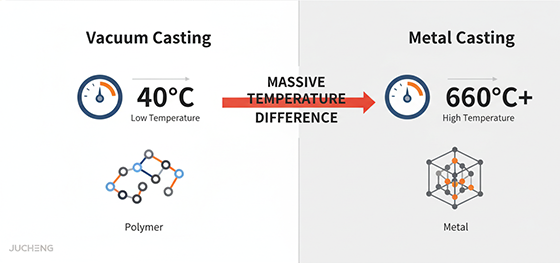
The key is temperature. Vacuum casting, or urethane casting, is a "cold" or "room temperature" process. It uses soft, flexible silicone molds. These molds are amazing at capturing detail, but they cannot handle high heat. The polyurethane resins used cure at a relatively low temperature, often around 40°C to 70°C.
Metal casting is a "hot" process. To cast aluminum, you must first melt it. The melting point of aluminum is 660°C (1220°F).
If you were to pour molten aluminum into a silicone mold, the mold would instantly melt and vaporize. It would be a catastrophic failure. This is the simple, physical reason why you cannot directly vacuum cast aluminum. They are two different manufacturing universes.
Solution 1: The Art of Illusion (Painted Polyurethane)

So, how do we solve your problem? The first solution is the art of illusion. We can create a part that, for all visual and tactile purposes, looks and feels exactly like solid aluminum.
We start with the standard vacuum casting process. We create a perfect master pattern. We make a high-quality silicone mold. We then cast your part using a rigid, high-performance polyurethane resin. This gives us a plastic part with a perfect, Class-A surface finish.
Then, the magic happens in our finishing department. Our expert painters can apply a multi-layer paint finish that perfectly mimics the look of brushed, anodized, or bead-blasted aluminum. We can even add a clear coat to give it a protective, metallic sheen.
The result is a prototype that is lightweight, cost-effective, and visually indistinguishable from a real metal part. For marketing models, trade show demos, and appearance prototypes, this is often the perfect solution.
Solution 2: A Bridge to Real Metal (Investment Casting Patterns)

But what if you need a real, solid metal part? What if you need to test the strength or thermal properties of actual aluminum?
There is a second, more advanced solution. Here, vacuum casting acts as a brilliant "bridge" to a different metal casting process called investment casting.
Instead of casting the part in polyurethane, we use the same silicone mold to cast it in a special "casting wax." We can quickly and affordably create 10 or 20 perfect wax copies of your part.
These wax patterns are then used in the investment casting process. The wax pattern is dipped in a ceramic slurry to build a hard shell around it. The shell is then heated, the wax melts out, and what is left is a perfect, empty ceramic mold. Finally, molten aluminum is poured into this ceramic mold.
In this workflow, vacuum casting is the fastest and most cost-effective way to create the initial patterns needed for a low-volume run of real metal parts.
Choosing Your Path to a Metal Look
So, when you are thinking about aluminum vacuum casting, what you are really asking for is a smart manufacturing solution.
Do you need a part that just looks like metal for a presentation? Solution 1 is your fastest, most cost-effective path.
Do you need a small batch of real, functional metal parts for testing? Solution 2 is the intelligent workflow.
A true manufacturing partner does not just say "no, we can't do that." They listen to your goal. They understand what you are trying to achieve. And then they use their deep knowledge of different processes to show you the best path forward. This is the value a partner like JUCHENG provides. We do not just answer your question. We solve your problem.

