


What is a prototype? Is it just a shape? A rough approximation of your idea? Or is it a convincing replica, a stand-in that can fool the senses and tell a powerful story?
For designers and engineers preparing for a critical trade show, a high-stakes investor pitch, or a final round of user testing, a simple shape is not enough. You need a prototype that looks, feels, and even weighs the same as your final production part.
You need a magic trick. You need a process that can create a perfect illusion. This is the art and science of polyurethane vacuum casting.
content:
The Designer's Challenge: A Prototype That Lies
The Magic Trick: How It Works
A Library of Personalities
The Final Touch: A Master of Disguise
Your Partner in Realism
The Designer's Challenge: A Prototype That Lies

Imagine you are conducting a user test for a new ergonomic remote control. You hand the user a 3D printed model.
The user feels the rough layer lines. They notice how lightweight and hollow it feels. Subconsciously, they are already thinking, "This feels cheap." Their feedback on the ergonomics is now biased. The prototype has failed to create a real experience. It has lied to the user.
For marketing photos or a pitch to a skeptical buyer, this is even worse. A prototype that does not look like the final product undermines your credibility. You need a way to create a small batch of hyper-realistic, production-quality models without paying for expensive injection mold tooling.
The Magic Trick: How It Works
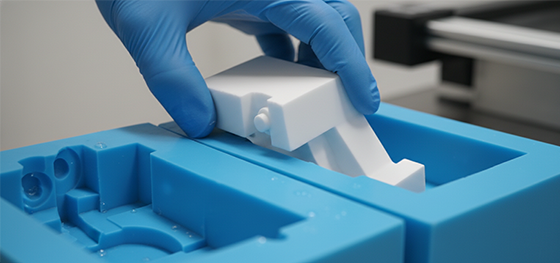
Polyurethane casting is the solution. It is a brilliant, multi-step process for creating these perfect replicas.
It starts with a "master pattern." This is a perfect, flawless model of your part, usually made with a high-precision method like CNC machining or SLA 3D printing. This master is sanded and polished to absolute perfection.
Next, a silicone mold is created around this master. The soft silicone captures every microscopic detail of the master's surface. When you open the mold, you have a cavity that is a perfect negative image of your part.
Finally, the magic. A two-part liquid polyurethane resin is mixed and poured into the silicone mold under a vacuum. The vacuum removes all air bubbles. The resin cures in the mold, perfectly replicating the flawless surface. The result is a part with the surface quality of a final injection molded product.
A Library of Personalities
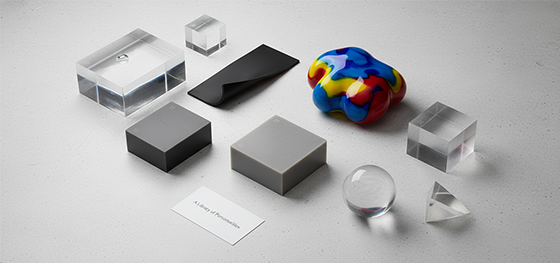
The real power of polyurethane vacuum casting lies in the incredible variety of available vacuum casting materials. Polyurethane resins are not one material. They are a vast library of materials, each formulated to mimic a specific production plastic.
Do you need your prototype to feel like hard, rigid ABS? There is a polyurethane resin for that. Do you need it to be crystal clear like polycarbonate? There is a resin for that.
Do you need it to be soft and flexible like a rubber TPE? There are dozens of elastomeric resins, in a huge range of hardnesses from gel-soft to pencil-eraser-firm.
This versatility allows you to create a prototype that does not just look right. It feels right. It has the correct hardness, flexibility, and even weight. This is the key to creating a truly convincing replica.
The Final Touch: A Master of Disguise
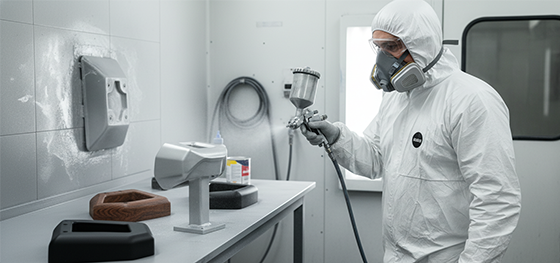
A perfectly molded polyurethane part is a blank canvas. The final step in the illusion is post-processing. A skilled manufacturing partner can make a cast polyurethane part look like almost anything.
With expert painting and texturing, a simple cast part can be given a flawless, high-gloss finish. Or a soft-touch matte finish. Or even a complex metallic or wood grain finish.
We can add logos and text with silkscreening. We can mask off different areas to create multi-color parts. We can even perform EMI shielding for functional electronic prototypes.
This mastery of disguise is what completes the magic trick. It is what elevates a simple cast resin part into a powerful marketing and sales tool.
Your Partner in Realism
Creating a hyper-realistic prototype is an art form. It requires expertise at every single step. From creating a flawless master pattern, to expert mold making, to precise casting, to artistic-level finishing.
This is not something every manufacturer can do well.
A true partner in realism, like JUCHENG, has a dedicated team of craftsmen for this process. We understand that your marketing prototype is a direct reflection of your brand.
We take pride in our ability to deliver a prototype that does not just meet your specifications, but exceeds your expectations. We deliver a prototype that tells a convincing story of quality and inspires confidence in your final product.

