


Selecting the optimal metal profile for a custom electronic chassis or outdoor bracket is a balancing act of competing physical constraints. Conducting a rigorous aluminum vs stainless steel sheet metal trade-off analysis helps engineering teams select the perfect alloy to optimize cost, weight, and lifespan. While stainless steel provides unmatched ultimate strength and raw chemical hardness, aluminum excels in weight reduction and thermal conductivity limits.

Choosing the incorrect alloy can quickly result in major engineering failures in the field. A portable medical device designed with heavy steel will strain end-users and drive up transit shipping costs, whereas using soft aluminum in a corrosive marine application can result in rapid structural oxidation. Sourcing the optimal material ensures your hardware maintains structural integrity throughout its lifecycle.
Let's compare the weight-to-strength ratios of these absolute industry pillars, examine how anodized coatings stack up against stainless passivation, and review how their different physical characteristics alter bending and welding setups on the shop floor.
content:
Weight, Strength, and Cost Comparison
Corrosion Resistance: Anodized Aluminum vs. SS304/316
Bending and Welding Differences
Expert Manufacturing for Both Metals at JUCHENG
FAQ: Critical Questions About Aluminum vs Stainless Steel Sheet Metal
Weight, Strength, and Cost Comparison

What are the primary physical and financial trade-offs between aluminum and stainless steel?
Aluminum is roughly one-third the weight of steel, making it ideal for portable devices, while stainless steel offers up to triple the tensile strength to handle severe structural loads.
Understanding the strength-to-weight ratio of your selected alloy is critical to minimizing product mass. If your hardware is portable or mobile (such as aerospace bracket arrays or automotive sub-frames), using lightweight aluminum represents the ultimate engineering path. It delivers high stiffness and reduces system weight, optimizing energy efficiency and shipping logistics.
However, if your design requires high resistance to shear and impact loads, stainless steel is the undisputed standard. Its high yield limits allow it to survive extreme structural stresses under continuous cyclic loading. Although stainless steel carries a higher material cost and weight, its high tensile strength often allows engineers to utilize much thinner sheets compared to aluminum, which can partially offset the raw weight penalty.
Corrosion Resistance: Anodized Aluminum vs. SS304/316
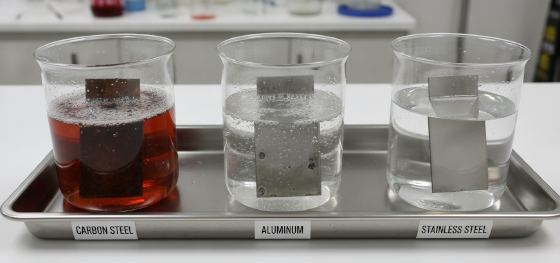
How does the corrosion protection of anodized aluminum compare to stainless steel?
Aluminum relies on anodizing to grow a protective oxide film, while stainless steel contains chromium to build a natural, self-healing passive oxide barrier.
When evaluating aluminum vs stainless steel sheet metal for harsh environments, understanding their chemical resistance is vital. Stainless steel contains a minimum of 10.5% chromium, which reacts with oxygen to form an invisible, self-healing passivation barrier. If the surface is physically scratched, the chromium instantly reforms this layer, making grades like SUS316 completely impervious to atmospheric rust, industrial acids, and high-saline marine environments.
In contrast, aluminum relies on anodizing to build its protective barrier. While anodized aluminum performs beautifully in standard environments and offers customizable metallic colors, the coating can wear away over years of abrasive sliding. Furthermore, aluminum is highly susceptible to galvanic corrosion when joined directly with stainless steel or copper fasteners without non-conductive washers, whereas stainless steel is far more chemically stable.
Bending and Welding Differences
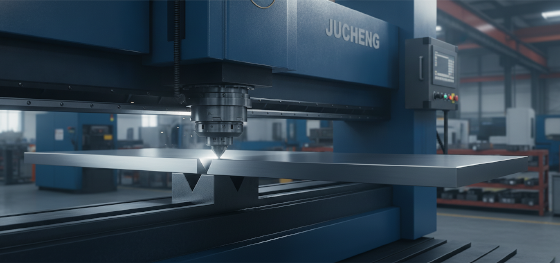
What makes forming and welding stainless steel more difficult than aluminum?
Stainless steel requires much higher bending forces and exhibits extreme angular springback, while aluminum is highly ductile but is highly sensitive to weld cracking.
Forming stainless steel requires high-tonnage press brakes because the material work-hardens rapidly during deformation. To prevent cracking along the bend line, our operators must utilize precise, pre-calculated springback compensation angles. Aluminum is much easier to fold and bend at low press forces, though designers must specify larger minimum bend radii on hard tempers (such as 6061-T6) to prevent outer-edge splitting.
Welding these materials also introduces distinct metallurgical issues. Aluminum dissipates heat rapidly due to its high thermal conductivity, requiring higher starting currents and precise shielding to prevent weld porosity. Furthermore, aluminum is prone to thermal cracking, whereas stainless steel welds smoothly but is highly susceptible to heat distortion, requiring precise fixture clamping and copper chill bars to maintain flat panel tolerances. Here is a direct physical comparison:
| Physical Property | Aluminum Alloys (e.g., 5052-H32) | Stainless Steel (e.g., SUS304) |
|---|---|---|
| Density (Weight) | Low (~2.7 g/cm³) - Highly lightweight | High (~8.0 g/cm³) - Heavy-duty |
| Yield Strength | Moderate (~193 MPa) | High (~290 MPa) |
| Thermal Conductivity | High (~138 W/m·K) - Excellent heat transfer | Low (~16.2 W/m·K) - Heat insulator |
| Aesthetics & Finishes | Brushed, anodized in custom colors | Polished, bead-blasted metallic satin |
Expert Manufacturing for Both Metals at JUCHENG
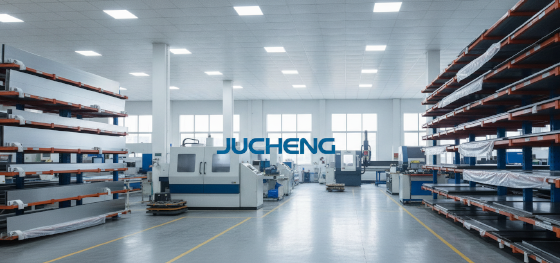
How does JUCHENG help you select and fabricate the ideal alloy for your custom parts?
We operate high-power fiber laser cutters and high-tonnage press brakes, running specialized tooling lines to prevent cross-contamination on both metals.
Selecting the correct sheet metal material ensures that your completed hardware maintains its target structural integrity under its specific operating conditions. JUCHENG integrates advanced shearing, punching, and forming systems into our full-service production lines. This allows us to transition your 3D models into fully finished, durable hardware with extreme dimensional accuracy.
We operate an IATF 16949 and ISO 13485 certified environment, utilizing over 150 high-performance manufacturing machines to execute complex stamping and forming runs. Our engineering team provides a 24-hour free DFM analysis to check your CAD models, checking bend tolerances and clearances before production. Supported by our no MOQ policy and rapid delivery guarantee, we manage your project from initial flat pattern cutting to final packaging and assembly.
FAQ: Critical Questions About Aluminum vs Stainless Steel Sheet Metal

How do you prevent carbon cross-contamination when fabricating stainless steel alongside aluminum?
Carbon cross-contamination occurs when carbon steel particles from tools embed in stainless steel, initiating rust. To prevent this, we completely isolate our stainless steel fabrication area from our carbon steel processing bays, and utilize certified iron-free grinding discs on our finishing line.
Why does aluminum have superior electrical and thermal conductivity?
Aluminum possesses high thermal conductivity and low electrical resistance due to its atomic structure, allowing electrons to move freely. This makes aluminum the preferred choice for electronic heat sinks and chassis requiring built-in electrical grounding.
Can aluminum and stainless steel be fastened together directly?
We do not recommend fastening them directly in outdoor or damp environments due to galvanic corrosion. Placing aluminum in direct contact with stainless steel creates a galvanic cell where the aluminum acts as an anode and corrodes rapidly. To prevent this, we insert non-conductive nylon washers or apply protective zinc-rich coatings to physically isolate the different metals.
How does JUCHENG prevent surface scratching during aluminum vs stainless steel sheet metal processing?
We protect the soft, delicate surfaces of raw aluminum and polished stainless steel sheets by executing CNC bending with specialized urethane die inserts or applying high-density protective vinyl masking films. This prevents direct metal-on-metal friction between the steel tooling and the sheet, delivering clean, scratch-free decorative faceplates ready for immediate anodizing or final assembly.

