


Deciphering the historic, non-linear specifications of raw plate thicknesses can be a major challenge during the design phase. Utilizing a comprehensive sheet metal gauge chart allows engineering teams to translate ambiguous gauge callouts into precise decimal measurements in inches and millimeters. Because the gauge system is neither standard metric nor standard imperial, relying on raw gauge numbers without a material-specific conversion guide is a recipe for severe assembly and structural fitment errors.
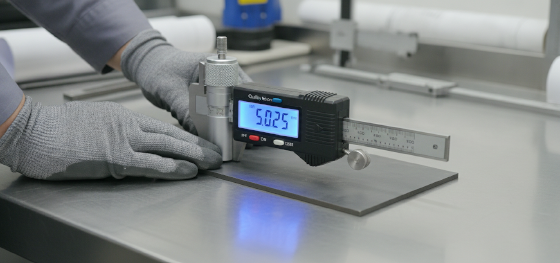
Many hardware teams face devastating production surprises when they assume a single gauge number represents the same physical thickness across different metals. These non-linear measurement systems are highly dependent on the physical density of the specific alloy being processed. A 16-gauge carbon steel sheet is significantly thicker than a 16-gauge aluminum sheet, meaning a simple design mix-up can instantly warp your flat layout or cause your bending tooling to stall.
Balancing metal thicknesses against your forming boundaries is what separates high-yield hardware assemblies from loose, poor-fitting structures. Let's examine the origin of the gauge system, compare standard conversion values across common industrial alloys, and review how physical sheet thickness dictates your bending parameters and tooling selection.
content:
What is a Sheet Metal Gauge?
Gauge Conversion Charts for Steel, Aluminum, and Galvanized
How Thickness Affects Bending Radius and Process Choice
Download the Chart or Get a Free DFM Review
FAQ: Critical Questions About Sheet Metal Gauge Chart
What is a Sheet Metal Gauge?

How did the non-linear sheet metal gauge system originate?
The system originated in the 19th-century British wire industry, where gauge numbers represented the number of times a metal wire had to be drawn through progressive sizing dies to reach its final thickness.
Unlike modern metric standards where thickness is indicated directly, the gauge scale is inversely proportional: a higher gauge number indicates a thinner sheet, and a lower number represents a thicker plate. This inverse scale is a direct legacy of the drawing process, as each drawing pass thinned the wire further, increasing the draw number.
As sheet rolling mills emerged, they adopted these established wire drawing scales to designate sheet thicknesses. Over time, different metal industries developed distinct, independent gauge systems. Ferrous alloys utilize the Manufacturers' Standard Gauge, while non-ferrous metals like aluminum and brass utilize the Brown & Sharpe scale, which explains why identical gauge callouts vary dramatically by material.
Gauge Conversion Charts for Steel, Aluminum, and Galvanized
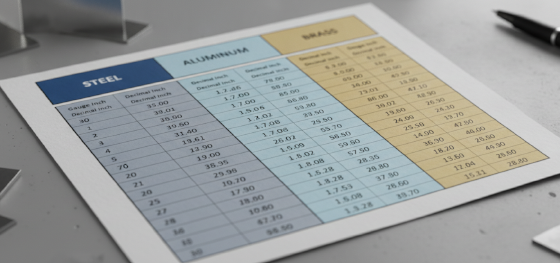
Why do standard steel, aluminum, and galvanized steel have different thicknesses for the same gauge?
Different materials utilize separate gauge systems based on their weight per square foot and historical processing methods, resulting in different decimal thicknesses.
To prevent costly design mix-ups, engineers must always verify the actual decimal dimensions of their selected metal before nesting flat patterns. For example, a 16-gauge standard steel sheet is approximately 1.52mm thick, while a 16-gauge aluminumsheet is only 1.29mm thick. A 16-gauge galvanized steel sheet, which includes its protective zinc coating, measures approximately 1.61mm thick.
This variance is why keeping a calibrated sheet metal gauge chart bookmarked on your design desk is essential. Here is a direct reference conversion table for common commercial gauges:
| Gauge Number | Standard Steel mm (inches) | Stainless Steel mm (inches) | Galvanized Steel mm (inches) | Aluminum mm (inches) |
|---|---|---|---|---|
| 10 GA | 3.42 (0.1345) | 3.43 (0.1350) | 3.51 (0.1382) | 2.59 (0.1019) |
| 12 GA | 2.66 (0.1046) | 2.68 (0.1054) | 2.75 (0.1084) | 2.05 (0.0808) |
| 14 GA | 1.90 (0.0747) | 1.91 (0.0751) | 1.99 (0.0785) | 1.63 (0.0641) |
| 16 GA | 1.52 (0.0598) | 1.51 (0.0595) | 1.61 (0.0635) | 1.29 (0.0508) |
| 18 GA | 1.21 (0.0478) | 1.27 (0.0500) | 1.31 (0.0516) | 1.02 (0.0403) |
| 20 GA | 0.91 (0.0359) | 0.95 (0.0375) | 1.01 (0.0396) | 0.81 (0.0320) |
How Thickness Affects Bending Radius and Process Choice

How does physical sheet thickness dictate press brake and tooling selection?
Thicker metal sheets require larger V-die openings, higher bending forces, and larger minimum bend radii to prevent material tearing and extreme tool wear.
The physical thickness of a metal plate is the primary driver of manufacturing limits. When a sheet is folded on a press brake, the material experiences extreme tensile stress on the outer radius. If the bend radius is set too tight for a thick plate, the outer fibers will stretch past their physical limits and split.
Additionally, press brake tonnage requirements scale exponentially with thickness. Bending a 10-gauge structural plate requires significantly more force than a 20-gauge thin skin, which dictates whether a standard press or a heavy-duty hydraulic brake is needed. Thickness also impacts cutting feed rates, as cutting thicker gauges slower is required to prevent dross and maintain clean edges.
Download the Chart or Get a Free DFM Review

How does JUCHENG prevent thickness and tolerance issues in custom sheet metal projects?
We analyze your CAD models using advanced 3D unfolding software, verifying bend allowances and K-factors relative to your chosen gauge and alloy before production.
Choosing the correct thickness for your sheet metal material is the foundation of structural and cost-effective product development. JUCHENG integrates these strict geometric checks into our digital manufacturing network. This allows us to transition your drawings into fully finished, durable hardware with extreme dimensional consistency.
We operate an IATF 16949 and ISO 13485 certified environment, utilizing over 150 high-performance manufacturing machines to execute complex stamping and forming runs. Our engineering team provides a 24-hour free DFM analysis to check your CAD models, checking flanges and stress points before tooling up. Supported by our no MOQ policy and rapid delivery guarantee, we manage your project from initial flat pattern cutting to final packaging and assembly.
FAQ: Critical Questions About Sheet Metal Gauge Chart
Why is a 16-gauge galvanized steel sheet thicker than a 16-gauge standard steel sheet?
Galvanized steel sheets are hot-dipped or electro-plated with a protective layer of zinc. Because the Manufacturers' Standard Gauge measures the total nominal thickness of the finished coated product, the thickness of the zinc coating is added to the base steel, making the final galvanized sheet slightly thicker than bare standard steel of the same gauge.
Does the gauge system apply to heavy steel plates over 6mm thick?
No, the gauge system is strictly optimized for thin to medium-gauge sheet metals, typically under 6mm. Once metal thicknesses exceed 6mm (or 0.25 inches), the material is classified as structural plate rather than sheet metal, and its thickness is specified directly in millimeters or fraction of an inch to prevent confusion.
How does material springback vary across different sheet metal gauges?
Thin-gauge sheets (such as 22 GA) exhibit significantly higher elastic recovery, commonly known as springback, compared to thick plates (such as 10 GA). Our press brake programmers utilize specialized CNC controller databases that dynamically adjust punch strokes to compensate for these varying springback rates across different gauges.
How does JUCHENG prevent thickness mix-ups based on the sheet metal gauge chart?
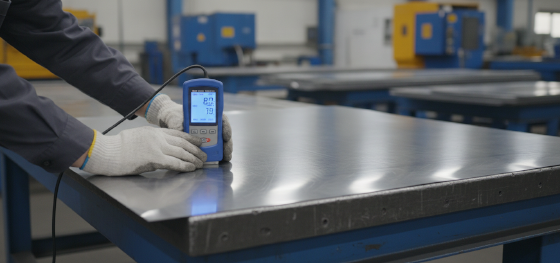
We physically measure every incoming batch of raw sheet stock using calibrated digital micrometers to verify the exact decimal thickness before nesting. Our engineers program our laser cutters and press brakes using these real, measured dimensions rather than generic gauge numbers, ensuring that every finished bracket aligns perfectly.

