


Biological decontamination represents the most violent thermodynamic environment a polymer will ever face. When an engineer designs a reusable surgical instrument, a dental tool handle, or a respiratory manifold, the transition from a digital CAD file to a physical asset is not merely a question of shape; it is a question of molecular survival. Exposing standard thermoplastics to 134°C (273°F) pressurized steam inside a hospital autoclave guarantees rapid, catastrophic failure. The combination of intense heat and moisture causes standard polymer chains to cleave apart—a process known as hydrolysis—leaving the part brittle, crazed, and structurally useless after a handful of cycles. Navigating this requirement for indestructible clinical hardware requires the strategic deployment of Autoclavable plastic injection molding. This elite manufacturing discipline utilizes "Super-Polymers" like PEEK and PPSU, which possess the chemical sovereignty to ignore the assault of steam and harsh sterilants. Jucheng Precision operates as a high-fidelity medical sanctuary in the Shenzhen precision manufacturing hub, providing the specialized high-temperature presses and tool-steel expertise needed to tame these notoriously difficult materials. We don't just "mold plastic"; we engineer a permanent thermal shield, ensuring your reusable medical devices survive thousands of surgical cycles without a single dimensional drift or micro-crack.
Establishing a resilient launch for reusable healthcare hardware demands the rejection of "General Purpose" molding logic. Amateurs attempt to process high-performance materials using standard cold-water molds, unaware that rapid cooling prevents the polymer from forming the dense, crystalline structures that give PEEK its chemical immunity. Jucheng Precision eliminates these "Invisible Failures" by enforcing a strict thermodynamic management system. We utilize specialized oil-heaters to bake our molds to 200°C before the first drop of 400°C molten resin enters the cavity. Whether you are developing a bone-drill housing or a transparent fluidic manifold, our facility provides the material science and metrological rigor required for 2026 FDA and CE Mark approval. This guide deconstructs the physics of steam hydrolysis, the necessity of high-heat tooling, and why JUCHENG’s "Cleanroom Protocol" is the mandatory foundation for anyone developing Medical Robotics Manufacturing projects for global clinical deployment.
Hydrolytic Defense: The Physics of Steam Sterilization
Thermodynamic Tooling: Mastering 200°C Mold Temperatures
The Super-Polymer Matrix: PEEK, PPSU, and Ultem (PEI)
Geometric Sovereignty: DFM Rules for High-Shrinkage Resins
JUCHENG Protocol: ISO 13485 Cleanroom Execution
Frequently Asked Questions: Autoclavable Plastics
Hydrolytic Defense: The Physics of Steam Sterilization
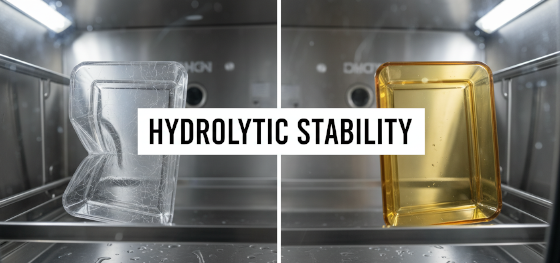
Chemical degradation in a hospital autoclave is driven by the lethal combination of heat, pressure, and water molecules. Standard Injection molding materials, such as Polycarbonate (PC) or ABS, are fundamentally susceptible to "Hydrolysis." When exposed to high-pressure steam (typically 2 bar at 134°C for 3 to 18 minutes), the water molecules attack the ester or carbonate bonds in the polymer chain, physically breaking them apart. This manifests visibly as "Crazing"—a network of fine, cloudy micro-cracks that ruin the part's appearance and act as a sanctuary for bacterial colonization. Ultimately, the part loses its impact strength and shatters. Autoclavable plastic injection molding utilizes polymers with chemical backbones (such as ether and ketone linkages) that are sterically hindered or chemically inert to water. Jucheng Precision engineers mandate the use of these advanced resins for any component labeled "Reusable," ensuring that your surgical tools maintain their flexural modulus and visual clarity even after 1,000 consecutive trips through the sterile processing department.
Thermodynamic Tooling: Mastering 200°C Mold Temperatures

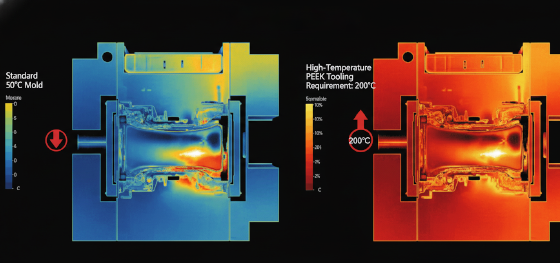
Morphology dictates the chemical resistance of semi-crystalline polymers like PEEK. In traditional molding, the goal is to cool the plastic as fast as possible to reduce cycle time. If you apply this logic to PEEK, injecting the 400°C melt into a standard 50°C mold, the material "quenches" instantly. It freezes in an amorphous state, appearing brown and translucent, while severely compromising its chemical resistance and mechanical strength. To achieve the "Bone-Like" stiffness and chemical immunity PEEK is famous for, it must achieve a high degree of crystallinity. Jucheng Precision operates dedicated high-heat injection bays equipped with specialized thermal controllers. We pump super-heated oil through the mold to maintain the steel at 170°C to 200°C. This allows the PEEK to cool slowly, giving the molecular chains time to fold into dense, highly ordered crystalline structures (turning the part opaque tan/grey). We manage the "Thermal Envelope" with surgical precision, ensuring the internal energy of the part is perfectly balanced to prevent post-molding warpage.
The Super-Polymer Matrix: PEEK, PPSU, and Ultem (PEI)

Selecting the correct super-polymer requires a dispassionate look at the "Strength-vs-Clarity" requirements. While PEEK is the undisputed king of mechanical rigidity, it is inherently opaque. If a surgeon needs to see fluid flowing through a manifold, PEEK is the wrong choice. Jucheng Precision acts as your material navigator, offering a comprehensive library of autoclavable resins. Below is the technical performance matrix our engineers use to guide MedTech material selection:
| Super-Polymer | Autoclave Cycles | Key Advantage | Primary Use Case |
|---|---|---|---|
| PEEK (Polyetheretherketone) | > 3,000 Cycles | Extreme Rigidity / Chemical Inertness | Bone Drill Housings / Implantables |
| Radel PPSU (Polyphenylsulfone) | > 1,000 Cycles | Extreme Impact Strength / Clarity | Surgical Trays / Fluid Manifolds |
| Ultem PEI (Polyetherimide) | Moderate (~100-300) | High HDT / Translucent Amber | Surgical Light Guides / Dental Tools |
Geometric Sovereignty: DFM Rules for High-Shrinkage Resins
Geometric failure in super-polymers is incredibly expensive. Processing PEEK or PPSU involves injecting highly viscous material into a hot mold, which results in significant volumetric shrinkage during the long cooling phase. If a design features thick, solid cross-sections (like a heavy handle), the core will shrink massively, creating severe "Sink Marks" and internal voids that compromise structural integrity. Jucheng Precision engineers mandate strict DFM protocols for Autoclavable plastic injection molding. We require designers to "Core-Out" heavy sections, replacing them with a uniform nominal wall (typically 1.5mm to 3.0mm) reinforced by a network of thin ribs. By enforcing the "50% Rib Rule" (where ribs are half the thickness of the main wall), we ensure rapid, uniform cooling. This digital foresight eliminates the "Thermal Hot Spots" that lead to warped parts and scraped production runs, maximizing your yield and protecting your tooling investment.
JUCHENG Protocol: ISO 13485 Cleanroom Execution
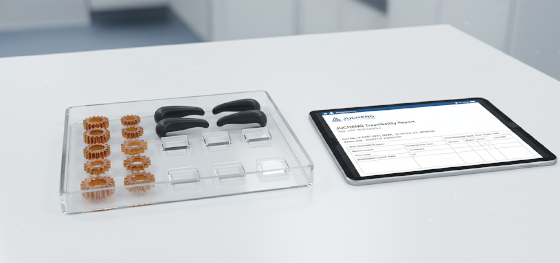
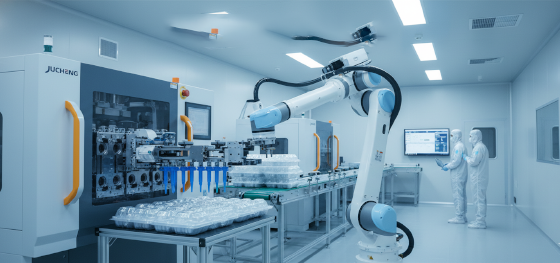
Manufacturing excellence at Jucheng Precision is built on the foundation of biological purity. We recognize that an autoclavable part is destined for the sterile field; any contamination during the molding process is an immediate clinical risk. Our facility operates dedicated high-heat presses within ISO Class 8 (100,000) cleanroom environments. We utilize all-electric machines to eliminate hydraulic oil mist and employ robotic part extraction to ensure "Zero Human Contact" before the parts are sealed in sterile packaging. Our ISO 13485 certified workflow guarantees absolute "Material Lot Traceability." When you receive a batch of surgical tools, it is accompanied by a Certificate of Analysis (COA) proving its USP Class VI biocompatibility. Stop gambling your FDA submission on machine shops that treat medical molding as a side business. Leverage our decade of thermal and regulatory mastery to validate rapidly, scale responsibly, and maintain a zero-defect supply chain. Contact our technical team today for a free DFM review.
Frequently Asked Questions: Autoclavable Plastics
Question: What is the typical lead time for an autoclavable medical tool mold?
Answer: Because high-temp resins require hardened H13 steel to resist abrasive wear and thermal fatigue, standard production molds take 6 to 8 weeks. However, JUCHENG offers rapid bridge tooling options for clinical trials in as fast as 3 weeks.
Question: Can JUCHENG handle the assembly of metal inserts into PEEK parts?
Answer: Yes. We utilize precision ultrasonic welding or in-mold insert placement to integrate stainless steel threads and contacts directly into the PEEK substrate, ensuring high torque-out resistance.
Question: How do you ensure the dimensions of a PEEK part remain stable after sterilization?
Answer: Our rigorous 200°C mold temperature control maximizes crystallinity during the molding phase, eliminating residual internal stress. This ensures the part's geometry is "locked in" and won't drift when exposed to the 134°C autoclave.

