


Regulatory approval is merely the starting gun; manufacturing execution determines who finishes the race. When a MedTech startup finally secures FDA 510(k) clearance or a CE Mark for a new diagnostic device, a terrifying financial reality sets in. The initial market demand is rarely 100,000 units; it is typically 500 to 5,000 units for regional rollouts and early-adopter hospitals. Relying on a massive, hardened steel production mold for this initial launch is a strategy for capital exhaustion, saddling the project with a six-figure tooling debt before a single dollar of revenue is generated. Conversely, attempting to fulfill these orders with fragile 3D printed surrogates is a massive liability risk. Navigating this precarious scaling phase requires the strategic deployment of Low volume injection molding for medical devices. This agile manufacturing methodology—often referred to as Bridge Tooling—utilizes high-strength aluminum alloys and standardized mold bases to slash upfront CapEx by up to 60% while delivering parts with the exact mechanical and biological properties of mass production. Jucheng Precision operates as a strategic scaling partner in the Shenzhen precision manufacturing hub, providing the technical depth and ISO 13485 rigor needed to ensure your medical hardware transitions from the laboratory to the hospital floor smoothly, swiftly, and profitably.
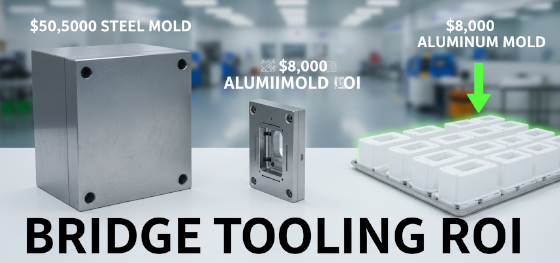
Establishing a resilient launch roadmap demands the absolute rejection of "All-or-Nothing" procurement logic. Amateurs often view tooling as a permanent, immovable asset, unaware that modern rapid tooling is designed specifically for iterative speed and low-risk market entry. Within the broader discipline of Medical Robotics Manufacturing, Jucheng Precision eliminates the "Tooling Blackout Window" by delivering your first thousands units in weeks, not months. We don't just "cut metal"; we engineer a financial bridge that protects your cash flow while ensuring your hardware meets the uncompromising safety standards of the global healthcare sector. This guide deconstructs the economics of the "Valley of Death," the thermodynamic superiority of aluminum molds, and why JUCHENG’s "Bridge Protocol" is the mandatory foundation for anyone launching a medical device in 2026.
Financial Paralysis: Escaping the Valley of Death
Thermodynamic Agility: The Science of Aluminum Rapid Tooling
Molecular Truth: Injecting Real Production-Grade Resins
Strategic Iteration: Modifying Tools Without Bankruptcy
JUCHENG Protocol: ISO 13485 Certified Bridge Production
Frequently Asked Questions: Low Volume Medical Molding
Financial Paralysis: Escaping the Valley of Death
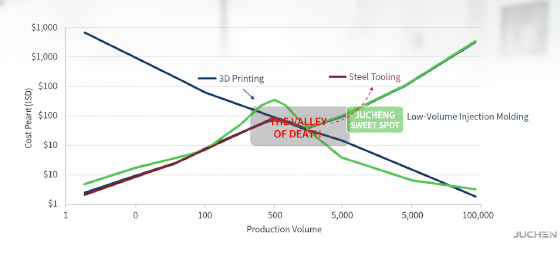
Procurement logic dictates that unit price must be balanced against capital expenditure. The "Valley of Death" occurs precisely when a project requires 1,000 units. At this volume, the per-part cost of 3D printing or CNC machining remains painfully high (e.g., $50/part), totaling $50,000 with zero long-term production capability. A hardened steel injection mold might drop the piece price to $2/part, but the tool itself costs $40,000. Amortizing that $40k across only 1,000 parts adds $40 to each unit, making the final cost $42/part—a minimal saving for a massive upfront risk and a 10-week delay. Low volume injection molding for medical devices shatters this paradox. By utilizing a Master Unit Die (MUD) system and machining only the custom core and cavity from Aluminum 7075, Jucheng Precision can deliver the tool for $8,000. Amortized over 1,000 parts, the tooling burden is only $8/part. Combined with a $2 piece price, your total cost plummets to $10/part. We provide the mathematical certainty that turns a stagnant project into a highly profitable, scalable reality, freeing up your capital for marketing and distribution.
Thermodynamic Agility: The Science of Aluminum Rapid Tooling
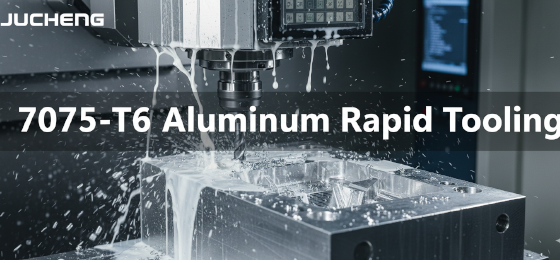
Tooling velocity is achieved by selecting materials that yield to the cutter. Traditional H13 steel is notoriously difficult to machine, requiring slow spindle speeds and extensive Electrical Discharge Machining (EDM) for fine details. Jucheng Precision engineers utilize aerospace-grade Aluminum 7075-T6 for rapid bridge tooling. This alloy possesses a tensile strength comparable to many mild steels but can be CNC machined up to three times faster. This "Spindle Agility" is what allows us to deliver T1 sample parts in as fast as 10 to 14 days. Furthermore, aluminum possesses a thermal conductivity rate nearly five times higher than steel. This means the mold pulls heat out of the molten plastic almost instantly, slashing cooling times and speeding up the injection cycle. While an aluminum tool may only be rated for 5,000 to 10,000 shots before wear occurs, this lifespan perfectly aligns with the initial market entry phase of most complex medical equipment. We treat the mold not as a permanent monument, but as a high-speed, disposable asset designed to get you to market first.
Molecular Truth: Injecting Real Production-Grade Resins
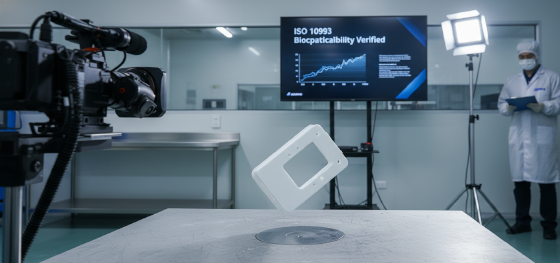
Biological and mechanical compliance cannot be simulated; it must be proven. Regulatory bodies will not accept clinical trial data based on a 3D-printed SLA resin that mimics Polycarbonate. The device must be manufactured from the exact USP Class VI or ISO 10993 certified resin specified in the final Bill of Materials. Low volume injection molding for medical devices provides this "Molecular Truth." Because we use high-pressure hydraulic presses, we inject the actual pellets of medical-grade ABS, PC, or PEEK. The resulting parts possess the exact isotropic strength, impact resistance, and chemical defense required for sterilization protocols (such as wiping down with IPA or bleach). By validating your hardware with the final production material during the low-volume phase, you ensure that any drop-test failures or chemical crazing issues are identified and resolved before you commit to the final, multi-cavity steel production molds.
Strategic Iteration: Modifying Tools Without Bankruptcy
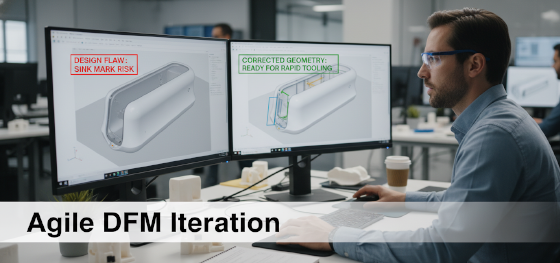
Design certainty is rarely achieved on the first attempt. When doctors or nurses interact with the first batch of 500 units, they inevitably provide feedback: a button is too hard to press, a snap-fit is too loose, or a display bezel reflects too much glare. Modifying a hardened steel mold to accommodate these changes is a brutal, expensive process involving welding, re-machining, and re-polishing. Modifying an aluminum rapid tool, conversely, is remarkably agile. Because the metal is softer, Jucheng Precision technicians can easily drop the mold back onto a CNC mill, cut away material to add a rib or move a mounting boss, and have the tool back on the injection press in 48 hours. This "Iterative Freedom" allows you to incorporate vital user-experience (UX) improvements into your "Version 1.5" product without incurring catastrophic delays or tooling replacement costs.
JUCHENG Protocol: ISO 13485 Certified Bridge Production
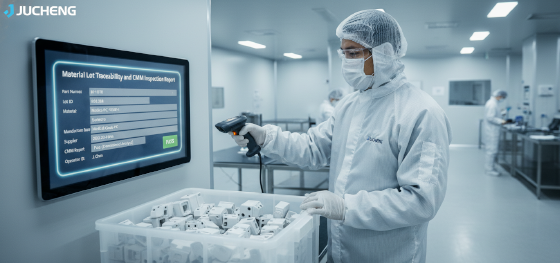
Manufacturing excellence at Jucheng Precision is built on the foundation of the documented pedigree. We recognize that a medical device without an audit trail is a massive liability. Our facility operates under a strict ISO 13485 quality management system, ensuring that every low-volume batch is accompanied by full material lot traceability, heat curing profiles, and CMM dimensional inspection reports. We operate dedicated medical-only cleanroom injection bays to ensure zero cross-contamination. We don't just provide "bridge parts"; we provide the documented certainty required to move from the clinical lab to the global market. Stop gambling your venture funding on vendors who treat small batches as an afterthought. Leverage our decade of medical replication mastery to scale safely and profitably. Contact our technical team today for a free DFM review and an itemized rapid tooling quote.
Frequently Asked Questions: Low Volume Medical Molding
Question: What is the typical lifespan of an aluminum rapid tool?
Answer: A well-maintained Al-7075 rapid tool can reliably produce between 5,000 and 10,000 shots depending on the abrasiveness of the resin (unfilled PC vs. Glass-filled Nylon).
Question: Can JUCHENG provide SPI A-1 or A-2 mirror finishes on aluminum tools?
Answer: Yes. High-grade aluminum can be polished to near-optical clarity for transparent medical windows or lenses, though it requires careful maintenance to avoid scratching during production.
Question: How does JUCHENG handle the transition from aluminum to steel molds when volumes increase?
Answer: We execute a seamless "Concurrent Manufacturing" protocol. While your aluminum tool is running production, our engineers use the processing data (shrinkage, gate freeze times) to design and cut your final steel tool, ensuring zero downtime during the transition.

