


Hospital sterilization protocols act as a relentless molecular executioner for standard polymers. When an engineer specifies a material for reusable surgical trays, dental tool handles, or fluidic manifolds, the part is condemned to a lifetime of extreme thermal shock. Subjecting a standard Polycarbonate (PC) enclosure to 134°C (273°F) pressurized steam while simultaneously bombarding it with aggressive chemical disinfectants guarantees a rapid, catastrophic failure via "crazing" and embrittlement. Navigating this requirement for indestructible, lightweight clinical hardware requires the strategic deployment of Radel PPSU machining for medical devices. Polyphenylsulfone (PPSU), commercially known as Radel, is the undisputed king of the amorphous sulfone polymer family. Jucheng Precision operates as a high-fidelity polymer sanctuary in the Shenzhen precision manufacturing hub, providing the 5-axis CNC depth needed to conquer this high-performance, heat-retaining material. Within the broader framework of Medical Robotics Manufacturing, we bridge the gap between "heavy stainless steel" and "fragile plastics," ensuring your reusable clinical instruments survive thousands of surgical cycles without a single micro-crack or dimensional deviation.
Establishing a resilient launch for reusable medical hardware demands the absolute rejection of "Cost-Saving" material substitutions. Amateurs often attempt to save budget by machining complex surgical effectors from Ultem (PEI) or standard PC, unaware that these materials possess a significantly lower impact resistance and will shatter if dropped on a hard clinical floor. Jucheng Precision eliminates these "Biological Risks" by enforcing a strict material sovereignty protocol. We utilize raw, certified Radel billets to deliver components that maintain their transparent, color-coded aesthetics and structural rigidity even after 1,000 autoclave cycles. Whether you are developing an articulating robot joint cover or a complex endoscopic housing, our facility provides the material science and metrological rigor required for 2026 FDA and CE Mark approval. This guide deconstructs the thermodynamics of steam sterilization, the physics of impact toughness, and why JUCHENG’s "Annealing Protocol" is the mandatory foundation for anyone developing life-critical hardware.
Thermal Sovereignty: Surviving 1,000+ Autoclave Cycles
Impact Dominance: The End of Brittle Fracture in the OR
Chemical Defense: Defeating Environmental Stress Cracking
Subtractive Violence: Managing Heat During CNC Execution
JUCHENG Protocol: ISO 13485 and Strict Thermal Annealing
Frequently Asked Questions: PPSU Surgical Hardware
Thermal Sovereignty: Surviving 1,000+ Autoclave Cycles
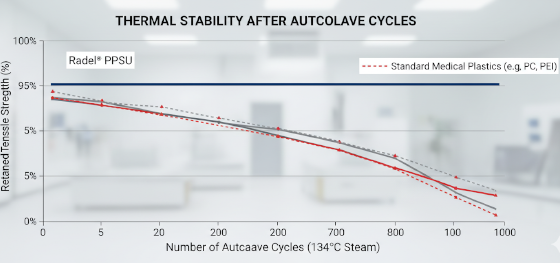
Hydrolytic stability defines the lifespan of a reusable medical instrument. The autoclave process is a violent combination of superheated steam, high pressure, and rapid cooling. Most amorphous plastics absorb this moisture, which then acts as a plasticizer, causing the polymer chains to slide apart, resulting in immediate dimensional warping and loss of tensile strength. Radel PPSU machining for medical devices eliminates this "Steam Hydrolysis" failure. PPSU features a remarkably high Glass Transition Temperature (Tg) of 220°C (428°F). This means the polymer matrix remains rock-solid and dimensionally locked during the standard 134°C sterilization cycle. Furthermore, Radel exhibits nearly zero water absorption. Jucheng Precision machines surgical trays and complex robotic tool housings that can withstand over 1,000 continuous autoclave cycles without losing their flexural modulus or developing the cloudy "haze" that plagues inferior transparent polymers. We don't just "cut plastic"; we engineer a permanent thermal shield for your clinical hardware.
Impact Dominance: The End of Brittle Fracture in the OR
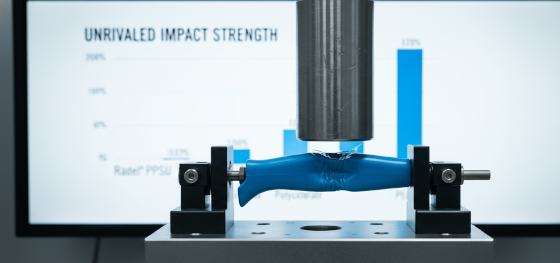
Kinetic energy absorption is a mandatory requirement for high-turnover clinical environments. Operating room equipment is frequently dropped, tossed into sterilization bins, and subjected to aggressive mechanical handling. While materials like Ultem (PEI) offer excellent heat resistance, they are notoriously "notch-sensitive"—meaning a sharp internal corner or a small scratch can act as a stress riser, causing the entire part to shatter upon impact. Radel PPSU provides a spectacular "Ductility Advantage." It possesses a Notched Izod Impact strength that is nearly ten times higher than Ultem or standard Polyethersulfone (PES). Jucheng Precision engineers mandate PPSU for heavy-duty orthopedic sizing blocks, surgical mallet handles, and robotic effector housings. By utilizing 5-axis CNC machining, we ensure that every internal corner is perfectly radiused, maximizing the material's inherent toughness. You receive a lightweight polymer component that behaves with the indestructible nature of a metal alloy, drastically reducing your product's field replacement rate.
Chemical Defense: Defeating Environmental Stress Cracking

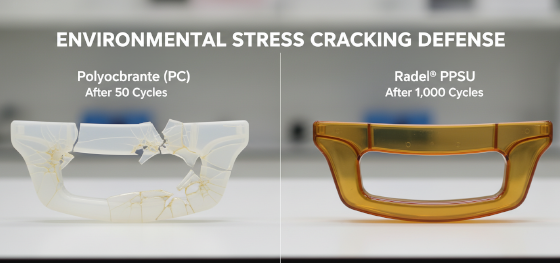
Chemical hostility in a hospital destroys plastics from the outside in. Strong alkaline cleaners, lipid-based bodily fluids, and aggressive germicides like Cidex (Glutaraldehyde) attack the molecular bonds of standard transparent polymers like Polycarbonate. Under the mechanical stress of a tightened screw or a press-fit bearing, this chemical attack triggers Environmental Stress Cracking (ESC)—a spiderweb of microscopic fissures that eventually splits the housing. Radel PPSU machining for medical devices provides an absolute chemical firewall. Because the sulfone backbone of the polymer is highly inert, it rejects chemical penetration, allowing the part to maintain its structural integrity even when constantly soaked in harsh disinfectants. Jucheng Precision ensures that your surgical instruments and fluidic manifolds remain bio-safe and structurally sound, preventing the catastrophic containment failures that lead to surgical suite contamination.
Subtractive Violence: Managing Heat During CNC Execution

Thermodynamic management is the primary barrier to entry for machining high-performance polymers. PPSU is an incredible thermal insulator; it stubbornly refuses to absorb or dissipate heat. When a CNC end-mill cuts the billet, the friction generates intense localized heat that is trapped exactly at the cutting edge. If an amateur shop runs the spindle too fast, the plastic will "melt and smear" rather than chip, causing catastrophic surface galling and ruining the tight tolerances required for robotic assemblies. Jucheng Precision eliminates this "Thermal Trap" by deploying a "Cold-Cut" philosophy. We utilize specialized, razor-sharp solid carbide tooling with highly polished flutes designed specifically for advanced plastics. We program highly aggressive feed rates combined with massive volumes of synthetic, medical-safe coolant to evacuate the heat instantly. This prevents the material from warping during the cut, allowing us to maintain +/- 0.01mm tolerances on critical bearing bores and fluidic channels, ensuring your hardware is metrologically perfect.
JUCHENG Protocol: ISO 13485 and Strict Thermal Annealing
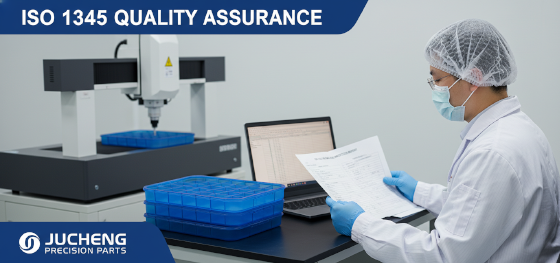
Manufacturing excellence at Jucheng Precision is built on the foundation of internal stress relief. Extruded PPSU rods and plates are "frozen" in a state of high internal tension. When we remove the outer skin during machining, these stresses are unleashed, causing the part to warp or twist uncontrollably. We prevent this "Dimensional Rebellion" by implementing a mandatory, multi-stage "Annealing Protocol." Before rough machining, and again before the final finishing pass, we bake the PPSU parts in digitally controlled convection ovens. We slowly raise the temperature, hold it near the Tg to allow the polymer chains to relax, and then cool it at a meticulously slow rate. This thermal stabilization ensures that when your part hits the 134°C autoclave in a hospital, its dimensions remain absolutely sovereign. Our ISO 13485 certified workflow guarantees that your medical components are accompanied by full material lot traceability and CMM inspection reports. Stop gambling your surgical launch on machine shops that treat PPSU like a cheap commodity plastic. Leverage our decade of polymer metallurgy mastery to validate rapidly, scale responsibly, and launch safely.
Frequently Asked Questions: PPSU Surgical Hardware
Question: Why choose Radel PPSU over Ultem PEI for surgical trays?
Answer: While both withstand autoclave temperatures, PPSU has significantly higher impact strength. If a heavy sterilization tray is dropped, Ultem is likely to crack or shatter, whereas Radel PPSU will absorb the impact and survive.
Question: Can JUCHENG provide colored or transparent PPSU components?
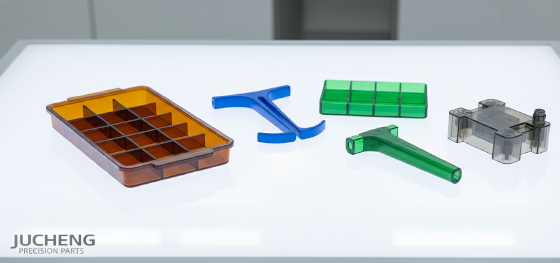
Answer: Yes. Radel PPSU is naturally transparent with a slight amber tint, but we can machine custom components from colored billets (blue, green, grey, etc.), which is vital for color-coding specific surgical instrument kits in the OR.
Question: How does JUCHENG prevent cross-contamination when machining medical polymers?
Answer: Our Shenzhen precision manufacturing hub maintains dedicated "Plastic-Only" 5-axis CNC machines to ensure zero contamination from metal shavings. Post-machining, all medical parts undergo a multi-stage ultrasonic cleaning process before entering the cleanroom for packaging.

