


Navigating the financial transition from a single lab-bench model to a fleet of 50 field-ready machines reveals a critical economic hurdle for hardware startups: the tooling gap. In the current market, the decision between RIM vs Vacuum Casting is often driven by the non-recurring engineering (NRE) fees and the labor-intensive nature of small-batch production. While pouring resin into silicone is the gold standard for the first 5 units, the scalability of that process hits a wall once you require the structural consistency of a pilot production run. Performing a detailed Breakeven Analysis: RIM vs Vacuum Casting Cost is the essential strategy for procurement leads who need to maximize their R&D budget without compromising on the mechanical integrity of their innovation.

Financial optimization in large-format hardware depends on the amortization logic of the tool. If a part spans over 1,000mm, the manual labor required for a vacuum cast pour becomes a significant cost driver, often leading to a per-unit price that is three times higher than a machine-injected alternative. Jucheng Precision addresses these budgetary hurdles by providing high-tier industrial solutions that bridge the gap from Alpha to Beta phases. Jucheng Precision utilize a fleet of 150+ CNC machines to manufacture rapid aluminum tools that offer total cost of ownership (TCO) advantages for batches as small as 25 units in our Shenzhen precision manufacturing hub.
Operating under a strict ISO 13485 quality framework, Jucheng Precision acts as the strategic financial consultant for global MedTech and robotics firms. Jucheng Precision delivers a free DFM analysis in 24 hours to ensure your design is optimized for the most cost-effective path, identifying potential complexity-traps before they inflate your tooling bill. This guide explores the essential NRE investment standards, the manual labor impact data, and the piece-price crossovers required for mastering Breakeven Analysis: RIM vs Vacuum Casting Cost to ensure your technology reaches the market on a lean and sustainable foundation.
content:
Initial Investment: Master Pattern + Silicone vs. Aluminum Tooling
Technical Data: Comparing Cost Curves and Amortization Intervals
The Labor Factor: Why Manual Pours are Expensive for 50+ Units?
Iterative Agility: The Financial Risk of Design Changes Mid-Run
JUCHENG Solution: Transparent Financial Modeling in the Shenzhen Shop
FAQ: Real Answers for Budgeting, Quantity Shifts, and ROI
Initial Investment: Master Pattern + Silicone vs. Aluminum Tooling
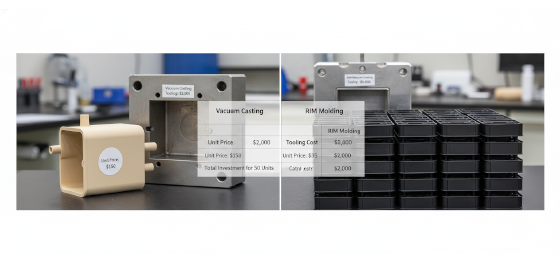
Upfront tooling costs are the primary barrier to high-fidelity prototyping. When executing a Breakeven Analysis: RIM vs Vacuum Casting Cost, the initial spend of the Alpha phase is focused on the master pattern. Vacuum casting requires a 3D-printed or CNC-machined master to create the silicone mold. While this is the absolute lowest entry cost for a single part, the silicone tool is a consumable asset that degrades after 20 shots. In contrast, the reaction injection molding process utilizes rigid aluminum tooling. Machining a 1.5-meter long aluminum mold requires more upfront machine-hours, but this tool becomes a permanent production asset capable of delivering thousands of identical parts with zero dimensional drift.
When is the higher tooling cost of RIM justified?
If your project requires more than 30 identical enclosures with IP67-rated seals, the repeatable accuracy of aluminum tooling eliminates the high cost of manual fitment labor required for cast parts.
Managing the NRE investment involves analyzing the complexity of the part. Features like deep internal ribs and mounting bosses require specialized core-pulls and slides. In an aluminum RIM tool, these are machined with sub-micron precision using high-end 5-axis centers. In a silicone mold, complex undercuts can sometimes be "Peeled" out manually, but this introduces geometric variability. Jucheng Precision’s Shenzhen facility manages this complexity by offering tiered tooling options, allowing you to select the tool life and accuracy that matches your financial runway. By focusing on the total cost of ownership (TCO), we help you avoid the trap of "Cheap Tooling" that leads to "Expensive Parts."
Design modification costs represent the hidden variable in the initial investment. If your field trial reveals that a sensor mounting hole needs to move, a silicone mold must be discarded and the entire process restarted from the master pattern. An aluminum RIM mold, however, can be welded and re-machined in the CNC bay within 48 hours. This agile modification capability ensures that your financial breakeven is not reset by every minor engineering change. By delivering hardware from a "Living Tool," Jucheng Precision ensures your prototype robot reaches the market at the lowest total project cost, providing the unyielding foundation your autonomous fleet requires.
Technical Data: Comparing Cost Curves and Amortization Intervals

Success in hardware procurement depends on the data. If your design assumes the scaling efficiency of injection molding but you only need 500 units, you are overpaying for tooling. Jucheng Precision provides transparent cost-benefit analysis for every project. The following table compares the typical financial variables of Breakeven Analysis: RIM vs Vacuum Casting Cost for a large medical console enclosure in the current global market.
| Production Quantity | Vacuum Casting (Manual) | RIM Molding (Machine) | Economic Driver |
|---|---|---|---|
| 1 - 10 Units | $800 - $1,200 / Part | $2,500 - $4,000 / Part | VC wins on Low NRE |
| 25 - 50 Units | $750 / Part (Mold remake) | $450 / Part (Amortized) | The Breakeven Zone |
| 100 - 500 Units | $700 / Part (Inefficient) | $180 / Part (High ROI) | RIM wins on Unit Price |
| 5,000+ Units | N/A (Process fails) | $120 / Part (Stable) | Production Efficiency |
The piece-price crossovers typically occur around the 30-unit mark for complex industrial robot parts. Once your Beta fleet reaches this scale, the automated cycle of the RIM press—which takes minutes—replaces the multi-hour hand-pouring and curing cycle of vacuum casting. Jucheng Precision’s Shenzhen hub is optimized for this "Scaling Zone," allowing you to pull hardware as needed without the crushing cost of mass-production infrastructure. By delivering high-fidelity hardware at optimized price points, we ensure your R&D budget is focused on innovation rather than manufacturing overhead.
The Labor Factor: Why Manual Pours are Expensive for 50+ Units?
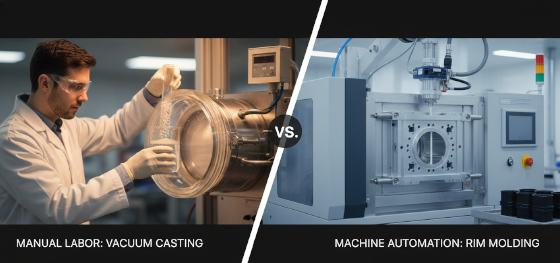
Human labor is the most volatile cost variable in low-volume manufacturing. In the analysis of Breakeven Analysis: RIM vs Vacuum Casting Cost, the labor intensity of the manual pour process dictates the high unit price of vacuum casting. Every cast part requires a technician to manually measure, mix, degas, pour, and demold the resin. This repetitive task increases the risk of human error—such as air bubbles or chemical ratio drift—which can lead to high scrap rates in large 2-meter panels. Because the RIM process utilizes automated servo pumps and high-pressure mixing heads, the labor requirement is reduced by 70%. This automation ensures that part #50 is identical to part #1, providing the statistical stability required for medical device hardware validation.
How does Jucheng reduce manual assembly labor?
By utilizing the structural consolidation capability of the RIM process, we integrate mounting bosses and reinforcement ribs into a single part, reducing your final assembly time by 40%.
Energy efficiency is the secondary win of automated manufacturing. Manual vacuum casting requires constant oven heating to maintain room temperatures for curing, and vacuum pumps must run for long periods to degas thick resins. Jucheng Precision operates under ISO 14001 standards, utilizing high-pressure RIM systems that operate at near room temperature. The chemical cross-linking reaction provides its own heat, reducing the external energy consumption per kilogram of material processed. This ESG-compliant approach not only lowers your production carbon footprint but also reduces the overhead costs passed on to our clients, ensuring your hardware is both sustainable and cost-effective.
Secondary finishing labor must also be factored into the ROI. Vacuum cast parts often require extensive hand-sanding to remove the heavy flash at the parting lines, which are hand-cut into the silicone. Jucheng Precision’s aluminum tools are finished on 5-axis trunnion machines to achieve micron-level parting line fitment. This results in a "Flash-Free" edge that moves directly from the mold to our dust-free painting suites. By eliminating the sanding and filling labor, Jucheng Precision lowers the effective piece price, ensuring your diagnostic equipment shell is retail-ready at a lower total cost than a lower-quality cast alternative in the current market.
Iterative Agility: The Financial Risk of Design Changes Mid-Run
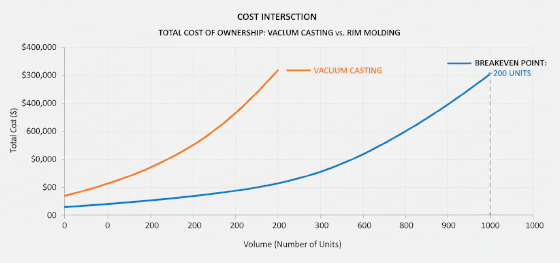
Designing for the future requires a tooling strategy that handles change. In Breakeven Analysis: RIM vs Vacuum Casting Cost, the "Cost of Change" is often the deciding factor for high-velocity robotics teams. During the Beta trial, a robot fender might need a reinforced mounting point to handle higher vibrational loads. If you are using vacuum casting, this change requires a new 3D-printed master and a new silicone mold, effectively doubling your NRE spend. Because Jucheng Precision utilize high-strength aluminum for our RIM molds, we can perform agile tooling modifications. We can add material via welding and re-machine the geometry in our CNC bay, preserving 90% of your initial tooling investment while keeping your R&D schedule on track.
Can I change material Shore hardness without a new mold?
Yes. One of the greatest benefits of the RIM process is the ability to adjust the A/B chemical recipe to change the part from "Rigid ABS-like" to "Flexible PP-like" using the same aluminum tool.
Scaling from one Alpha prototype to a 1,000-unit pilot run is managed through our "Bridge to Production" philosophy. We don't ask you to commit to $100,000 steel tools before you are ready. Our aluminum RIM tools serve as the permanent bridge, providing production-quality hardware for your entire first year of sales. This capital agility allows our clients to invest their resources in critical AI algorithms and customer acquisition rather than idle manufacturing infrastructure. By delivering "Iterative-Ready" hardware, Jucheng Precision ensures your innovation survives the volatile transition from concept to mass adoption in the Shenzhen hub.
Quality assurance at the breakeven point includes full traceability. As you scale from 10 to 500 units, the regulatory documentation requirements for ISO 13485 compliance grow significantly. Jucheng Precision’s automated RIM systems record the exact chemical ratio, pressure, and temperature for every shot. This "Digital Birth Certificate" is included with every production batch, providing the manufacturing evidence your quality team needs for global certification. By delivering validated hardware with a clear paper trail, we eliminate the risk of clinical delays, ensuring your medical device prototyping project moves from the Shenzhen factory to the global healthcare market with 100% confidence.
JUCHENG Solution: Transparent Financial Modeling in the Shenzhen Shop

Dominating the large-format hardware market requires a partner that doesn't just mold plastic, but understands the financial math of them all. Jucheng Precision operates with a 24/7 manufacturing mindset in our Shenzhen precision manufacturing hub, delivering high-tolerance RIM components and structural industrial robot parts with industry-leading speed. Jucheng Precision provides the bridge to production that ensures your innovations move from CAD to field trial with 100% metallurgical and dimensional confidence. Jucheng Precision provides free DFM analysis in 24 hours to ensure your design is optimized for the unyielding reality of the field, whether you are building an autonomous medical assistant or a heavy-duty industrial mobile base.
Integrating your structural design with JUCHENG’s expertise ensures that your tooling decision is based on performance data, not guesswork. Jucheng Precision offer comprehensive DFM reviews within 24 hours, identifying potential aging-risks or thermal-expansion bottlenecks in your design before they become field failures. Whether you are building an autonomous vineyard scout or a multi-part MRI housing, Jucheng Precision provides the rigid, precise, and chemically optimized foundations that keep your innovation moving through the high-stakes cycles and the years of hard labor.
Our facility is equipped with 150+ CNC machines and dedicated high-pressure RIM assembly cells, allowing us to manage the entire hardware lifecycle in one location. Jucheng Precision manage the complexity of multi-material bonding and automotive-grade finishing so your engineering team can focus on the clinical outcomes and the AI. By combining Shenzhen's speed with industrial-grade material verification and global quality standards, Jucheng Precision remains the preferred partner for the world's most aggressive hardware challenges. Contact the Shenzhen hub today to start your next project.
FAQ: Real Answers for Budgeting, Quantity Shifts, and ROI

What is the maximum part size for the lowest NRE cost?
For parts under 500mm, vacuum casting offers the lowest entry price. For parts over 1,000mm, RIM aluminum tooling provides the best ROI for 25+ units.
Can I scale from a single prototype to 2,000 parts with one tool?
Yes. Jucheng Precision’s aluminum RIM tools are guaranteed for up to 10,000 shots, handling your entire growth cycle from R&D to mass market.
How do you calculate the breakeven point for medical housings?
We analyze the part geometry, material requirement (e.g., PEEK-like PU), and the cost of manual labor to determine the exact quantity where RIM saves you money.
Does JUCHENG provide volume discounts for high-quantity runs?
Yes. We offer tiered piece-pricing that reduces the cost per part as your order volume increases, helping you transition from 50 to 5,000 units.
What is the typical lead time for a 1-meter RIM aluminum tool?
Functional RIM tools and initial T1 samples are typically delivered in 15 to 20 business days in our Shenzhen facility.
Tooling debt and material fatigue are absolute project killers in the high-stakes world of robotics and medical hardware. Partnering with Jucheng Precision ensures that your functional iterations are built with the cost-effective polyurethane reaction injection molding and specialized Breakeven Analysis: RIM vs Vacuum Casting Cost knowledge the industry demands. Reach out to our Shenzhen manufacturing hub today for a complete DFM review and build the unyielding foundation your autonomous fleet requires.

