


Evaluating the mechanical foundations of a large-scale diagnostic housing or a rugged robotic fender often leads back to the durability of the tool itself. In the current hardware development landscape, the choice between RIM vs Vacuum Casting is primarily a debate regarding the rigidity and longevity of the mold. While both processes utilize liquid resins to create complex geometries, the substrate of the mold—whether flexible or rigid—dictates the final part’s dimensional repeatability and surface finish. Choosing the correct path requires a deep dive into Silicone Mold vs Aluminum Tooling for PU Parts to ensure your hardware maintains its integrity across a Beta pilot run of 50 to 5,000 units.
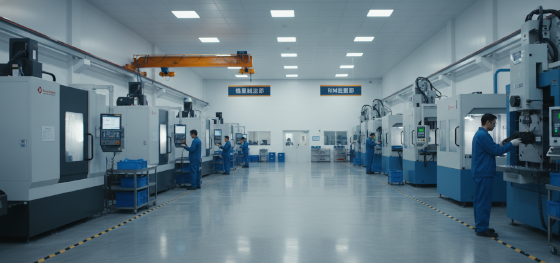
Dimensional accuracy in oversized enclosures depends on the material's ability to resist deformation during the curing phase. Silicone is an elastomer; it naturally flexes under the weight of heavy liquid resins and the pressure of a vacuum. Jucheng Precision addresses these precision hurdles by utilizing high-strength aluminum alloys for medium-volume production needs. Jucheng Precision leverages a fleet of 150+ CNC machines to carve these rigid tools from solid billets, ensuring that your Silicone Mold vs Aluminum Tooling for PU Parts decision results in hardware that fits perfectly into your high-precision robotic assembly.

Operating under a strict quality management framework, Jucheng Precision acts as the high-tier manufacturing advisor for global MedTech and robotics firms. Jucheng Precision delivers a free DFM analysis in 24 hours to help engineers decide if their part geometry requires the unyielding support of a rigid metal cavity. This guide explores the essential repeatability standards, tooling life cycles, and geometric complexity limits required for mastering Silicone Mold vs Aluminum Tooling for PU Parts to ensure your next fleet of autonomous machines survives the transition from the laboratory to the industrial floor.
content:
Precision and Repeatability: Why Rigid Aluminum Beats Flexible Silicone?
Technical Data: Comparing Tooling Life and Shot Capacity
Geometric Complexity: Managing Sliders and Lifters in Rigid Molds
JUCHENG Solution: Mastering Aluminum Mold Engineering in Shenzhen
FAQ: Real Answers for Tolerance, Cost, and Lead Times
Precision and Repeatability: Why Rigid Aluminum Beats Flexible Silicone?
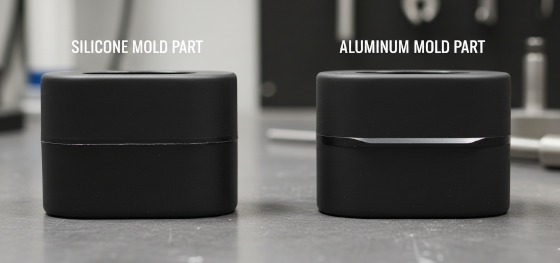
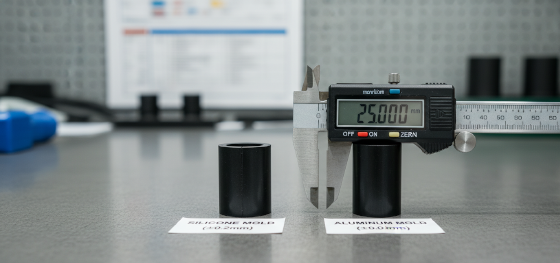
Geometric stability in large-format parts is governed by the rigidity of the mold walls. In the comparison of silicone mold vs aluminum tooling for PU parts, the primary difference is the tolerance window. Silicone molds are created by pouring liquid silicone around a 3D-printed master. Because silicone is soft, the mold can expand or distort slightly as the polyurethane resin cures and generates heat. This results in a typical tolerance of +/- 0.3mm to 0.5mm on large parts. Aluminum tools, however, are machined with +/- 0.01mm precision using high-end CNC centers. This rigid substrate ensures that every part produced is a digital twin of the CAD, providing the "Zero-Play" fitment required for medical scanner seams and robotic joints.
How does tool rigidity impact high-gloss finishes?
Aluminum molds allow for sub-micron polishing that stays flat, whereas silicone tools often develop surface waves that ruin the mirror-reflections of automotive-grade paint.
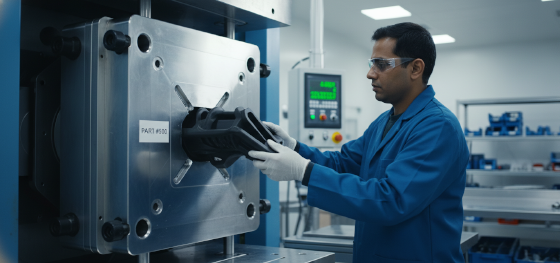
Repeatability is the second pillar of the rigid-tool advantage. In a silicone mold, the tool degrades with every shot as the chemicals and heat erode the surface. By the 20th part, the dimensions often drift outside of acceptable limits. Aluminum tooling maintains its geometric integrity for thousands of cycles. Jucheng Precision utilize 25 5-axis Haas/Mazak units to finish the critical parting lines of these aluminum tools, ensuring that the seal pressure remains constant. This consistency is essential for maintaining an IP67 rating on your enclosures, preventing the moisture ingress that can short out expensive internal AI processors during field testing.
Parting line quality also differs significantly between these two methods. In a silicone tool, the parting line is often hand-cut with a blade, resulting in a visible seam that requires manual sanding on every part. Jucheng Precision’s aluminum tools feature CNC-machined parting lines that result in a "Flash-Free" edge. This reduces the labor-intensive post-processing and ensures that your medical console or robot fender looks like a finished retail product directly out of the mold. By delivering hardware with locked-in precision, Jucheng Precision allows your assembly team to focus on the high-value sensor calibration rather than manual hardware adjustments.
Technical Data: Comparing Tooling Life and Shot Capacity
Success in hardware optimization depends on matching the tool material to your production volume. If your design assumes the life of a steel mold but you use silicone, your project will face sudden supply chain gaps. Jucheng Precision provides transparent tooling lifecycle reports to help your engineering team validate their sourcing decisions. The following table compares the essential durability metrics of different tooling substrates used in the current polyurethane market.
| Tooling Metric | Silicone Mold (VC) | Aluminum Tooling (RIM) | Engineering Driver |
|---|---|---|---|
| Typical Shot Life | 20 - 25 Parts | 2,000 - 10,000 Parts | Scalability and ROI |
| Tolerance (over 500mm) | +/- 0.40mm | +/- 0.10mm | Fitment Reliability |
| Texture Retention | Low (Fades after 10 shots) | Permanent (CNC Cut) | Brand Consistency |
| Modification Difficulty | Impossible (Remake required) | Low (Weld and Re-machine) | Iterative Agility |
The "Shot Life" data highlights why aluminum is the preferred "Bridge to Production" tool. While silicone is cheaper for the first 5 parts, the cost of remaking silicone molds every 20 units quickly exceeds the price of a single aluminum tool. For Beta trials requiring 100 units, aluminum tooling offers a 40% lower total cost of ownership. Jucheng Precision’s material vault contains high-grade 7075-T6 billets that maintain their hardness throughout these cycles, protecting your hardware from the dimensional drift that plagues low-tier prototyping.
Geometric Complexity: Managing Sliders and Lifters in Rigid Molds
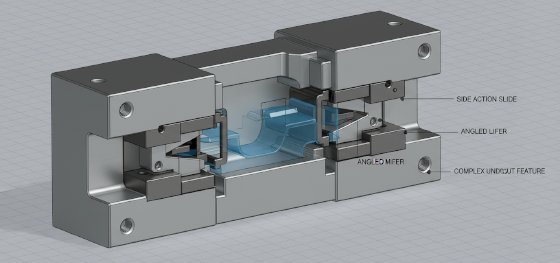
Design freedom for complex internal features is the second major differentiator in the tooling debate. In a silicone mold, undercuts can often be "Peeled" out of the tool due to the material's elasticity. While this is convenient for small parts, it becomes impossible for large structural ribs or interlocking tabs that require absolute straightness. Aluminum tools handle these features through mechanical slides and cam-actions. Jucheng Precision utilize 5-axis CNC machining to carve these moving components, allowing for the production of parts with complex undercuts and internal mounting features that would be impossible to achieve in a manual pour.
How to handle zero-draft features in aluminum tools?
We integrate mechanical lifters and side-actions that physically retract away from the part before ejection, ensuring the 90-degree aesthetic faces are not scuffed.
Thermal management within the tool is the final secret to part quality. Aluminum has five times the thermal conductivity of tool steel and hundreds of times that of silicone. Jucheng Precision designs aluminum molds with integrated water-cooling channels that snake through the cavity and core. This active cooling ensures the exothermic reaction is controlled, preventing localized "Hot Spots" that cause sink marks or brittle zones. By managing the heat, we ensure that your massive 2-meter shells are cured uniformly, providing the unyielding foundations that high-speed surgical robots and autonomous tractors demand.
JUCHENG Solution: Mastering Aluminum Mold Engineering in Shenzhen
Dominating the hardware market requires a partner that can scale from a single hand-poured model to a commercial deployment of 5,000 units with industry-leading speed. Jucheng Precision operates with a 24/7 manufacturing mindset in our Shenzhen precision manufacturing hub, delivering high-tolerance aluminum tooling and structural industrial robot parts. Jucheng Precision provides the bridge to production that ensures your innovations move from CAD to field trial with 100% metallurgical confidence. We provide a free DFM analysis in 24 hours to ensure your design is optimized for the unyielding reality of the field, whether you are building a medical diagnostic scanner or a heavy-duty industrial mobile base.
Integrating your structural design with Jucheng Precision’s expertise ensures that your tooling decision is based on performance data, not guesswork. We offer comprehensive design reviews identifying potential gas-trap zones or thermal-expansion risks in your design before they become field failures. Whether you are building an autonomous vineyard scout or a multi-part MRI housing, Jucheng Precision provides the rigid, precise, and chemically optimized foundations that keep your innovation moving through the high-stakes cycles and the years of hard labor.
Our facility is equipped with dedicated high-pressure RIM assembly cells and dedicated ISO 13485 and ISO 14001 quality labs, allowing us to manage the entire hardware lifecycle in one location. We manage the complexity of multi-material bonding and automotive-grade finishing so your engineering team can focus on the motion control and the AI. By combining Shenzhen's speed with industrial-grade material verification and global quality standards, Jucheng Precision remains the preferred partner for the world's most aggressive hardware challenges. Contact the Shenzhen hub today to start your project.
FAQ: Real Answers for Tolerance, Cost, and Lead Times
What is the tightest tolerance an aluminum RIM tool can hold?
We regularly achieve +/- 0.1mm across 1,000mm spans, and can finish critical seats to +/- 0.02mm via secondary CNC machining.
Is aluminum tooling always more expensive than silicone?
Upfront, yes. However, for quantities over 20-30 units, aluminum is significantly cheaper because you don't have to remake the mold multiple times.
How long does it take to build an aluminum RIM mold?
Most structural RIM tools are completed and delivering parts in 15 to 20 business days in our Shenzhen facility.
Can I add custom textures to aluminum molds?
Yes. We utilize 5-axis laser texturing to apply VDI 3400 or Mold-Tech grains that are a permanent part of the tool surface.
Which tool is better for a 2-meter long robot fender?
Aluminum tooling. A silicone mold of that size would sag significantly, making it impossible to hold the required dimensional accuracy.
Tooling debt and warped panels are absolute innovation killers for high-end robotic systems. Partnering with Jucheng Precision ensures that your functional iterations are built with the unyielding polyurethane reaction injection molding and specialized knowledge the industry demands. Reach out to our Shenzhen manufacturing hub today for a complete DFM review and build the unyielding foundation your autonomous fleet requires.

