


For any CNC machinist, pure copper is often synonymous with frustration. It is arguably one of the most difficult materials to machine efficiently. The material is gummy, it drags against the cutting edge, and it creates long, stringy chips that wrap around tooling like a bird's nest. These "copper nests" force operators to pause machines frequently to clear debris, destroying cycle times and risking damage to sensitive surface finishes. Yet, the electrical and thermal industries demand the high conductivity that only copper can provide. This creates a fundamental conflict between design performance requirements and manufacturing reality.
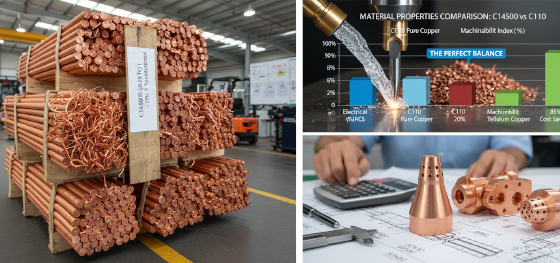
The solution lies in a specific, often underutilized alloy: c14500 tellurium copper machining. By introducing a tiny fraction of tellurium into the copper matrix, this material transforms from a machinist's nightmare into a production dream. It is widely regarded as the "Problem Solver" of the copper family, bridging the gap between the conductivity of pure elements and the machinability of brass.
At Jucheng Precision, we specialize in precision manufacturing for the electronics and automotive sectors. We often advise clients to switch to C14500 for high-volume electrical components. Why? Because while the raw material cost per kilogram is slightly higher than pure C110 copper, the massive gain in machining speed and process reliability can reduce your total part cost by up to 50%. This guide will dive deep into the properties, processing strategies, and economic advantages of this remarkable alloy.
The Metallurgy: Why Tellurium Changes Everything
Properties: 93% IACS Meets 85% Machinability
Best Practices for Machining C14500
Critical Applications: Nozzles and Connectors
The JUCHENG Calculation: Volume and Cost Savings
The Metallurgy: Why Tellurium Changes Everything
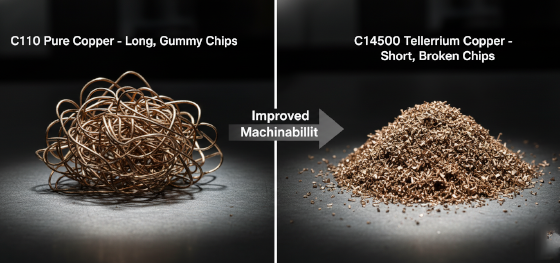
To understand why C14500 is superior for machining, we must first understand what makes pure copper so difficult. In standard C110 Electrolytic Tough Pitch (ETP) copper or C101 Oxygen-Free copper, the grain structure is soft, continuous, and highly ductile. When a cutting tool engages with pure copper, the material does not want to separate. Instead, it creates a "plastic flow." The tool essentially plows through the metal rather than cutting it cleanly. This generates immense heat and produces continuous ribbons of waste material that are dangerous to both the operator and the machine.
C14500 Tellurium Copper is an alloy typically composed of 99.5% copper and 0.5% tellurium (Te), sometimes with a trace of phosphorus (0.004-0.012%) to aid in deoxidation. While 0.5% sounds like a negligible addition, its impact on the metal's microstructure is revolutionary. Tellurium is insoluble in copper at room temperature. This means it does not dissolve into the copper crystal lattice. Instead, it precipitates out, forming microscopic copper telluride particles dispersed uniformly throughout the matrix.
These microscopic particles act as internal "stress risers" or chip breakers. When the shear stress of the cutting tool is applied during c14500 tellurium copper machining, these precipitates create weak points that cause the chip to fracture immediately. Instead of a long ribbon, you get small, manageable chips that fall away from the cutting zone. This phenomenon is very similar to how lead works in C360 brass, but tellurium provides a cleaner, more conductive alternative for specific applications.
Properties: 93% IACS Meets 85% Machinability
Engineering material selection is almost always a game of trade-offs. Usually, when you alloy copper to make it harder, stronger, or easier to machine, you destroy its electrical and thermal conductivity. For example, Beryllium Copper (C172) is strong but has lower conductivity. Brass is easy to machine but is a terrible conductor compared to copper.
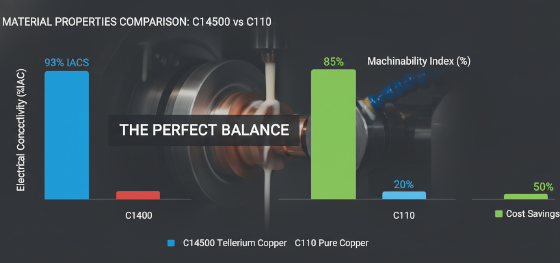
C14500 is unique because it minimizes this trade-off better than almost any other alloy. Let us look at the numbers that matter to engineers. The conductivity of pure annealed copper is defined as 100% IACS (International Annealed Copper Standard). C14500 Tellurium Copper retains an impressive 90% to 93% IACS rating. This means for 99% of real-world power transmission applications—such as high-current pins, grounding blocks, and welding tips—the performance difference between C14500 and pure copper is negligible.
Now consider the Machinability Rating. If C360 Free-Cutting Brass is the standard at 100%, pure copper rates a dismal 20%. It is gummy, soft, and notoriously difficult to hold tight tolerances. C14500 rates at 85%. This is a four-fold increase in machinability compared to pure copper. This 85% rating allows Jucheng Precision to run our Swiss lathes and 5-axis milling centers at high RPMs with aggressive feed rates. We can achieve mirror-like surface finishes (Ra 0.4 or better) directly off the machine without the need for expensive secondary polishing or deburring operations.
Best Practices for Machining C14500
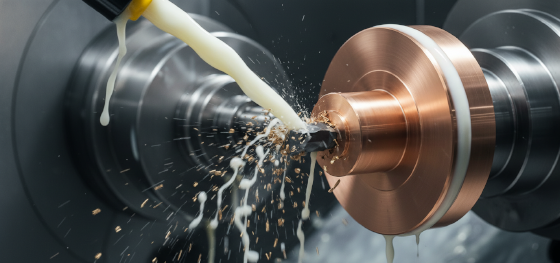
While C14500 is "free-machining," achieving the perfect part still requires specific expertise. At Jucheng Precision, we have developed a set of standard operating procedures to maximize the potential of this alloy.
First is Tooling Geometry. Although C14500 breaks chips well, it is still relatively soft. We recommend using polished carbide tools with a positive rake angle. A positive rake helps to shear the metal cleanly rather than pushing it, which keeps the cutting forces low and the heat generation to a minimum. Coated tools, such as TiCN or AlTiN, can extend tool life, but for the absolute best surface finish, uncoated, sharp, polished carbide is often the winner to prevent material buildup on the cutting edge.
Second is Chip Management and Coolant. Even though chips are small, they can still accumulate in deep holes. High-pressure coolant (through-spindle coolant if available) is essential when drilling deep blind holes in C14500 components like gas nozzles. The coolant not only evacuates the chips but also keeps the thermal expansion in check. Copper expands significantly with heat; keeping the part cool is critical to maintaining dimensional tolerances of +/- 0.005mm.
Finally, we must address Deburring. While C14500 leaves fewer burrs than pure copper, they can still occur on exit paths. Because these parts are often used in high-voltage environments, a single loose burr can cause a catastrophic short circuit (arcing). Jucheng employs a combination of rigid on-machine deburring cycles and secondary thermal or magnetic tumbling processes to ensure every part is 100% burr-free before it enters the quality control room.
Critical Applications: Nozzles and Connectors

Where does this material shine? It is the preferred choice anywhere you need high conductivity combined with complex geometries that require extensive drilling, turning, or milling.
Plasma and Gas Cutting Nozzles: This is perhaps the most common application. Cutting nozzles are consumables that are exposed to extreme heat. They need excellent thermal conductivity to pull heat away from the tip to prevent it from melting. However, they also feature intricate, tiny internal holes that shape the gas flow. C14500 allows manufacturers to drill these deep, straight, precise holes without the drill wandering or breaking, which is a constant risk with pure copper.
High-Volume Electrical Connectors: For EV charging pins, banana plugs, and industrial switchgear, reliability and volume are key. These parts often have complex profiles with threads, slots, and knurling. C14500 offers the arc resistance and conductivity needed for safe power transfer, while allowing for mass production of millions of units on Swiss screw machines.
Welding Guns and Tips: Similar to cutting nozzles, MIG and TIG welding tips require the same balance of thermal management and precision bore geometry. The anti-galling properties of Tellurium copper also help in preventing the welding wire from sticking to the tip during operation.
The JUCHENG Calculation: Volume and Cost Savings

This is the "Secret Sauce" we share with our customers during our Free DFM (Design for Manufacturability) reviews. Many engineers default to C101 or C110 pure copper, assuming that "purer is better." They design a pin and specify C101. However, they fail to account for the machine time.
Let's break down a hypothetical example of manufacturing 10,000 electrical pins.
Scenario A (Pure C110 Copper): The raw material cost is lower. However, the machine must run at 30% speed to prevent bird-nesting. The operator must stop the machine every hour to clear chips. Tool life is short. Cycle time per part is 3 minutes.
Scenario B (C14500 Tellurium Copper): The raw material cost is 15-20% higher. However, the machine runs at 100% speed. Chips break automatically, allowing for "lights-out" unmonitored production. Tool life is tripled. Cycle time per part is 45 seconds.
In high-volume manufacturing, machine time is almost always the most expensive variable. The massive reduction in cycle time with C14500 easily offsets the higher material cost, often resulting in a total project cost reduction of 30% to 50%.
If you need 10 prototypes, stick with C110 if you wish; the material availability is better for small chunks. But if you are scaling to production, switching to C14500 is a financial and technical necessity. At Jucheng Precision, we specialize in helping companies make this transition. We can source high-quality C14500 and verify it with our in-house spectrometer. Contact us today, and let us help you optimize your copper parts for speed, quality, and cost.

