


In the world of precision manufacturing, few materials cause as much confusion as copper. Imagine this scenario: You have two polished copper blocks on your desk. They look identical. They weigh exactly the same. They both conduct electricity beautifully. Yet, one costs significantly more than the other. If you choose the cheaper one for a vacuum chamber or a hydrogen-brazed assembly, it might physically crack and leak, ruining a million-dollar system.
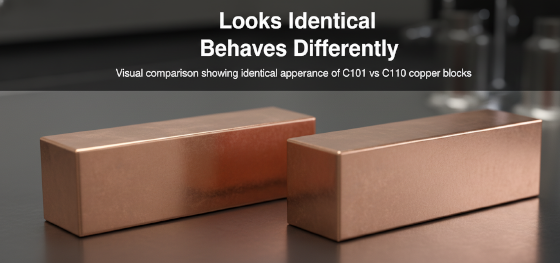
This is the silent but critical battle of c101 vs c110 copper. It is a choice between purity grades that defines the success or failure of high-tech components. At Jucheng Precision, we process tons of both alloys annually for our global clients. We see engineers over-specifying C101 when they don't need it, and under-specifying C110 when they absolutely do.
To help you optimize your budget without compromising performance, this guide breaks down the microscopic differences between Oxygen-Free Electronic (OFE) and Electrolytic Tough Pitch (ETP) grades, and explains why oxygen content matters more than you think.
content:
The Purity Gap: OFE vs ETP Defined
The Hidden Killer: Hydrogen Embrittlement
Conductivity and Electrical Performance
The Cost Reality: Why Vacuums are Expensive
Machinability: Is There a Difference?
JUCHENG's Verdict: Choosing for Your Application
The Purity Gap: OFE vs ETP Defined

To understand the difference, we must look at the chemistry. Both alloys are "pure" copper, but the definition of purity varies by a fraction of a percent that changes everything.
C110 Copper (ETP - Electrolytic Tough Pitch): This is the most common copper on the planet. It is 99.90% pure minimum. The "Pitch" refers to the oxygen content, which is intentionally left in the metal (typically 0.02% to 0.04%) during the refining process to scavenge impurities. For general electrical use, this oxygen is harmless.
C101 Copper (OFE - Oxygen-Free Electronic): This is the Rolls-Royce of copper. It is refined in a vacuum or a carefully controlled atmosphere to reduce oxygen levels to less than 0.0005% (5 ppm). It boasts a minimum purity of 99.99%. It is virtually free of any volatile impurities.
The Hidden Killer: Hydrogen Embrittlement
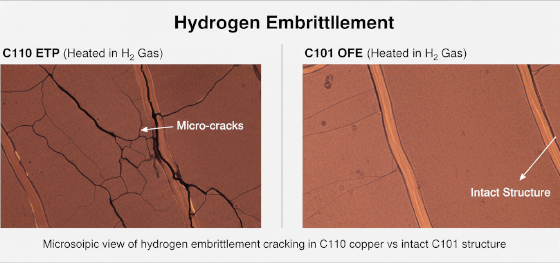
Why does that tiny amount of oxygen in C110 matter? It comes down to a chemical reaction known as "Hydrogen Embrittlement" or "Steam Reaction." This is the single most important factor when choosing between c101 vs c110 copper.
In C110, the oxygen exists as microscopic cuprous oxide ($Cu_2O$) particles at the grain boundaries. If you heat C110 in an atmosphere containing hydrogen (which is common in brazing furnaces, annealing ovens, or vacuum systems), the small hydrogen atoms diffuse into the solid copper. They find the oxide particles and react with them:
$Cu_2O + H_2 rightarrow 2Cu + H_2O (Steam)$
The reaction creates water vapor (steam) inside the solid metal. Because the water molecule is too big to diffuse out, it creates immense internal pressure, literally blasting the grain boundaries apart. The metal becomes brittle, cracks, and loses its structural integrity. C101, having no oxides, is immune to this. It can be brazed, welded, and heated in hydrogen without fear.
Conductivity and Electrical Performance
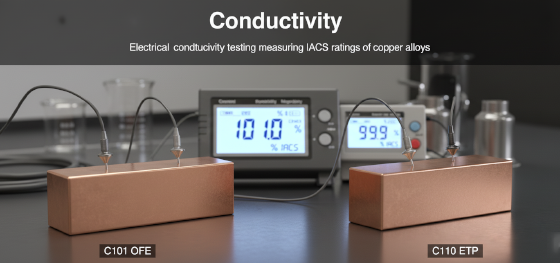
If hydrogen embrittlement is the "Killer," conductivity is the "Subtle Artist." Both grades are excellent conductors, but C101 has the edge.
| Feature | C110 Copper (ETP) | C101 Copper (OFE) |
|---|---|---|
| Purity | 99.90% | 99.99% |
| Oxygen Content | ~0.04% (400 ppm) | 0.0005% (5 ppm) |
| Conductivity (IACS) | 100% (Standard) | 101% (Premium) |
| Hydrogen Safe? | No (Will crack) | Yes |
C101 is rated at 101% IACS, while C110 is the standard 100%. For general wiring, busbars, and switch cabinets, this 1% difference is undetectable and irrelevant. However, in high-precision fields like semiconductor manufacturing, particle accelerators, and high-end audio equipment, that extra 1% represents signal purity and thermal efficiency that engineers are willing to pay for.
The Cost Reality: Why Vacuums are Expensive
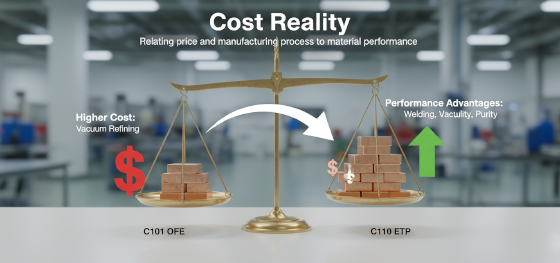
When you request a quote from Jucheng Precision, you will notice a distinct price gap. C101 is not just slightly more expensive; it carries a significant premium, often 3 to 4 times the base material cost of C110 depending on market volatility.
This cost comes from the refining process. Producing C110 is a standard industrial process. Producing C101 requires melting and casting the copper in a complete vacuum to ensure no oxygen molecules can bond with the metal. Additionally, C101 comes with rigorous certification paperwork (ASTM B170) to prove its grade. If your budget is tight and your application is standard, stick to C110. If performance is paramount, C101 is the investment you must make.
Machinability: Is There a Difference?
From a CNC machinist's perspective at Jucheng, both C101 and C110 fall into the category of "Pure Copper." This means both are notoriously gummy, soft, and difficult to machine compared to brass or aluminum.
However, C101 is slightly more ductile due to the lack of oxide impurities. While this makes it excellent for deep drawing or forming, it can be slightly "stickier" on the cutting tool than C110. The oxides in C110 can sometimes act as very minor chip breakers, though the effect is minimal.
In our copper cnc machining workflow, we treat them with the same high-precision protocols: razor-sharp polished carbide tools, high-pressure coolant, and careful dwell time management to prevent work hardening. The key difference is often in the post-processing; C101 parts are frequently packaged in nitrogen-filled bags or vacuum sealed immediately after cleaning to preserve their oxide-free surface for the customer.
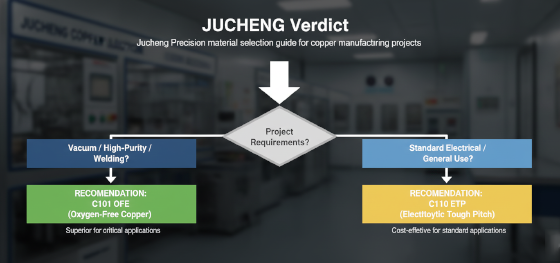
JUCHENG's Verdict: Choosing for Your Application
To simplify your decision, Jucheng Precision uses this logic flow when reviewing client designs:
Select C110 (ETP) if:
• You are making busbars, electrical contacts, ground straps, or lugs.
• The part will be joined using bolts, rivets, or soldering (tin/lead).
• Cost is a primary driver.
• The part will operate in standard air environments.
Select C101 (OFE) if:
• You are making components for vacuum chambers, X-ray tubes, or particle physics.
• The part will be Brazed, TIG/MIG welded, or heated in a hydrogen atmosphere.
• You need glass-to-metal seals (oxides interfere with the seal).
• You require the absolute maximum electrical or thermal conductivity.
Choosing the right copper is the first step to a successful project. Whether you need the cost-effectiveness of C110 or the pristine purity of C101, Jucheng Precision has the material stock and the machining expertise to deliver. Contact us today for a free material consultation and quote.

