


Heat is the silent killer of modern electronics. As processors get faster and LED systems get brighter, the thermal density (watts per square centimeter) skyrockets. Engineers are constantly fighting a battle to move this heat away from sensitive components before they throttle or fail. In this battle, two materials stand as the primary champions: Aluminum and Copper.

The debate of aluminum vs copper heat sink selection is one of the oldest in thermal engineering. Is it better to choose Copper for its superior conductivity, or Aluminum for its lightweight efficiency? The answer is rarely a simple binary choice. It involves balancing thermal performance against weight, manufacturing feasibility, and budget.
At Jucheng Precision, we manufacture thousands of heat sinks every year, ranging from simple extruded aluminum profiles to complex CNC-machined copper cold plates. This guide compares these two materials from a manufacturing perspective to help you design the coolest possible product.
Thermal Conductivity: Copper is King
The Weight Penalty: Aluminum's Advantage
Manufacturing: Extrusion vs Skiving
Cost and Machinability Trade-offs
Corrosion and Surface Finish Options
JUCHENG's Verdict: The Hybrid Solution
Thermal Conductivity: Copper is King

The primary metric for any heat sink material is Thermal Conductivity, measured in Watts per meter-Kelvin (W/mK). This number represents how fast heat can travel through the material.
Aluminum (6061 or 6063): Typically ranges from 160 to 210 W/mK.
Pure Copper (C110): Typically ranges from 385 to 400 W/mK.
As the data shows, Copper is nearly twice as effective as Aluminum at conducting heat. This makes Copper the undisputed "King" for the initial heat spreading. When you have a small, highly concentrated heat source (like a high-performance CPU or a laser diode), Copper is essential for pulling that heat away from the source and spreading it out rapidly. If you use aluminum for a very high-density heat source, you might create a "hot spot" because the material cannot move the energy fast enough.
The Weight Penalty: Aluminum's Advantage

If Copper is so good, why isn't every heat sink made of it? The answer lies in density.
Copper has a density of approximately 8.96 g/cm³, while Aluminum sits at just 2.70 g/cm³. This means that for an identical volume, Copper is more than three times heavier than Aluminum.
For aerospace applications, drones, or handheld medical devices, this weight penalty is unacceptable. A solid copper heat sink could break a PCB board due to vibration or add necessary cost to shipping. Aluminum offers an incredible strength-to-weight ratio and is efficient enough for 80% of standard cooling applications. It allows for large surface areas (tall fins) without turning the device into a heavy brick.
Manufacturing: Extrusion vs Skiving
The material choice dictates the manufacturing process, which drives the cost. This is where the aluminum vs copper heat sink battle is often decided.
Aluminum Extrusion: Aluminum is soft and flows easily. We can push heated aluminum through a die (like squeezing toothpaste) to create complex fin profiles with very little machining. This is an incredibly fast and cheap process. Millions of heat sinks can be made for pennies.
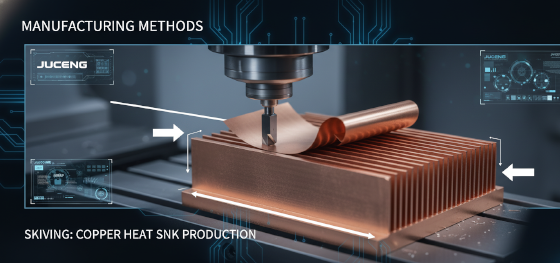
Copper Challenges: Copper cannot be easily extruded into tall, thin fins. It is too tough. To make a copper heat sink, we usually have to use CNC Machining (milling a solid block, which is slow and wastes material) or a process called Skiving.
Skiving involves using a sharp blade to slice thin layers of metal from a block and bending them up to form fins. While Jucheng Precision offers advanced copper skiving services, it is inherently slower and more expensive than aluminum extrusion.
Cost and Machinability Trade-offs
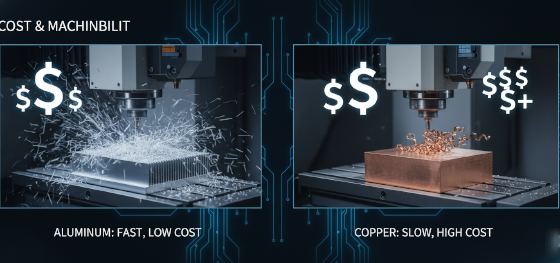
Let's talk about the bottom line. Copper is expensive. The raw material cost of copper is typically 3 to 4 times higher than aluminum.
Beyond raw material, machining copper adds to the bill. As we discussed in our other articles, copper is "gummy." It requires slower cutting speeds and more careful chip management than aluminum. Aluminum 6061 is "free machining," allowing us to fly through material removal.
Therefore, a fully machined copper heat sink can cost 5x to 10x more than a comparable aluminum one. This premium is only justified if the thermal requirements are so extreme that aluminum simply cannot do the job.
Corrosion and Surface Finish Options
How the part looks and survives in the environment is another key factor.
Aluminum Anodizing: One of aluminum's greatest strengths is that it can be anodized. This creates a hard, electrically insulating, and corrosion-resistant layer. We can dye it black, blue, red, or gold. A black anodized heat sink also has higher emissivity, meaning it radiates heat better.
Copper Oxidation: Copper reacts with oxygen. Over time, it will tarnish and turn brown or green. It cannot be anodized. To protect copper, we usually have to plate it with Nickel or Silver. While nickel protects the copper, it adds another step to the manufacturing chain.
JUCHENG's Verdict: The Hybrid Solution
So, which one should you choose? Often, the best answer is "Both."
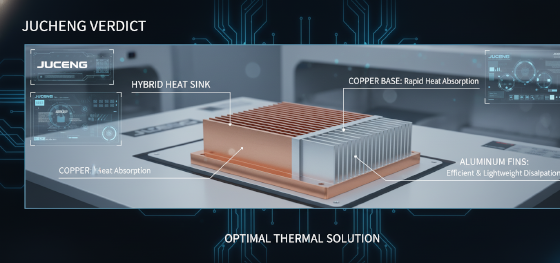
At Jucheng Precision, we often recommend Hybrid Heat Sinks. We can machine a Copper Base Plate (or use a copper vapor chamber) to contact the hot chip directly. This exploits copper's speed in pulling heat away. Then, we attach Aluminum Fins (via soldering or press-fitting) to the copper base.
This design gives you the fast thermal transfer of copper at the source, combined with the light weight, low cost, and high surface area of aluminum for dissipation. It is the best of both worlds. Whether you need a simple extrusion, a skived copper block, or a complex hybrid assembly, Jucheng has the DFM expertise and machining capability to keep your products cool. Contact us today to discuss your thermal management strategy.

