


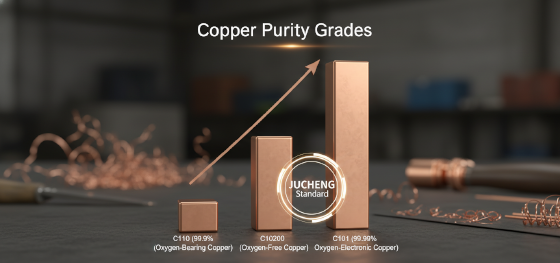
In the spectrum of copper alloys, there is a "Goldilocks" zone. C110 ETP copper is affordable but contains oxygen that can cause embrittlement. C101 OFE copper is chemically perfect but comes with a massive price tag that kills project budgets. Sitting right in the middle is C10200, also known as Oxygen-Free Copper (OFC).
For 90% of high-end industrial applications—ranging from microwave waveguides to audiophile connectors—C10200 is the smartest choice. It offers the purity required for vacuum brazing without the premium cost of certified electronic grade copper. However, machining it is not easy. It is "dead soft," meaning it behaves more like chewing gum than metal under the cutter.
Getting precision c10200 oxygen free copper cnc machined parts requires a manufacturer who understands how to hold, cut, and protect this delicate material. At Jucheng Precision, we have mastered the art of handling soft metals. This guide explores the properties of C10200 and our unique strategies for manufacturing it flawlessly.
Defining C10200: The 99.95% Standard
The "Dead Soft" Machining Challenge
Workholding Strategy: Preventing Deformation
Burr Control and Surface Finish
Industries: Audio and Microwave
JUCHENG's Promise: Anti-Tarnish Packaging
Defining C10200: The 99.95% Standard
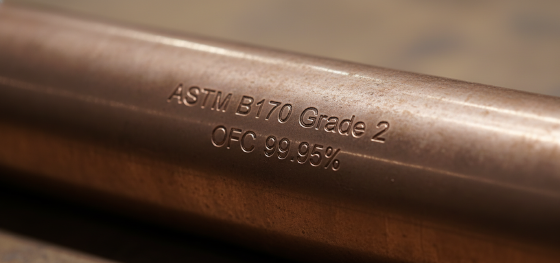
C10200 is technically classified under ASTM B170 as Grade 2 Oxygen-Free Copper. While C101 (Grade 1) requires 99.99% purity, C10200 requires a minimum of 99.95% purity. Crucially, like C101, it is refined in an atmosphere that prevents oxygen from bonding with the metal, keeping oxygen levels typically below 10 ppm (0.001%).
This low oxygen content gives C10200 two distinct advantages over standard C110:
1. Immunity to Hydrogen Embrittlement: It will not crack when heated in hydrogen or vacuum environments, making it suitable for brazing.
2. Superior Ductility: The lack of oxide particles makes the metal incredibly pliable, allowing for deep drawing and complex forming without tearing.
The "Dead Soft" Machining Challenge

Engineers love the ductility of C10200, but machinists often dread it. In its annealed state, C10200 is often referred to as being "dead soft." It lacks the structural rigidity of brass or steel.
When a CNC cutter engages with c10200 oxygen free copper cnc machined parts, the material tends to "smear" rather than cut. It is very sticky. If the cutting tool is even slightly dull, it will push the material rather than shearing it. This creates immense heat, which causes the copper to expand rapidly. Once the part cools down, it shrinks, often resulting in the part being undersized and out of tolerance. Furthermore, the gumminess can cause the chip to weld itself back onto the machined surface, ruining the aesthetic finish.
Workholding Strategy: Preventing Deformation

The softness of C10200 creates a second problem: clamping deformation. If you clamp a C10200 ring or thin-walled housing in a standard 3-jaw chuck with the same force you would use for aluminum, you will crush it. The part will become triangular.
At Jucheng Precision, we employ "Low-Stress Workholding" techniques for OFC copper:
• Pie Jaws (Soft Jaws): We machine custom aluminum jaws that wrap 360 degrees around the part. This distributes the clamping pressure evenly across the entire surface rather than at three points.
• Vacuum Fixtures: For flat plates, we use vacuum tables to hold the part down without any side pressure, ensuring the plate remains perfectly flat after machining.
• Super Glue/Wax Method: For extremely delicate micro-parts, we may bond the copper to a fixture plate using heat-activated wax, machine it, and then release it with heat, ensuring zero clamping force is applied.
Burr Control and Surface Finish

Burrs are the enemy of precision. Because C10200 stretches before it breaks, it loves to leave a hanging burr on the exit edge of a cut. In waveguide applications, a burr can disrupt radio frequencies. In sealing applications, it can cause leaks.
We tackle this with a three-step process:
1. Polished Carbide Tools: We use tools specifically designed for aluminum and copper with a high helix angle (45°+) and a polished flute. The polish reduces friction, allowing the chip to slide off.
2. Smart Toolpaths: Our CAM programmers design toolpaths that keep the cutter engaged in the material as much as possible, rolling the burr off the part rather than pushing it over the edge.
3. Thermal Deburring: For complex internal intersecting holes that cannot be reached by hand, we utilize thermal energy methods to vaporize the thin burrs without affecting the main dimensions of the component.
Industries: Audio and Microwave
Who buys C10200? The biggest users are industries where signal purity is paramount.
High-End Audio: Audiophiles swear by OFC cables and connectors. They believe that the lack of oxide boundaries in the crystal structure allows audio signals to travel with less distortion. We machine binding posts, RCA jacks, and speaker spades from solid C10200 rods.
Microwave and RF: In radar and telecommunications, waveguides must conduct high-frequency waves. Any surface impurity or oxide layer increases "skin effect" losses. C10200 provides the pristine, uniform conductivity required for these critical transmission lines.
JUCHENG's Promise: Anti-Tarnish Packaging
Manufacturing the part is only half the battle. Copper begins to oxidize the moment it is machined. A beautiful, shiny C10200 part can turn brown and ugly within days if left exposed to humid air.
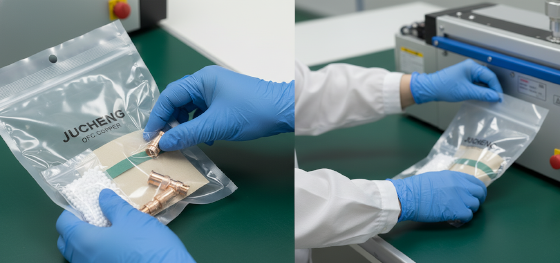
Jucheng Precision treats packaging as a critical manufacturing step. Immediately after ultrasonic cleaning and drying, our c10200 oxygen free copper cnc machined parts are handled with gloves to prevent oil transfer from skin. They are then placed into vacuum-sealed bags with desiccants and anti-tarnish paper. This ensures that when you open the box in your facility—whether it is in New York or Berlin—the copper looks exactly as bright as the moment it left our CNC machine.

