


Holding an aerospace-grade aluminum joint in one hand and a high-performance nylon lattice in the other summarizes the modern dilemma of the [2026] robotics engineer. As the demand for more agile, intelligent autonomous systems grows, the choice between additive and subtractive manufacturing becomes a high-stakes decision. Selecting the wrong path for a prototype robot can lead to misleading test results, where a design that is theoretically sound fails in the field because the material couldn't handle the physics. Understanding the nuances of CNC vs 3d printing for robot prototypes is essential for bridging the gap between a benchtop concept and a commercially viable machine.
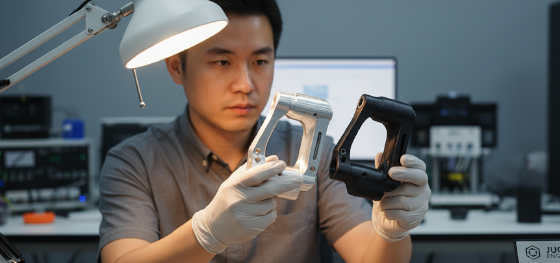
Subtractive CNC machining and additive 3D printing are no longer competing technologies; they are specialized tools in a hybrid development arsenal. While 3D printing offers unrivaled geometric freedom for bionic limbs and internal routing, CNC machining remains the only way to validate the mechanical integrity of load-bearing structures. Jucheng Precision addresses this technical divide by providing both processes under one roof, allowing engineering teams to deploy the right technology for each specific sub-assembly without supply chain friction.
Operating within the Shenzhen precision manufacturing hub, JUCHENG serves as the technical advisor for global robotics firms navigating the "Material Reality" of hardware development. We don't just provide parts; we provide the manufacturing data required to make informed decisions on scale, cost, and performance. This guide explores when to prioritize CNC strength, when to leverage additive complexity, and how to find the economic break-even point for your next CNC vs 3d printing for robot prototypes project.
Material Reality: When CNC is Mandatory for Torque
Complexity and Lattices: The Additive Advantage
Technical Data: Cost and Lead Time Break-even Analysis
JUCHENG Hybrid Integration: The Best of Both Worlds
FAQ: Navigating the Process Choice for Robot Hardware
Material Reality: When CNC is Mandatory for Torque
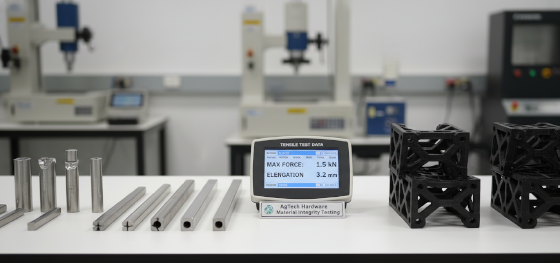
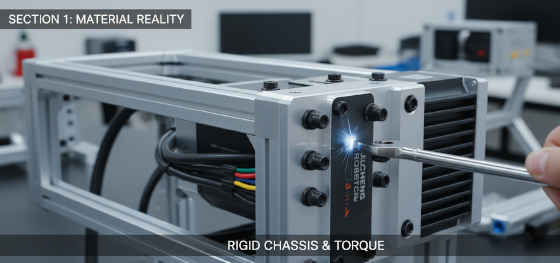
Structural skeletons of autonomous machines are subjected to localized stresses that exceed the capabilities of even the best 3D-printed polymers. In CNC vs 3d printing for robot prototypes, the "Material Reality" favored by CNC is its use of isotropic materials. Extruded aluminum or steel billets possess uniform mechanical properties in all directions. When a high-torque actuator reverses direction on a J1 axis, the motor mount must resist several thousand newtons of force. A 3D-printed part, which is essentially a stack of layers, may delaminate under these specific torsional loads, leading to a catastrophic Alpha-build failure.
Fatigue resistance is the second area where CNC machining dominates. Robots are designed for millions of cycles. Testing a prototype robot with a 3D-printed chassis often provides a "false positive" during the first hour of testing, followed by a sudden fatigue crack in the second. JUCHENG utilizes high-speed 5-axis CNC machining to carve these structural bones from 7075-T6 aluminum. This ensures that the vibration and impact data gathered during field trials is 100% accurate, allowing engineers to finalize their safety factors without the "ghost variables" introduced by inconsistent additive layer adhesion.
Thermal management requires the high conductivity of metals. High-power servo motors and AI compute stacks generate concentrated heat that must be moved away to prevent system throttling. 3D-printed plastics act as thermal insulators, effectively trapping heat and cooking the electronics. JUCHENG’s CNC machining capability allows for the integration of custom heat sinks and liquid-cooling channels directly into the robot’s frame. By using CNC for the "thermal foundation" of the robot, we ensure that the Alpha unit can run at 100% duty cycle during software stress tests, providing a true representation of production performance.
Precision fits for bearings and encoders are only achievable via subtractive processes. A robotic joint requires sub-micron concentricity to prevent gearbox binding and encoder "jitter." While 3D printing has improved, it still cannot hold the +/- 0.01mm tolerances required for a press-fit bearing over a large span. JUCHENG recommends a hybrid approach: if a part is mostly complex but has a critical bearing seat, we 3D print the "blank" and then perform secondary CNC machining on the precision features. This ensures that the industrial robot parts we deliver provide the mechanical silence and accuracy that define a premium robotic system in [2026].
Complexity and Lattices: The Additive Advantage
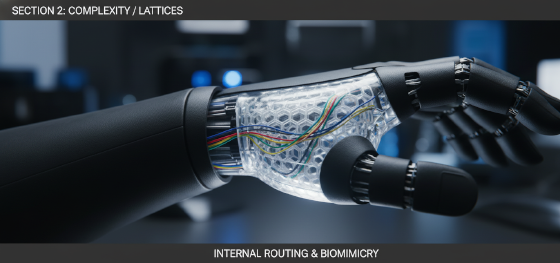
Bionic design for end-effectors and humanoid components often features internal geometries that are physically impossible to reach with a CNC tool. This is where 3D printing wins the CNC vs 3d printing for robot prototypes battle. Additive manufacturing processes like MJF (Multi Jet Fusion) and DMLS (Direct Metal Laser Sintering) allow engineers to "grow" parts with internal honeycomb structures and topology-optimized lattices. JUCHENG utilizes these techniques to create robotic gripper fingers that are 60% lighter than solid counterparts but maintain the same grip stiffness, directly improving the robot’s acceleration and reducing motor wear.
Internal routing for "nerves and veins" is a secondary additive superpower. Modern robots are packed with sensors, requiring dozens of data cables and pneumatic lines to pass through the arm. JUCHENG machines can print internal "veins" directly into the structure of an arm link, allowing cables to be shielded and routed through the most efficient path. This eliminates the need for external cable clips and "dress packs" that often snag on obstacles in a warehouse or farm. By consolidating the structure and the routing into a single 3D-printed component, we reduce the total part count of the prototype robot and simplify the final assembly.
Rapid iteration speed is the ultimate driver for 3D printing in the Alpha phase. If an engineering team needs to test five different gripper geometries by Friday, 3D printing is the only viable path. JUCHENG operates a fleet of high-velocity industrial printers in our Shenzhen hub, delivering complex nylon and metal components in as little as 24 to 48 hours. This allow for a "Design-Print-Test-Repeat" cycle that can happen twice in a single week, dramatically shortening the R&D timeline for startups and established OEMs alike.
Customization for unique sensors is another focus area. As LiDAR and multi-spectral camera manufacturers release new models, robot housings must be updated instantly. JUCHENG utilizes SLS (Selective Laser Sintering) to print bespoke sensor mounts that isolate vibration and provide a perfectly calibrated field of view. This "just-in-time" hardware development ensures that your prototype robot is always equipped with the latest autonomy stack, preventing the hardware from becoming the bottleneck for the software team’s progress in the fast-moving [2026] market.
Technical Data: Cost and Lead Time Break-even Analysis
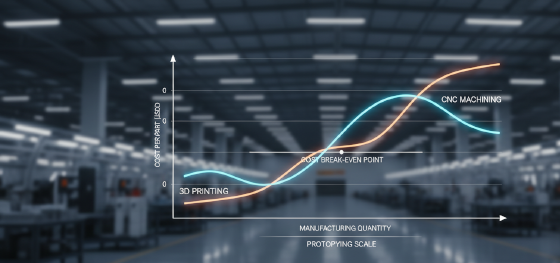
Economic optimization is as important as mechanical performance in robotics R&D. While a single 3D-printed part is cheaper than a single CNC part (due to zero NRE), as the quantity increases, the curves eventually cross. Jucheng Precision provides transparent DFM and cost modeling to help you maximize your R&D budget. The following table illustrates the typical break-even points for common CNC vs 3d printing for robot prototypes scenarios in the Shenzhen hub.
| Metric | 3D Printing (MJF) | CNC Machining | Decision Driver |
|---|---|---|---|
| Setup Cost (NRE) | Zero / Low | Moderate (Fixtures) | Quantity 1-5 favors 3DP |
| Material Range | Limited Polymers/Metals | Universal (Alu, Steel, PEEK) | Dynamic loads favor CNC |
| Surface Finish (Ra) | 3.2 - 6.4 (Rough) | 0.4 - 0.8 (Mirror) | Bearing seats favor CNC |
| Lead Time (10 units) | 2 - 3 Days | 5 - 7 Days | Time-to-market favors 3DP |
| Scaling Efficiency | Linear ($ remains high) | Exponential ($ drops) | Quantity >20 favors CNC |
Quantity >20 is often the crossover point for most mid-sized robot components. For a single prototype robot, 3D printing is almost always the winner for covers and non-structural pods. However, if your Beta trial requires a fleet of 50 machines, the per-unit cost of 3D printing remains high, while the cost of CNC machining drops significantly as tooling and setup time are amortized across the run. JUCHENG helps engineers identify this "sweet spot" during the initial quote phase, suggesting process shifts that can save 30% of the total hardware budget without sacrificing quality.
JUCHENG Hybrid Integration: The Best of Both Worlds
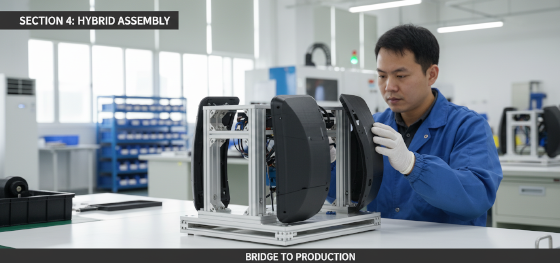
Dominating the [2026] robotics market requires a manufacturing partner that doesn't force you into a single technology. Jucheng Precision operates with a 24/7 manufacturing mindset in our Shenzhen precision manufacturing hub, delivering a hybrid integration that combines the best of CNC vs 3d printing for robot prototypes. We provide the "Skeleton" in CNC aluminum for structural rigidity and the "Skin" in 3D-printed MJF for aerodynamic form and sensor integration. This unified assembly arrives at your facility fully measured, tested, and ready for power-up.
Integrating your design with JUCHENG’s expertise ensures that your prototype robot survives the "First-Trial Fatigue" and moves into mass adoption. We offer comprehensive DFM reviews within 24 hours, identifying potential weight-saving opportunities or machining risks in your design before they become field failures. Whether you are building an autonomous drone for logistics or a heavy-duty robot for warehouse automation, Jucheng Precision provides the balanced hardware foundations that keep your innovation moving through the high-speed cycles and the years of hard labor.
Our facility is equipped with 150+ CNC machines and dedicated additive manufacturing cells, allowing us to manage the entire prototype lifecycle in one location. We manage the complexity of multi-material bonding and precision fitment so your engineering team can focus on the motion control and the AI. By combining Shenzhen's speed with industrial-grade material verification, JUCHENG remains the preferred partner for the world's most aggressive robotics challenges. Contact us today to start your next CNC vs 3d printing for robot prototypes project.
FAQ: Navigating the Process Choice for Robot Hardware
Is 3D-printed metal strong enough for robot joints?
DMLS stainless steel is very strong but lacks the surface hardness and dimensional precision of CNC. We recommend CNC for high-speed rotational interfaces.
Can JUCHENG secondary-machine 3D printed parts?
Yes. We frequently use 5-axis CNC to finish bearing bores and mounting flanges on 3D-printed "blanks" for micron-level precision.
Which process is better for vacuum-sealed robot covers?
Vacuum Casting or CNC. 3D printing often has microscopic porosity that makes hermetic sealing difficult without secondary coatings.
How do you ensure a 3D-printed prototype won't overheat?
We integrate CNC-machined aluminum "thermal pads" into the printed housing to conduct heat directly from the motors to the external air.
What is the typical lead time for a hybrid prototype build?
A complete assembly with both CNC and 3D printed parts is typically delivered in 7 to 10 business days.
Hardware indecision in the robotics sector is an absolute project killer. Partnering with Jucheng Precision ensures that your functional iterations are built with the strategic mix of CNC vs 3d printing for robot prototypes the industry demands. Reach out to our Shenzhen manufacturing hub today for a complete DFM review and build the high-fidelity foundation your autonomous fleet requires.

