


Procurement disasters often begin with a misunderstanding of manufacturing scalability. Hardware startups frequently burn through 40% of their seed capital simply because they utilized the wrong fabrication method for a twenty-unit pilot run. The marketing narrative surrounding additive manufacturing promises a "tool-less" revolution, implying that avoiding molds equals saving money. This is a dangerous financial half-truth. While 3D printing is indeed the undisputed king of the "quantity-one" prototype, its economic structure collapses the moment you attempt to scale. The debate regarding the cost of vacuum casting vs 3d printing is not about technology; it is about the mathematical "Breakeven Point." It is the precise moment where the high unit price of a laser-sintered part intersects with the amortized efficiency of a silicone mold. Failing to identify this crossover point transforms a routine prototyping order into a massive line-item variance that no CFO will approve. Jucheng Precision operates as your financial safeguard here, utilizing our dual-capability factory to route your order based on total project cost, not just technological novelty.

The Linear Trap: Why Printing Never Gets Cheaper
Amortization Mechanics: Diluting the Tooling Cost
The Crossover: Pinpointing the 10-Unit Switch
Hidden Variables: Post-Processing Labor Impact
The Linear Trap: Why Printing Never Gets Cheaper
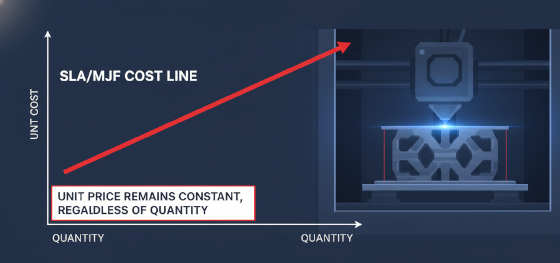
Additive manufacturing suffers from a distinct lack of "Economies of Scale." Consider the physics of an SLA or MJF machine: the laser must trace every single vector of every single layer. If printing one complex manifold takes four hours, printing ten of them takes forty hours. The machine time is linear. The resin consumption is linear. Consequently, the price per part remains stubbornly flat. A vendor might offer a trivial 5% discount for a batch order, but the fundamental cost drivers do not change. You are paying for "machine occupancy."
This "Linear Trap" is financially invisible at low volumes but becomes catastrophic at high volumes. If a high-resolution SLA part costs $150 to print, ordering thirty units results in a $4,500 invoice. There is no efficiency gained because the laser cannot move faster just because you ordered more. For a procurement manager, this represents a "fixed unit cost" scenario, which is the enemy of batch production. You are effectively paying a premium for a "setup-free" process that you no longer need. This is why 3D printing is often characterized as the most expensive possible way to manufacture the 100th part, even if it was the cheapest way to manufacture the 1st.
Amortization Mechanics: Diluting the Tooling Cost
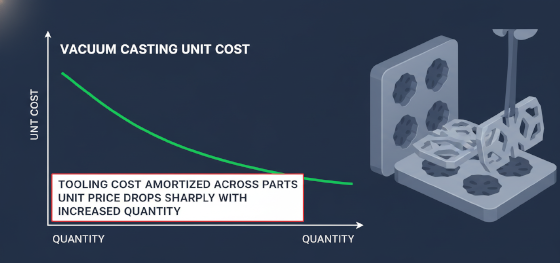
Vacuum casting introduces an upfront hurdle that magically lowers the finish line. To create the first part, we must build a master pattern and pour a silicone mold. Let's assume this "setup" costs $600. For a single unit, this is prohibitively expensive compared to the $150 print. However, the silicone mold is a multiplier. It can produce 20 to 25 copies before degrading. The cost of the liquid polyurethane resin and the labor to pour it is significantly lower than printing resin—perhaps only $40 per part.
Here is where the math of amortization takes over. If you order 20 parts, that initial $600 tooling cost is divided by 20, adding only $30 to each unit. Your total unit cost becomes $30 (tooling share) + $40 (part cost) = $70. Compare this to the flat $150 SLA print. You have effectively slashed your unit price by more than 50% simply by committing to a small batch. This curve only gets better as you maximize the mold life. By utilizing the mold to its full potential, you are diluting the setup cost into insignificance, transforming a "costly tooling process" into a high-efficiency production engine. This financial leverage is the primary reason smart hardware teams switch to casting the moment their demand exceeds single digits.
The Crossover: Pinpointing the 10-Unit Switch
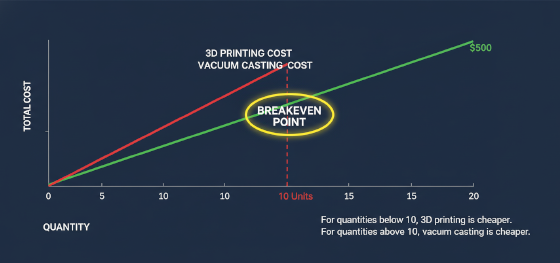
Identifying the exact moment to pivot from additive manufacturing to silicone molding requires simple algebra. Let us construct a real-world scenario using a standard handheld enclosure roughly the size of a smartphone. A high-quality SLA print might cost $150 per unit. A silicone mold setup costs $600, with a per-unit pour cost of $50.
If you order five units, printing costs $750 ($150 x 5). Casting costs $850 ($600 setup + $250 parts). Here, printing wins. The upfront tool cost hasn't been diluted enough. However, watch what happens at ten units. Printing costs surge to $1,500 ($150 x 10). Casting costs only $1,100 ($600 setup + $500 parts). You have just crossed the "Financial Breakeven Point." From unit eleven onwards, vacuum casting becomes exponentially cheaper. By the time you reach fifty units, printing would cost a staggering $7,500, while casting would only cost roughly $3,100 (assuming two molds). This represents a savings of nearly 60%. Continuing to print beyond ten units is effectively burning capital that could be used for other critical R&D tasks. Smart procurement managers map this crossover point before sending out the RFQ (Request for Quote).
Hidden Variables: Post-Processing Labor Impact

Quoted piece price rarely tells the whole story. Labor is the silent killer of prototyping budgets. 3D printed parts, particularly SLA and MJF, do not emerge from the machine ready for the boardroom. They are covered in support structures or loose powder. Achieving a glossy, consumer-grade finish on a printed part requires aggressive manual sanding, filling, and painting. If you order twenty printed casings, a technician must hand-sand twenty individual parts. That is twenty hours of skilled labor billed at shop rates, often doubling the effective cost of the part.
Vacuum casting eliminates this redundant labor through "Master Pattern Efficiency." We invest significant labor into finishing just one single master pattern. We sand it, polish it, and paint it to perfection. The silicone mold then captures that texture down to the micron. Every part pulled from that mold emerges with that identical high-quality finish already applied. There are no layer lines to sand. There are no support scars to fill. You are paying for the finishing labor once, but receiving the benefit twenty times. When you factor in the "Cost of Finishing," the value proposition of casting becomes even more dominant for cosmetic prototypes.
JUCHENG Strategy: Optimized BOM Routing
Financial stewardship is a core component of our engineering service. Jucheng Precision does not simply execute orders; we optimize your Bill of Materials (BOM). When you submit a project, our quoting engine analyzes the geometry and quantity to determine the most fiscally responsible production route. If you need three functional brackets, we route them to our MJF machines. If you need fifteen cosmetic housings, we immediately flag the order for vacuum casting to save you money.
We act as your manufacturing CFO. Our "Bridge to Production" methodology ensures you are never overpaying for a prototype simply because of technological inertia. We provide transparent cost-benefit breakdowns, showing you exactly where the break-even point lies for your specific design. Stop guessing with your budget. Leverage our integrated factory floor to ensure every dollar spent on prototyping delivers maximum physical value. Contact our team today for a comprehensive cost analysis of your next project.

