


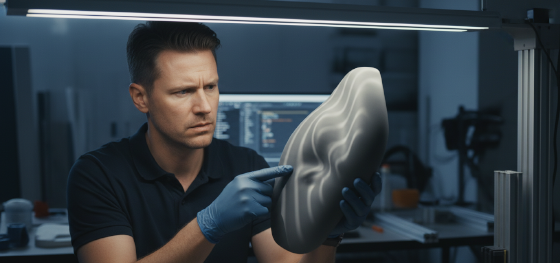
First impressions are optical, but final judgments are tactile. When a stakeholder picks up a physical prototype, their thumb instinctively slides across the surface to gauge quality. If they encounter the rough, rhythmic ridges of a layer-based fabrication, the illusion of a finished product instantly shatters. In the high-stakes arena of consumer electronics and medical device validation, surface fidelity is not merely a cosmetic preference; it is a functional requirement for evaluating ergonomics, seal integrity, and brand value. The engineering comparison of Surface Finish: Vacuum Casting vs 3D Printing is fundamentally a battle between "Digital Stepping" and "Analog Replication." While additive manufacturing has made massive strides in resolution, it remains bound by the physics of slicing a 3D model into 2D layers. Vacuum casting, conversely, operates on the logic of liquid conformity, allowing it to capture surface textures with atomic-level precision. This guide dissects the microscopic reality of roughness averages (Ra), the challenge of VDI texture mapping, and why liquid silicone remains the only viable path for cosmetically perfect prototypes.
The Layer Line Problem: Anatomy of a Staircase
Silicone Fidelity: The Liquid Mirror Effect
Industrial Textures: Decoding VDI and SPI Standards
The Sanding Tax: Hidden Labor in Additive Finishing
The Layer Line Problem: Anatomy of a Staircase
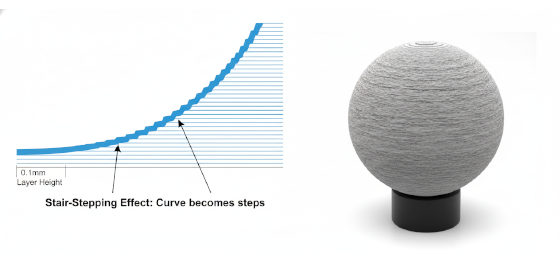
Geometry dictates the unavoidable roughness of additive manufacturing. Regardless of whether you utilize Fused Deposition Modeling (FDM), Stereolithography (SLA), or Multi Jet Fusion (MJF), the machine builds the part by stacking two-dimensional slices. This process introduces a phenomenon known as the "Stair-Stepping Effect." On a vertical wall, these layers stack neatly. However, on any curved surface or angled draft, the edge of each layer protrudes slightly, creating a microscopic staircase. Even with high-resolution SLA printing at 0.05mm layer heights, these steps remain visible under inspection lighting and palpable to the fingernail.
Quantitative analysis reveals the severity of this issue. A standard FDM print typically exhibits a Roughness Average (Ra) between 10µm and 20µm, which feels like medium-grit sandpaper. MJF and SLS nylon parts, while mechanically robust, possess a granular, porous surface with an Ra of roughly 5µm to 10µm, resembling unpolished stone or sugar cubes. While vapor smoothing can reduce this to 1-2µm, it often rounds off sharp edges and obliterates fine details. For an industrial designer attempting to simulate the Class-A surface of an injection-molded automotive dashboard (typically Ra < 0.1µm), raw 3D printing simply cannot provide the necessary specular reflection. The light scatters across the layer lines, resulting in a diffuse, "matte" appearance that screams "prototype" rather than "product."
Silicone Fidelity: The Liquid Mirror Effect
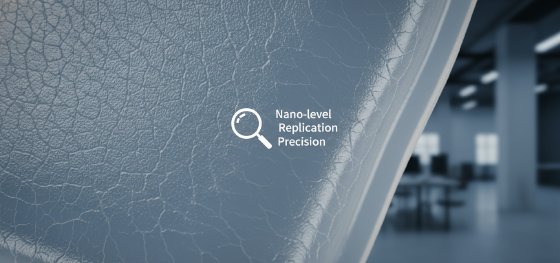
Vacuum casting operates in a different physical dimension. The RTV (Room Temperature Vulcanizing) silicone used to create the mold is a liquid with extremely low surface tension. When poured under a vacuum, it flows into every microscopic crevice of the master pattern. It does not "approximate" the surface with polygons or layers; it wets the surface completely. This allows the silicone to capture details as small as a human fingerprint. If the master pattern is polished to an optical mirror finish (SPI A2), the silicone mold will reflect that mirror perfectly. If the master has a specific leather grain, the silicone will replicate that grain.
This "Transfer Fidelity" is the superpower of polyurethane casting. Jucheng Precision leverages this by focusing all our manual labor on the single master pattern. We use CNC machining or high-resolution SLA to create the initial geometry, and then our master model makers spend hours hand-polishing that single unit to perfection. Once that master is flawless, the silicone mold acts as a cloning device. Every subsequent polyurethane part poured into that mold emerges with the exact same surface finish—down to the nanometer. There are no layer lines because the part was formed chemically as a single, monolithic liquid mass, not a stack of slices.
Industrial Textures: Decoding VDI and SPI Standards
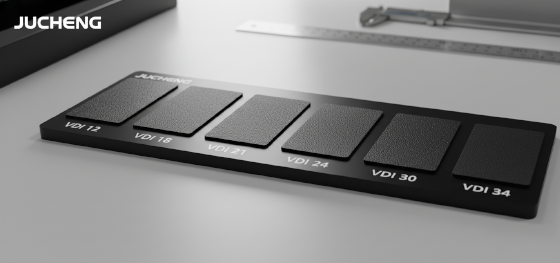
Communicating surface requirements requires a standardized language. In the injection molding world, we speak in VDI 3400 (Spark Erosion) or SPI (Society of the Plastics Industry) grades. 3D printing struggles immensely to replicate these specific standards directly from the CAD file. You cannot simply "print" a VDI 34 spark texture; the printer's resolution is too coarse, and the layer lines interfere with the grain pattern. The result is often a messy, digital noise that looks nothing like the intended finish.
Vacuum casting is the only rapid prototyping method capable of true VDI simulation. Jucheng Precision maintains a physical library of texture plates. When you specify a "VDI 24" finish for your handheld device grip, we apply that exact texture to the master pattern. We can achieve this by bead-blasting the master with specific media grit or by applying specialized mold-tech skins before pouring the silicone. The resulting cast parts will possess the authentic, uniform matte texture of a production part. We can even achieve "Dual-Gloss" finishes, where one area of the part is high-gloss (SPI A2) for a display window, and the adjacent area is textured (VDI 30) for fingerprint resistance. This level of cosmetic sophistication is impossible to achieve with a single 3D print run.
The Sanding Tax: Hidden Labor in Additive Finishing
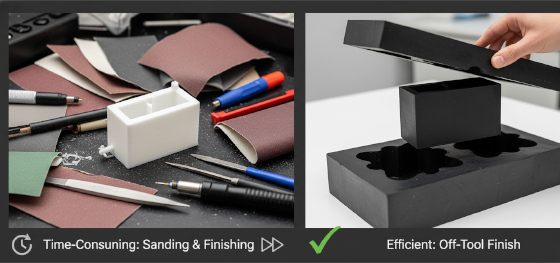
Achieving a showroom-quality finish on a 3D printed part is possible, but it comes with a steep "Labor Tax." Transforming a raw SLA print into a glossy visual model requires a technician to sand the surface progressively—starting with 400 grit, moving to 800, 1500, and finally 2000 grit—before applying primer and paint. This process strips material away, potentially altering critical dimensional tolerances. Worse, complex geometries with deep internal corners or recessed grilles are physically impossible to sand by hand. The layer lines in these hard-to-reach areas remain visible, permanently marking the part as a prototype.
Casting creates "Net Shape" surfaces. Because the surface finish is intrinsic to the mold, the part exits the tool 95% finished. There is no risk of over-sanding critical features because no sanding is required on the visible surfaces. The only post-processing involves removing the feed gate and a light flash trim. This efficiency allows Jucheng Precision to deliver ten, twenty, or fifty cosmetically identical units in less time than it would take to hand-finish five printed parts. If your project demands the visual authority of a final product—where light reflections are crisp, textures are uniform, and layer lines are non-existent—vacuum casting is the undisputed master of surface reality.

