


Engineering validation fails when the physical prototype lies to the test rig. Hardware development teams constantly debate between vacuum casting vs 3d printing when transitioning a concept from digital CAD space into physical reality. Choosing the incorrect methodology during this critical phase does not merely waste departmental budget; it pollutes the data of your drop tests, thermal cycles, and executive stakeholder reviews. Additive manufacturing revolutionized the immediate verification of complex geometries. Liquid urethane replication maintained its absolute dominance in functional, multi-unit batch simulation. Deciding which technological route to deploy depends entirely on the mechanical burden and cosmetic expectations placed upon the final component. Jucheng Precision operates extensive production facilities for both disciplines, effectively removing vendor bias from the equation. We engineer certainty into your product development cycle. This comprehensive breakdown strips away the marketing hype to expose the raw physical, chemical, and economic differences between building parts layer-by-layer versus pouring cross-linked polymers into flexible silicone cavities.
Core Physics: Additive Mechanics vs Formative Casting
Financial Breakeven: Calculating the 10-Unit Threshold
Surface Reality: Eradicating Layer Lines for Cosmetic Validation
Material Science: Thermoset Simulants vs Printed Polymers
Lead Time Dynamics: Time-to-First-Part vs Batch Delivery
JUCHENG Advantage: Unbiased Navigation in Prototyping
Core Physics: Additive Mechanics vs Formative Casting

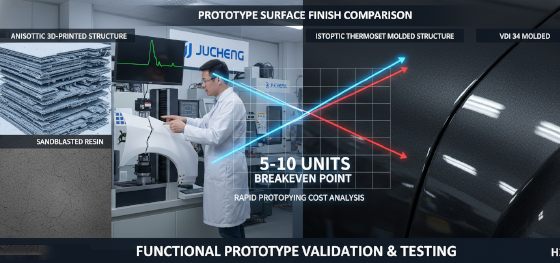
Structural integrity dictates whether a prototype survives the testing phase or shatters under applied load. Fused Deposition Modeling (FDM) and Stereolithography (SLA) rely fundamentally on stacking two-dimensional cross-sections upon one another. This inherent Z-axis weakness creates highly anisotropic parts. Stress directed perpendicularly against these layer lines frequently results in catastrophic delamination. Engineers attempting to validate living hinges or aggressive snap-fits with basic additive resins constantly encounter premature brittle failure. Printing introduces internal voids and weak adhesion points that do not represent the isotropic strength of a real molded product.
Formative manufacturing bypasses this directional vulnerability entirely. Polyurethane replication utilizes a highly precise CNC-machined master pattern to create a solid RTV silicone void. Specialized two-part resin is mixed and poured into this cavity under strict negative atmospheric pressure. The subsequent exothermic chemical reaction generates an isotropic thermoset matrix. Covalent bonds cross-link uniformly in all three dimensions, granting the cast component equivalent tensile and flexural strength regardless of the force vector. You are no longer holding a fragile stack of melted plastic lines; you possess a monolithic chemical structure that accurately mimics the mechanical certainty of final production hardware.
Financial Breakeven: Calculating the 10-Unit Threshold
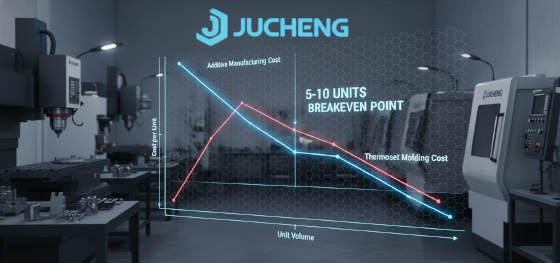
Capital allocation during aggressive R&D cycles demands ruthless mathematical efficiency. Single-unit fabrication heavily favors additive systems. Pushing a digital file directly to a high-end MJF or SLA machine incurs virtually zero physical setup cost, cementing its status as the undisputed financial champion of "quantity one." Scaling that quantity immediately alters the economic geometry. Printing fifty complex medical monitor housings consumes identical machine time and raw material cost per unit. This translates to a brutal, linear expense curve where volume provides absolutely no cost relief to the procurement department.
Silicone tooling introduces a highly advantageous amortized financial model. Creating the initial master pattern and pouring the mold requires an upfront capitalization of several hundred dollars. Once that mold finishes curing, the cost to pour each subsequent polyurethane unit plummets drastically. The mathematical breakeven point typically materializes between five and ten units, depending heavily on part volume and geometric complexity. Demanding thirty sets of a handheld scanner enclosure from an external print farm is outright financial malpractice compared to the amortized efficiency of a multi-cavity silicone tool. Smart hardware teams leverage this threshold to secure dozens of high-fidelity functional units for the price of a handful of printed equivalents.
Surface Reality: Eradicating Layer Lines for Cosmetic Validation
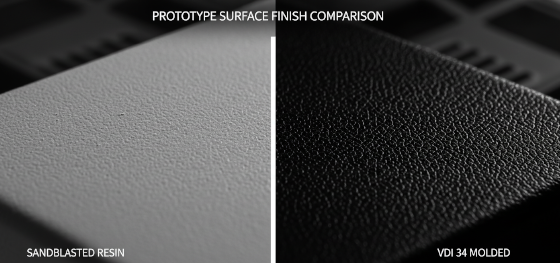
Tactile feedback dictates executive and investor approval during critical product beta phases. Presenting a heavily striated, step-lined additive prototype immediately signals a crude "work in progress" mentality. Post-processing printed parts to achieve a retail-ready mirror finish requires intensive, manual sanding procedures which inevitably destroy tight dimensional tolerances. FDM systems struggle immensely to achieve anything remotely resembling injection-molded reality. SLA provides superior underlying smoothness but frequently suffers from extensive support-structure scarring that requires aggressive surface remediation.
Polyurethane replication captures cosmetic reality with microscopic, uncompromising fidelity. Because the liquid silicone matrix flows deeply into every microscopic crevice of the CNC-machined master pattern, the resulting tool inherits its exact surface texture. We can apply aggressive VDI electrical discharge grains, intricate Mold-Tech automotive finishes, or optically clear high-gloss polishes directly to the master. Every subsequent part cast from that tool emerges with that identical, flawless texture permanently baked into its surface architecture. Automotive internal light guides, premium consumer electronics, and surgical device handles demand this exact level of aesthetic perfection to secure focus-group confidence.
Material Science: Thermoset Simulants vs Printed Polymers
Chemical mimicry dictates the validity of rigorous thermal and mechanical audits. Relying on standard photo-curable resins for functional drop-testing frequently leads to false negative data. Traditional SLA materials suffer from aggressive UV degradation, rendering them extremely brittle mere days after leaving the post-curing chamber. While industrial additive solutions like MJF utilize robust nylon powders, the resulting components remain inherently porous and restricted to a stark grey or black aesthetic, making them unsuitable for devices requiring IP68 water resistance or optical clarity. Hardware engineers attempting to validate a flexible TPE overmold or a transparent polycarbonate light guide find themselves severely bottlenecked by the chemical limitations of the extruder nozzle or the laser bed.
Polyurethane replication completely shattered this material barrier. Operating within our climate-controlled casting laboratory, technicians manipulate specialized thermoset systems from industry leaders like Hei-Cast and Axson to execute perfect "Molecular Mimicry." Instead of compromising on a generic "tough plastic," we pour engineered simulants that aggressively replicate the exact Shore hardness, flexural modulus, and UL94 flame-retardant ratings of your final injection-molded bill of materials. Need a crystal-clear medical manifold with 90% light transmission? We degas specialized clear urethanes under deep vacuum to eradicate light-refracting micro-bubbles. Require a rigid internal chassis bonded to a soft-touch ergonomic grip? We execute flawless two-shot overmolding directly inside the silicone tool, generating a monolithic chemical bond that printed adhesives simply cannot duplicate.
Lead Time Dynamics: Time-to-First-Part vs Batch Delivery
Clock speed on the manufacturing floor operates under two entirely different metrics depending on the chosen technology. Pushing a highly complex digital geometry directly into a powder bed fusion system dominates the "time-to-first-part" race. If your engineering team requires a single physical manifestation of a CAD file within 48 hours to verify a spatial interference issue, bypassing all tooling requirements via additive methods is the absolute correct strategic maneuver. However, attempting to scale that immediate gratification into a beta-testing run of forty units exposes the inherent sluggishness of sequential layer-building.
Tooling introduces a front-loaded delay that pays massive dividends during batch execution. Machining the flawless master pattern on a 5-axis Haas CNC and properly degassing the RTV silicone requires a mandatory gestation period of three to five days. Executives often view this initial delay as a negative metric until the mold becomes active. Once the silicone cavity cures, the math violently reverses. A single tool can yield four to five production-grade polyurethane enclosures every single day. By day eight, the casting process overtakes the print farm, delivering dozens of cosmetically perfect, structurally isotropic units while the additive machines are still struggling through their lengthy, high-risk vertical builds.
JUCHENG Advantage: Unbiased Navigation in Prototyping
Hardware innovators require agnostic manufacturing intelligence rather than heavy-handed vendor bias. Many rapid prototyping bureaus aggressively push either printing or casting simply because their facility only houses one type of equipment. This severely compromises the integrity of your engineering validation. Jucheng Precision entirely eliminates this conflict of interest by operating a massive, fully integrated production campus. We deploy an arsenal of over 150 elite CNC machining centers, a comprehensive suite of industrial additive technologies covering 20 distinct material profiles, and dedicated low-pressure casting cleanrooms stocked with 11 distinct performance urethanes.
Consulting with our veteran manufacturing engineers guarantees that your project geometry dictates the process, never the other way around. We actively intercept your STEP files to perform a rigorous, complimentary DFM audit. If your requirement is a solitary, ultra-complex nylon internal bracket, we immediately route it to our MJF bay. When your clinical trial demands fifty biocompatible, water-tight housings possessing injection-molded aesthetics, we initiate the silicone tooling protocol. This strategic versatility forms the core of our "Bridge to Production" methodology. We protect your R&D budget, ensure your physical test data is undeniably accurate, and seamlessly transition your successful prototype into low-volume mass production without skipping a single heartbeat.

