


Every time a human hand touches a part to re-clamp it, precision dies a little. In the traditional milling room, complex parts are treated as a series of disconnected operations—side A, flip, side B, fixture, side C. Each move introduces a fresh opportunity for misalignment, vibration, and "tolerance stack-up." Design for 5-Axis Machining is the strategic exit from this manual gauntlet. It isn't just about making "curvy" parts; it is about the aggressive elimination of setups. When you can tilt and rotate the workpiece while the spindle is live, the entire geometry of your cnc machining design guidelines shifts from a struggle for access to a study in fluid motion.
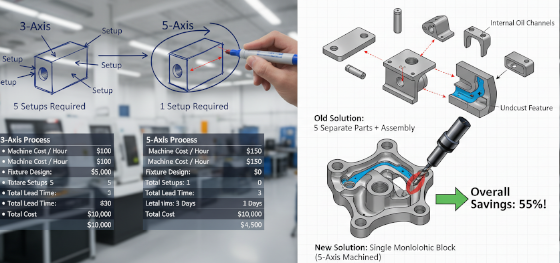
JUCHENG’s floor operates twenty-five high-end 5-axis centers not because they are flashy, but because they are the most reliable quality-control tools we own. We’ve seen aerospace engineers struggle with the "3-axis curse"—designing complex manifolds that require ten different fixtures, only to have the final bore miss its mark by fifty microns. By embracing a 5-axis mindset, you stop designing for the limitations of the vice and start designing for the capabilities of the axis. This guide isn't a sales pitch; it is a technical manifesto on how to leverage the 5th axis to kill assembly costs, shorten lead times, and achieve a level of feature-to-feature accuracy that fixed-table machines can never replicate.
The real profit in multi-axis manufacturing is found in the consolidation of complexity. If your design requires multiple parts to be bolted together just because a 3-axis tool couldn't "see" around a corner, you are carrying unnecessary weight and risk. Let’s break down the actual physics of setup liquidation and see how the 5th axis redefines the ROI of your CAD file.
Setup Liquidation: The War Against Cumulative Error
Part Consolidation: Converting Assemblies to Monolithic Blocks
Geometric Gymnastics: Designing Beyond the Line-of-Sight
Economic Re-Calculation: The Myth of the Multi-Axis Premium
Tactical Implementation: How JUCHENG Executes the 5th Axis
Setup Liquidation: The War Against Cumulative Error
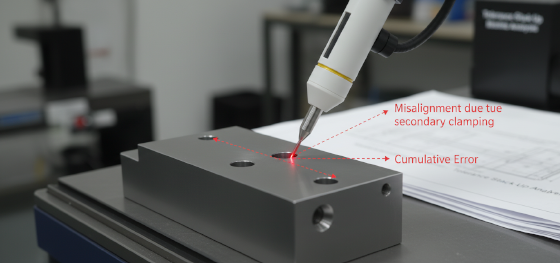
Think of every setup as a technical gamble. When a part moves from a mill to a lathe, or even from one vice to another, you are trusting the operator's ability to locate a datum with a probe or a dial indicator. But there is always a margin of error—five microns here, ten microns there. By the time you reach the fourth setup, those errors have stacked up. This is the primary reason why complex 3-axis parts often feel "off" during assembly. Design for 5-Axis Machining solves this by keeping the part stationary relative to its coordinate system.
In a 5-axis "3+2" or continuous setup, we locate the part's zero-point once. From that single mathematical origin, the machine can reach five sides of the block and any number of angled holes or compound faces. This "One-Setup" integrity is non-negotiable for medical surgical blocks and aerospace sensor housings where the relationship between a front-side bore and a back-side port must be perfect. When we review cnc machining design guidelines with our clients, we look for ways to eliminate "flip" operations. If your design allows for a clear clamping zone on the bottom, a 5-axis machine can carve everything else in one go. You aren't just getting a part; you are getting a component that is geometrically superior because it never had the chance to be misaligned.
Part Consolidation: Converting Assemblies to Monolithic Blocks
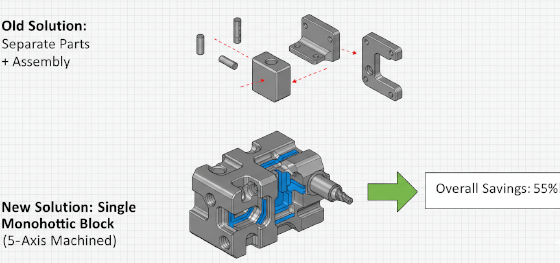
One of the most powerful moves an engineer can make is to stop bolting things together. Traditional design logic suggests that if you can't reach a feature with a vertical tool, you should make that feature a separate part and bolt it on later. This creates "Part Count Fatigue"—more drawings, more inventory, and more labor in assembly. 5-axis technology makes this logic obsolete. If you can dream of the shape, we can likely reach it. We encourage our clients to think "monolithic."
Imagine a structural bracket that was originally five separate plates welded or bolted together. Through Design for 5-Axis Machining, JUCHENG can machine that entire assembly from a single solid block of 7075 aluminum. The benefits are immediate: the part is lighter (no fasteners), stronger (no weld joints or seams), and perfectly aligned. In the cnc machining process, this "assembly-to-part" conversion is the ultimate efficiency hack. While the individual 5-axis part might cost more than a single 3-axis plate, the *total cost* of the assembly—including procurement, QC for five parts, and labor for assembly—drops by 40% or more. We help you identify these consolidation targets, turning a complex logistics headache into a single high-performance component.
Geometric Gymnastics: Designing Beyond the Line-of-Sight
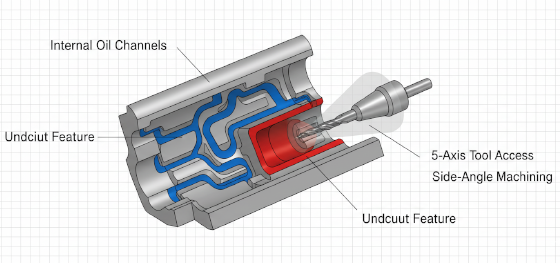
3-axis machines are slaves to "Line-of-Sight." If a tool can't see it from the top, it can't cut it. This results in parts that look very "boxy" and unoptimized. 5-axis machining is the domain of "Geometric Gymnastics." It allows the tool to "snake" into internal cavities, cut undercuts, and follow organic, multi-curved surfaces like impellers or anatomical bone plates. For the designer, this means you can finally optimize for weight and fluid dynamics without worrying about tool access.
Successful Design for 5-Axis Machining exploits the tool's ability to maintain a constant contact angle. On a 3-axis machine, a ball-nose mill finishing a steep curve is often cutting on its very tip—the slowest and weakest part of the tool. On a 5-axis machine, we tilt the part so the tool cuts on its "sweet spot" (the side of the radius). This drastically improves the surface finish (Ra) and extends tool life. We also use this freedom to create "self-draining" features or angled ports that improve the performance of hydraulic manifolds. Don't restrict your engineering to 90-degree intersections. Use the extra axes to design the most efficient load-paths and fluid-paths your physics requires. We have the trunnions and the spindles to follow you into any geometric corner.
Economic Re-Calculation: The Myth of the Multi-Axis Premium
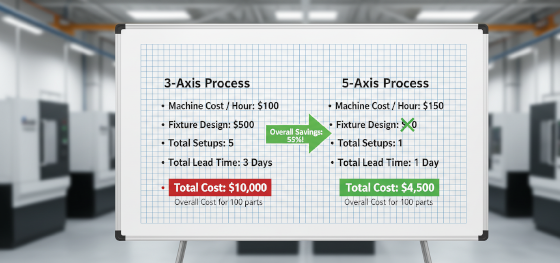
Let’s talk about the invoice. There is a persistent myth that 5-axis machining is always a "premium" service only reserved for billionaire aerospace projects. This is an outdated view. While the hourly rate for a Mazak 5-axis center is higher than a standard 3-axis mill, the *effective cost* is often lower. Why? Because time on a machine is only part of the bill. You must also account for the labor to design five different fixtures, the time to set up five different operations, and the cost of the scrap generated every time a part is misaligned during a flip.
In a Design for 5-Axis Machining workflow, we often see a "Break-Even" point that occurs much earlier than expected. For a part with three or more setup faces, 5-axis is almost always the cheaper path. Furthermore, the use of shorter, more rigid tools allowed by 5-axis tilting means we can run faster feed-rates, removing material in half the time. At Jucheng Precision, we perform a "Multi-Path ROI" for our clients. We show you the cost of building it the "old way" (multiple setups) versus the "new way" (single setup 5-axis). Nine times out of ten, the 5-axis path wins on both price and lead time. By investing in design complexity early, you are actually simplifying your manufacturing logistics and protecting your project budget.
Tactical Implementation: How JUCHENG Executes the 5th Axis
Execution is where the engineering dream meets the metal chips. At Jucheng Precision, we operate as a "Process-First" shop. Our fleet of 25+ 5-axis machines is managed by a team of master-programmers who live and breathe simultaneous motion. We don't just follow a CAD file; we look for "Setup Squeezing"—ways to orientation-lock your part to ensure 100% of the features are reached in one clamping operation.
Our quality protocol includes the use of "In-Process Probing." Our machines use laser and touch-probes to verify the part’s position after every rotation, ensuring that the 5-axis kinematics are perfectly synchronized with your digital model. This level of technical oversight is essential for the CNC machining industry applications found in medical and defense sectors. When you receive a shipment from JUCHENG, you aren't just receiving a part; you are receiving the result of an optimized, high-fidelity manufacturing strategy. We bridge the gap between design theory and real-world assembly. Whether you are building an innovative heart pump or a mission-critical satellite mount, our 5-axis expertise ensures your vision is delivered with absolute precision. Contact Jucheng Precision today for a comprehensive DFM review and let our multi-axis protocols clarify and elevate your next engineering challenge.

