


A thread is essentially a wedge wrapped around a cylinder. It is the most common mechanical interface in modern hardware, yet it remains the single most misunderstood feature on the CNC machine bed. Every year, thousands of expensive components reach the final stage of cnc machining design guidelines implementation, only to be scrapped because a tap snapped inside a blind hole. This isn't just a shop-floor accident; it is usually a design failure born from a lack of respect for tool dynamics. A CNC Threading Design Guide is not about choosing a bolt size—it is about managing torque, chip evacuation, and material elasticity.
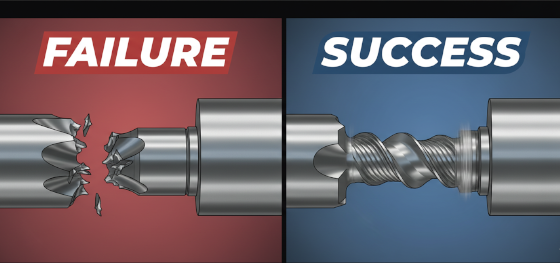
JUCHENG’s engineering team has performed thousands of DFM audits where "over-threaded" parts created unnecessary manufacturing risks. We’ve seen designs specifying M3 threads to a depth of 20mm in Grade 5 Titanium—a geometric request that defies the physical limits of carbide tooling. If your design treats a tapped hole as a simple 3D cylinder with a texture, you are inviting production delays. This guide moves past the standard tables to explore the actual mechanics of thread engagement and how JUCHENG utilizes advanced milling and forming techniques to ensure your assemblies are robust and your project stays on budget.
The real cost of a thread is not the time it takes to cut it; it is the risk it brings to the part. When you design a thread, you are designing a failure point for the tool. Let us break down the physical laws of thread depth, hole preparation, and tool selection that define a manufacturing-ready CAD model.
The Depth Trap: Physics of the 3x Diameter Rule
Internal vs. External: Managing Class Fits and Tolerances
The Tap Drill Equation: Percentage of Thread Logic
Thread Milling: The Strategic Shield for High-Value Alloys
JUCHENG’s Reliability Standard: Process Planning for Threads
The Depth Trap: Physics of the 3x Diameter Rule
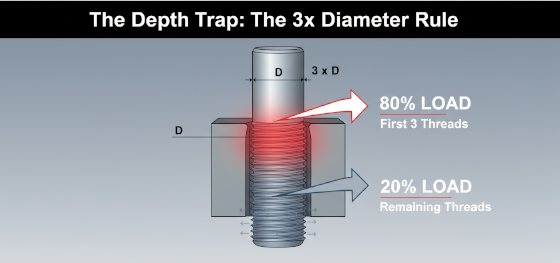
One of the most dangerous myths in mechanical design is that a longer thread is a stronger thread. Designers often think that if a 10mm deep thread is good, a 20mm deep thread must be twice as secure. Physics disagrees. In a standard fastener assembly, the first three threads carry approximately 75% to 80% of the entire load. By the time you reach the sixth thread, the added strength becomes negligible. This is the foundation of the "3x Diameter Rule" found in every professional CNC Threading Design Guide. For a 5mm bolt (M5), a thread deeper than 15mm adds zero functional value while exponentially increasing the risk of tool failure.
The deeper a tap goes into a hole, the more friction it encounters. In materials like Stainless Steel or Titanium, this friction generates intense heat and makes chip evacuation nearly impossible. The spiral flutes of a tap have limited space; once that space is packed with compressed metal chips, the tap will seize and snap. JUCHENG’s rule of thumb is simple: aim for a thread depth of 1.5x to 2x the diameter for most applications. If you absolutely must have a deep thread, we suggest using a "Relieved Shank" design or switching to thread milling. By curbing the urge to over-design the depth, you allow us to maintain a faster, safer, and much more cost-effective production cycle. We don't want you to pay for deep holes that offer no mechanical advantage.
Internal vs. External: Managing Class Fits and Tolerances
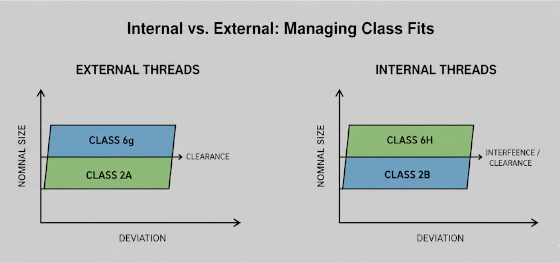
Threading is not a binary state—it is a spectrum of clearance and interference. In cnc machining design guidelines, we refer to this as "Class of Fit." For internal threads (tapped holes), the standard is typically 6H or 2B. For external threads (bolts and shafts), it is 6g or 2A. These designations define the specific gap between the screw and the hole. If you design a part that will later be powder-coated or anodized, you must account for "Coating Growth." A standard anodize layer will add thickness to the tooth of the thread, making a "perfect" fit impossible to assemble.
At Jucheng Precision, we manage this through proactive tool-path offsets. If we know your aluminum part is destined for a heavy Type III Hardcoat, we will machine the internal threads to a 6G (over-sized) class. This allows the finish to grow into the dimensions required for a standard bolt. External threads on long shafts present another challenge: runout. If the thread is not perfectly concentric with the shaft's axis, the fastener will bind. We utilize single-point turning on our CNC lathes to ensure that external threads are cut in the same setup as the primary diameters. This technical alignment is the only way to guarantee a smooth, hand-tight fit in complex mechanical assemblies. We guide our clients through these tolerance choices to ensure that the final product doesn't require a tap-and-die "cleanup" after it leaves our factory.
The Tap Drill Equation: Percentage of Thread Logic
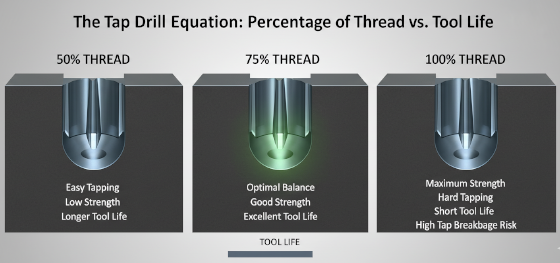
The strength of a thread is not determined by its sharpness, but by the "thread engagement percentage." Most engineers assume that a thread should be 100% full—meaning the internal and external teeth are perfectly interlocked. In reality, a 100% thread is a manufacturing disaster. It requires the tool to remove a massive amount of material from a tight space, leading to extreme torque and instant tool breakage. The industry standard we follow at Jucheng Precision is the "75% Rule." A thread that is 75% full provides over 95% of the strength of a 100% thread but requires only 40% of the cutting force.
This CNC Threading Design Guide encourages the use of slightly larger pre-drill holes (tap drills). For an M6x1 thread, a standard 5.0mm drill provides roughly 77% engagement. In tough materials like Inconel, we might suggest a 5.1mm drill to reach a 65% engagement. This subtle shift reduces the load on the tap by half, significantly lowering the risk of part rejection. We provide our clients with optimized "Tap Drill Charts" during the DFM phase, ensuring that the hole you specify in your CAD matches the physical torque limits of the chosen material. By balancing engagement with manufacturability, JUCHENG delivers threads that are structurally invincible without the unnecessary risk of brittle tool failure.
Thread Milling: The Strategic Shield for High-Value Alloys
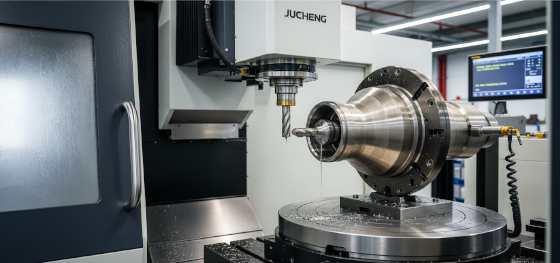
Tapping is a "one-and-done" process—fast, but binary. If the tap breaks, the part is often lost. For high-value aerospace components or medical manifolds made from PEEK, Jucheng Precision shifts the strategy to thread milling. A thread mill is a rotating tool that spirals its way down a hole to carve the thread profile. Because the tool is smaller than the hole diameter, it has massive advantages in chip evacuation and safety. If a thread mill breaks, it doesn't get stuck in the hole like a tap; it can simply be removed, a new tool inserted, and the operation resumed.
Thread milling also allows for total geometric freedom. We can use a single milling tool to create internal and external threads of any diameter, as long as they share the same pitch. It is the definitive solution for large-diameter holes where a standard tap would be physically too large to drive. More importantly, it allows us to control the thread fit down to the micron. If we find that a thread is a bit too tight during our in-process QC, we can simply adjust the tool offset and take a second "clean-up" pass. This level of iterative control is what allows JUCHENG to deliver perfect threads in materials that other shops find "un-tappable." We prioritize process security over raw speed because we know that for your most critical parts, a 100% yield rate is the only metric that matters.
JUCHENG’s Reliability Standard: Process Planning for Threads

At Jucheng Precision, we don't just "push buttons" on a machine. Threading is treated as an engineered sub-system of the cnc machining process. Our reliability standard starts with tool selection—we only use premium cobalt-infused or vanadium-carbide taps designed for specific material groups. We don't use "general purpose" tools on your specialized parts. We also utilize high-pressure through-spindle cooling to physically blast chips out of blind holes, ensuring the tool never re-cuts waste material.
Our quality control department utilizes a "double-verification" method for all threaded features. We use physical Go/No-Go gauges for functional validation, and for high-precision components, we use optical comparators to verify the actual tooth profile and root radius. This ensures that your parts won't just "screw together," but will withstand the structural fatigue and vibration of the real world. Whether you are building an innovative heart pump or a mission-critical satellite mount, our expertise in thread engineering clarifies your design vision. We bridge the gap between a digital helix and a mechanical fit that lasts a lifetime. Contact Jucheng Precision today for a technical DFM review and see how our threading protocols can stabilize and elevate your next precision project.

