


Sharp internal corners are the ghosts that haunt precision engineering. In the sterile, perfect world of CAD modeling, a 90-degree internal angle is just two intersecting lines. But on the floor of a high-speed machine shop, that same corner is a physical impossibility. Every subtractive tool in a CNC arsenal—from a massive face mill to a microscopic end mill—is round. It is a cylinder spinning at thousands of revolutions per minute. This geometric fundamental is the primary reason why CNC Corner Radius Design is the most critical chapter in any set of cnc machining design guidelines. Ignoring the roundness of the tool doesn't just complicate manufacturing; it drives up costs and invites structural failure.
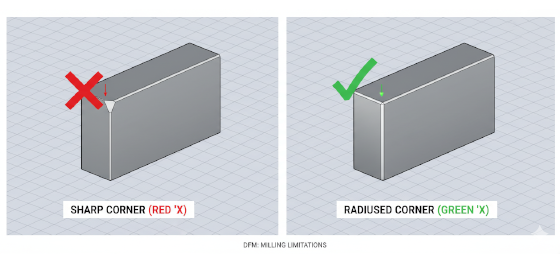
At Jucheng Precision, we see thousands of designs where the "aesthetic of the square" creates unnecessary manufacturing friction. When a designer insists on a sharp corner inside a pocket, they are inadvertently asking for slower production, more expensive specialized tooling, or secondary EDM processes that inflate the budget by 300%. Our goal as your manufacturing partner is to align your design intent with the physical reality of the spindle. This guide breaks down the physics of internal fillets, the economic logic of radius sizing, and the clever workarounds like dog-bones that allow you to fit square components into rounded spaces without breaking the bank.
Efficiency in CNC production is measured by the diameter of the tool you can use. A larger radius allows for a larger, more rigid tool, which translates to faster material removal and superior surface quality. Let us examine the technical pillars of corner design that ensure your components are as profitable as they are precise.
Physics of Roundness: Why Square Holes Don't Exist
Cost-to-Radius Correlation: Sizing for Efficiency
Deep Pocket Dynamics: Managing Tool Length and Vibration
Designing Functional Squareness: Undercuts and Reliefs
Collaborative DFM: Catching Corner Errors Early
Physics of Roundness: Why Square Holes Don't Exist
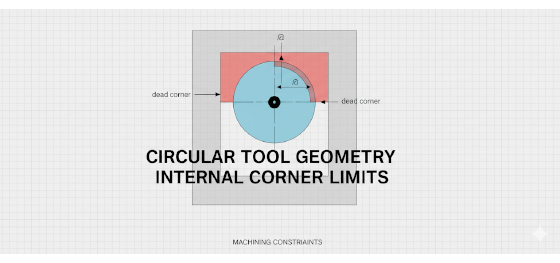
To master CNC Corner Radius Design, you must visualize the tool-path as a dance between a rotating cylinder and a solid block. A milling cutter is essentially a spinning rod with teeth. As it travels along a contour, it carves out a path that mirrors its own diameter. When that tool reaches an internal corner, it can only get as close to the corner as its own radius allows. If you have a 10mm cutter, the sharpest corner it can physically create is a 5mm radius. The law of the mill is absolute: a round tool cannot carve a square corner.
Inexperienced designers often place sharp internal 90-degree corners in their CAD files because they want a specific part to "seat" perfectly inside another. However, attempting to achieve this through standard milling requires incredibly small tools and multiple setups. Even then, the tool will still leave a minute radius. The only way to achieve a truly sharp 90-degree internal corner in metal is through EDM Electrical Discharge Machining or broaching, both of which add significant time and expense to the project. In the cnc machining design guidelines used at Jucheng Precision, we advocate for "Fillet Optimization." By designing your internal corners with a radius slightly larger than the tool being used (e.g., specifying a 3.2mm radius for a 6mm tool), you prevent the tool from "burying" itself in the corner, which reduces heat and prevents the chatter that leads to surface defects.
Cost-to-Radius Correlation: Sizing for Efficiency
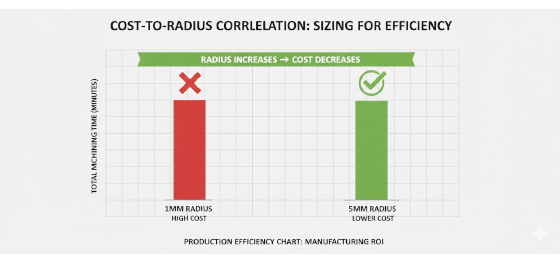
There is a direct, often exponential relationship between the size of your corner radii and the final price on your invoice. This is the "Economy of the Fillet." Small radii require small-diameter cutting tools. Small tools have less mass, which means they are less rigid and more prone to snapping under pressure. To prevent breakage, the machinist must reduce the spindle speed and the feed rate, resulting in significantly longer cycle times. A pocket with a 1mm corner radius might take four times longer to machine than the same pocket with a 5mm radius.
At Jucheng Precision, our DFM team identifies these cost-drivers during the first review. We suggest the "Plus-Ten-Percent" rule: if your assembly allows it, make the corner radius 110% of the radius of a standard tool size. For example, if we intend to use a 10mm end mill (5mm radius), designing a 5.5mm internal corner radius allows the tool to sweep through the corner without coming to a complete stop or engaging 100% of its surface area. This reduces the mechanical load on the spindle and allows us to maintain a constant feed rate. By slightly relaxing your CNC Corner Radius Design, you enable JUCHENG to use more aggressive material removal strategies, passing those time savings directly back to your project’s budget. Remember, in CNC manufacturing, "sharp" is expensive, and "round" is efficient.
Deep Pocket Dynamics: Managing Tool Length and Vibration
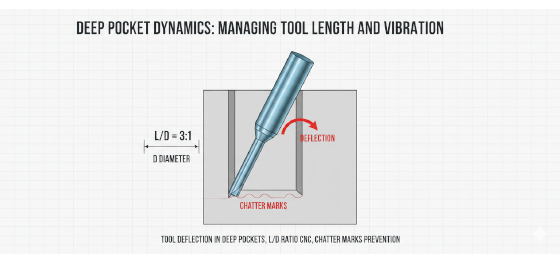
The challenge of corner radii becomes significantly more complex as the depth of the pocket increases. In cnc machining design guidelines, we refer to this as the "L/D Ratio"—the ratio of tool length to its diameter. If you design a pocket that is 50mm deep with 2mm corner radii, the machinist must use a 4mm tool that is long enough to reach the bottom. A tool that is 12 times longer than its diameter is like a piece of wet spaghetti; it will vibrate, deflect, and likely snap before it finishes the cut.
The rule of thumb we follow at Jucheng Precision is the "1/3 Rule": the internal corner radius should be at least one-third of the depth of the pocket. If your pocket is 30mm deep, your corner radii should ideally be 10mm or larger. This allows us to use a rigid, large-diameter tool that can reach the floor of the cavity without the vibration that ruins surface finishes. If a design absolutely mandates a small radius in a deep cavity, we are forced to use "staged machining," utilizing progressively smaller tools to nibble away at the corners. This adds multiple tool changes and hours of extra machine time. By aligning your CNC Corner Radius Design with the depth of your features, you ensure that JUCHENG can deliver a part that is structurally sound and aesthetically clean, free from the "chatter scars" that occur when tools are pushed beyond their physical limits.
Designing Functional Squareness: Undercuts and Reliefs
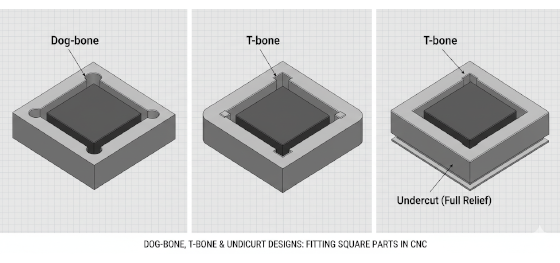
If your assembly requires a perfectly square object—like a PCB or a battery—to fit flush into a machined pocket, you might think you are stuck with expensive sharp corners. This is where "Relief Design" provides an engineering workaround. Instead of trying to cut a square corner, you can cut "past" the corner. The most common solution is the "Dog-Bone" or "T-Bone" relief. In this design, the CNC tool drills or mills a small circular area at each corner that extends beyond the 90-degree intersection.
This creates a clearance space where the sharp corner of the mating part can sit without interference. It is a brilliant way to achieve functional squareness while still using large, fast-cutting tools. Another option is the "Corner Undercut," where a tool enters from the side or bottom to relieve the corner. At Jucheng Precision, we help our clients implement these features during the DFM phase. We analyze the fitment requirements and suggest the least invasive relief pattern that satisfies your assembly logic. By embracing the circular nature of CNC Corner Radius Design and utilizing these reliefs, you can maintain the "square" function of your assembly while exploiting the "round" efficiency of the CNC machine. It is the ultimate "cheat code" for cost-effective precision manufacturing.
Collaborative DFM: Catching Corner Errors Early
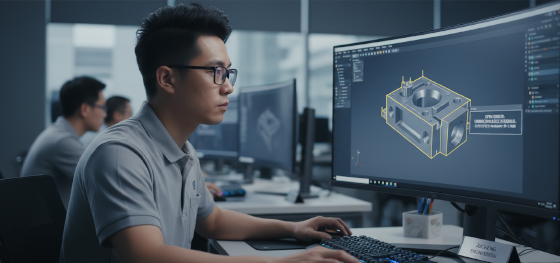
The final hallmark of a world-class manufacturing partner is the ability to provide feedback before the first chip is cut. At Jucheng Precision, we don't just quote what is on the print—we audit it for survival. Our engineering team utilizes advanced software to perform a full "Radius Sweep" of your CAD model. We flag any internal corner that is too small for the pocket depth or that will require non-standard, fragile tooling. We treat cnc machining design guidelines as a collaborative conversation.
By working together during the design phase, we can often suggest radius modifications that look nearly identical to your original vision but can be machined 50% faster. We provide our clients with detailed DFM reports that highlight these opportunities for cost reduction. Whether you are building a prototype for a high-end consumer device or a production run of heavy-duty industrial manifolds, our expertise in CNC Corner Radius Design ensures your components are delivered with absolute integrity and optimized pricing. We don't just follow the lines; we understand the physics behind them. Contact Jucheng Precision today for a free technical review and see how our design-for-manufacturing protocols can clarify and elevate your next precision project.

