


Thin is beautiful until it becomes a vibration nightmare. In the digital vacuum of CAD software, a wall thickness of 0.2mm looks elegant and weight-efficient. However, the moment that design meets the 12,000 RPM spindle of a 5-axis mill, the laws of physics take over. The metal is no longer a static solid; it behaves like a vibrating reed, deflecting away from the tool and absorbing heat that it cannot dissipate. This is the primary hurdle in modern cnc machining design guidelines. Achieving lightness without sacrificing manufacturability is the hallmark of a world-class engineer.

At Jucheng Precision, we have reviewed over 10,000 unique designs, and wall thickness errors remain the most frequent reason for project delays and cost overruns. A wall that is too thin leads to "chatter"—microscopic vibrations that ruin surface finishes—and "spring-back," where the part physically moves during the cut and ends up out of tolerance. This CNC Wall Thickness Guide is built on raw floor data, designed to help you push the limits of your materials while ensuring your parts can actually be built. Whether you are working with aerospace-grade aluminum or high-purity medical plastics, understanding these thresholds is essential for turning a brilliant concept into a functional physical reality.
Successful manufacturing is the art of compromise between structural ambition and mechanical stability. You cannot ignore the tool pressure, and you certainly cannot ignore the material's internal stress. Let us examine the technical pillars of wall design that ensure your components survive the machine and thrive in the field.
The Physics of Failure: Why Wall Thickness Matters
Metal Thresholds: Navigating Aluminum to Titanium
Plastic Sensitivity: Rigid vs. Flexible Polymers
Geometric Consistency: The Uniformity Rule
JUCHENG’s Technical Approach: CAM and Pressure Control
The Physics of Failure: Why Wall Thickness Matters
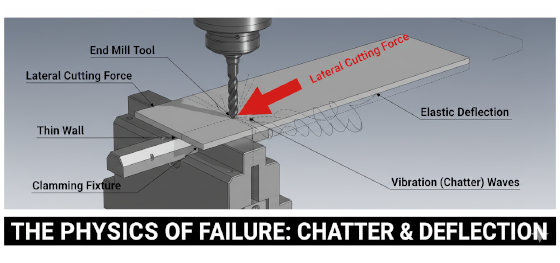
Every time a CNC tool engages a workpiece, it exerts a specific amount of force. In a solid block, this force is easily absorbed by the mass of the material. But as you thin the walls, that mass disappears, leaving the material vulnerable to "deflection." Deflection is the physical act of the material bending away from the cutting edge. Imagine trying to cut a thin sheet of paper held only at one end—the paper simply moves with the blade rather than being sliced. This is exactly what happens at the micron level during cnc machining design guidelines implementation.
When a wall deflects, it begins to vibrate at high frequencies, leading to a phenomenon known as "chatter." Chatter is the enemy of precision; it creates an orange-peel surface finish and can cause the tool to chip or snap. Even worse is the problem of residual stress. Most raw materials—whether extruded aluminum or cast plastic—have internal energy trapped within their grain structure. When we remove large amounts of material to create thin walls, we are releasing those "molecular springs." Without enough wall thickness to resist these internal forces, the part will warp, bow, or twist into a non-conforming shape. This is why a CNC Wall Thickness Guide must account for both the external pressure of the tool and the internal biology of the material. At Jucheng Precision, we look at the "Aspect Ratio"—the relationship between a wall’s height and its thickness. A tall, thin wall is exponentially more difficult to machine than a short, thin one. We advise maintaining a height-to-width ratio of less than 10:1 for best results.
Metal Thresholds: Navigating Aluminum to Titanium
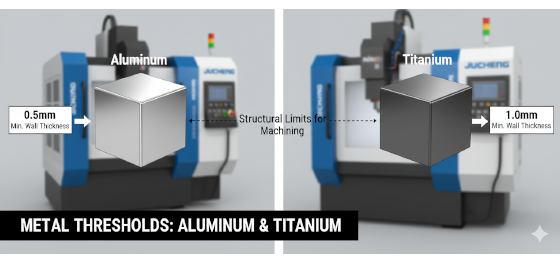
Different metals have different "floors" when it comes to thickness. This is dictated by the material's Young’s Modulus—its inherent stiffness. Aluminum, the most common material in CNC shops, is relatively forgiving. For standard commercial parts, JUCHENG recommends a minimum wall thickness of 0.8mm. In specialized aerospace applications where weight is critical, our master machinists can push this down to 0.5mm, provided the geometry is supported by neighboring ribs or features. However, going below 0.5mm in aluminum significantly increases the scrap rate and machine time, as we must take incredibly light "whisper" cuts to prevent the metal from tearing.
For tougher alloys like Stainless Steel and Titanium, the rules shift upward. Because these materials require much higher cutting forces to shear, they put more stress on the part. For 304 or 316 stainless, a minimum wall of 1.0mm is the safe engineering threshold. Titanium, while possessing an incredible strength-to-weight ratio, is notorious for its low thermal conductivity. A thin titanium wall cannot move heat away from the tool, which often leads to localized overheating and dimensional drift. We recommend a 1.0mm floor for titanium structural components to ensure the heat-affected zone doesn't compromise the material’s properties. By respecting these metal-specific limits, you ensure your design remains structurally sound and economically viable for high-precision CNC machining design guidelines.
Plastic Sensitivity: Rigid vs. Flexible Polymers
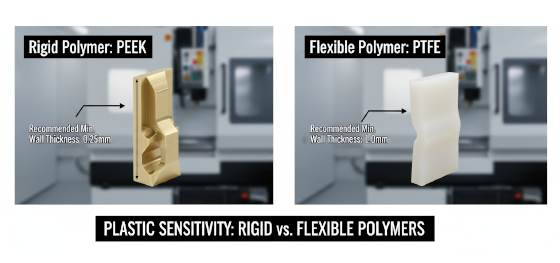
Machining thin walls in plastics is a high-wire act of thermal management. Unlike metals, which can dissipate heat through the workpiece, plastics act as insulators. If a wall is too thin, the heat of the cut will soften the polymer, causing it to "gum up" or melt rather than shear. For rigid engineering plastics like Nylon 66 or Machining PEEK, Jucheng Precision recommends a minimum wall thickness of 1.5mm. These materials have the structural "spine" to stay vertical during a cut, but anything thinner risks significant warping during the cooling phase.
When we move to soft, low-friction polymers like PTFE (Teflon), the CNC Wall Thickness Guide must be even more conservative. PTFE is effectively a "solid liquid"; it flows under its own weight and has almost no rigidity. For PTFE components, we suggest a minimum wall of 2.0mm to 2.5mm. If a designer specifies a 1mm wall in PTFE, the material will simply "flutter" in front of the tool like a flag in the wind, making it impossible to hold a tolerance. Furthermore, plastics are highly hygroscopic; thin walls absorb moisture faster than thick ones, which can lead to rapid dimensional expansion. At JUCHENG, we analyze the "thirst" of your polymer choice and adjust our DFM feedback to ensure your thin-walled parts stay in spec even in humid environments.
Geometric Consistency: The Uniformity Rule

The secret to a stable part isn't just the thickness—it is the consistency of that thickness. The most common error in cnc machining design guidelines is the transition from a very thick section to a very thin one. This creates a "thermal bottleneck." During machining, the thick section holds onto heat while the thin section cools rapidly. This temperature differential creates internal stress that pulls on the part, leading to a permanent bow or twist. We call this the "Asymmetric Pull."
JUCHENG engineers advocate for the "Uniformity Rule": keep your walls as consistent as possible across the entire part. If you need a thin feature, try to pocket out the surrounding heavy areas to balance the material mass. This homogenizes the stress distribution. We also advise against sharp transitions at the base of thin walls. A sharp 90-degree corner where a thin wall meets a heavy floor is a prime location for stress cracks to begin. By adding a small radius (fillet) at the base, you distribute the cutting forces and create a much more durable part. A well-designed 1.0mm wall with generous fillets will often outperform a 1.5mm wall with sharp corners in both the machine shop and the field.
JUCHENG’s Technical Approach: CAM and Pressure Control

At the end of the day, achieving the impossible in wall thickness is a matter of software and strategy. Jucheng Precision doesn't just use standard milling cycles for thin-walled parts. Our CAM department utilizes "Trochoidal Milling" and high-speed "Peeling" toolpaths. These strategies keep the tool engagement at a constant, low percentage—typically 10% to 15% of the cutter diameter. By taking thousands of tiny, rapid bites rather than one big one, we keep the cutting pressure so low that the wall doesn't even realize it's being machined.
We also utilize specialized workholding like "Cryogenic Fixturing" or "Wax Clamping" for extremely delicate foils and thin-walled manifolds. By supporting the material from the inside out or freezing it into a solid block of ice during the cut, we provide the temporary rigidity needed to achieve thicknesses that were once thought impossible. Our quality control team uses non-contact laser scanning to verify wall thickness without the risk of deforming the part with physical probes. When you receive a component from JUCHENG, you are getting the benefit of optimized physics and advanced CAM engineering. Whether you are building an ultra-lightweight drone chassis or a complex satellite housing, our CNC Wall Thickness Guide ensures your design is flight-ready and cost-effective. Contact Jucheng Precision today for a free DFM review and see how our technical rigor can clarify your next thin-walled challenge.

