


Digital perfection is a dangerous illusion. In the friction-free environment of a CAD workstation, every line is straight, every corner is sharp, and every material is invincible. But the transition from a STEP file to a physical component is where the hidden costs of poor design reveal themselves. A single sharp internal corner or an over-specified tolerance can inflate your quote by thousands of dollars or, worse, lead to a material failure on the assembly floor. This is why a Design for Manufacturability Checklist is the most powerful tool in an engineer’s arsenal. It is the final "pre-flight" check that ensures your design respects the laws of physics and the constraints of the cnc machining design guidelines used by world-class facilities.
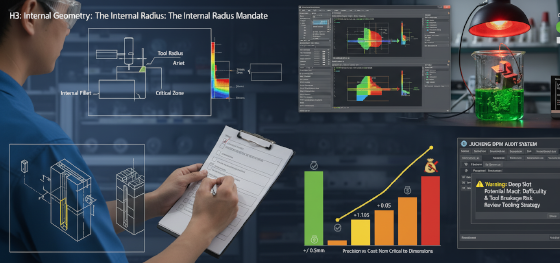
At Jucheng Precision, we have performed over 10,000 deep-dive audits for aerospace, medical, and automotive clients. We have noticed a consistent pattern: 90% of manufacturing delays are caused by issues that could have been identified in the first five minutes of a CAD review. We don't want you to pay for "impossible" features that offer no functional benefit. This guide moves beyond basic advice to provide a technical manifesto for model verification. Whether you are building a subsea sensor or a surgical robotic arm, these pillars of DFM will help you strip away unnecessary complexity and lock in the precision your project demands.
Profitability in manufacturing is decided at the drawing board. A design that is optimized for the machine spindle is a design that reaches the market faster. Let us break down the essential audit points that every professional CAD model must clear before it ever sees a purchase order.
Internal Geometry: The Internal Radius Mandate
Structural Guardrails: Verifying Wall Stability
Hole and Thread Inventory: Standardizing for Speed
Tolerance Discipline: Budgeting for Microns
Material and Environment: Matching Spec to Reality
JUCHENG’s Automated DFM: The Digital Safety Net
Internal Geometry: The Internal Radius Mandate
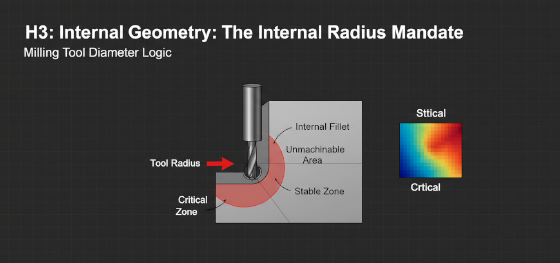
The first and most critical item on any Design for Manufacturability Checklist is the audit of internal corners. Subtractive manufacturing is performed by rotating cutters. Because tools are round, they cannot physically reach into a sharp 90-degree corner. If your CAD model specifies a square pocket, you are essentially demanding a process like EDM Electrical Discharge Machining, which adds significant lead time and cost. The audit question is simple: Does every internal corner have a radius?
Furthermore, you must evaluate the size of that radius relative to the pocket depth. A tiny 1mm radius in a 50mm deep pocket is a failure point for the tool. The "Long-Tool Curse" causes vibration and deflection that ruin surface finishes. At Jucheng Precision, we suggest the "110% Rule": design your corner radii to be slightly larger than standard tool sizes (e.g., a 3.2mm radius for a 6mm tool). This allows the cutter to sweep through the corner without coming to a jarring stop, reducing thermal load and ensuring a smooth, consistent finish. If your design requires a square fit, utilize undercuts or "dog-bone" reliefs rather than sharp corners. By clearing the radius hurdle early, you align your design with the high-speed reality of our 5-axis spindles.
Structural Guardrails: Verifying Wall Stability
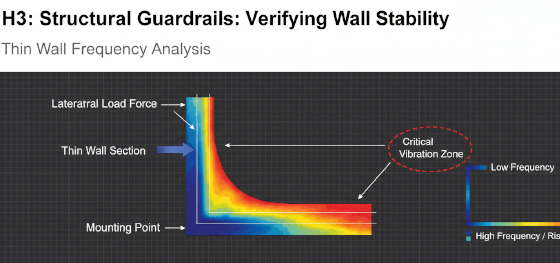
Wall thickness is where aesthetics meet the laws of harmonics. In cnc machining design guidelines, thin walls are the primary source of manufacturing scrap. When a wall becomes too thin, it loses its damping capacity. It begins to vibrate in harmony with the tool's frequency, leading to "chatter marks"—a series of ripples that look like orange peel. The audit must verify that your walls meet the minimum stability thresholds for the chosen material. For aluminum, JUCHENG recommends a 0.8mm floor; for plastics like Nylon 66, stay above 1.5mm.
Consistency is as vital as the dimension itself. Your Design for Manufacturability Checklist must identify sharp transitions between heavy masses and thin webs. This temperature differential during machining creates internal stress that causes the part to "potato chip" or warp. We advocate for uniform wall thickness across the entire component. If you must have a thin section, design supporting ribs to anchor the feature. By verifying structural guardrails in CAD, you ensure that JUCHENG can run your parts at maximum feed rates without the risk of material deflection or structural collapse, delivering a more stable part at a lower per-unit cost.
Hole and Thread Inventory: Standardizing for Speed
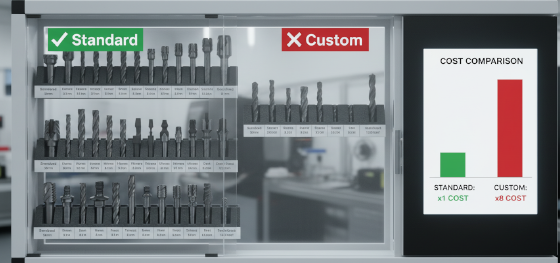
Customization is an enemy of speed. When you specify a non-standard hole size or a unique thread pitch, you are adding "Procurement Friction" to your project. JUCHENG maintains a vast inventory of standard taps, reamers, and drill bits. If your design clears the Design for Manufacturability Checklist by using these standard sizes, your parts move straight to the machine. If you specify a 6.75mm hole where a 6.5mm or 7.0mm hole would suffice, we must either order custom tooling or use slower circular interpolation methods that drive up costs.
Threads require a specific audit for depth. A common mistake is designing a thread depth that is 5x the diameter. Physics dictates that the first three threads carry 80% of the load. Specifying a deeper thread doesn't make the assembly stronger; it just makes it more likely that a tap will break inside the part. Aim for 2x to 3x the diameter as your upper limit. We also suggest providing a "Clearance Zone" at the bottom of blind holes to allow for chip accumulation. By standardizing your hole and thread inventory, you leverage the existing logistical power of Jucheng Precision, ensuring your high-volume orders are completed with surgical consistency and rapid turnaround.
Tolerance Discipline: Budgeting for Microns

Tolerances are the primary engine of cost in a CNC shop. Every time you tighten a tolerance from +/- 0.1mm to +/- 0.01mm, you aren't just making the part better—you are potentially doubling the machine time. Precision requires slower speeds, more frequent tool checks, and a climate-controlled environment. The Design for Manufacturability Checklist must challenge every tight tolerance: Is this dimension mission-critical? Does it mate with another precision surface? Or is it a "Default" setting in the CAD template?
At Jucheng Precision, we advocate for "Strategic Precision." Apply your tight tolerances (like H7 or g6 fits) only where they impact function—bearing seats, seal grooves, and alignment pins. For aesthetic surfaces or structural frames, use general tolerances like ISO 2768-m. This disciplined approach allows our 5-axis machines to "fly" through non-critical areas while focusing their immense accuracy on the features that matter. By loosening what you don't need, you preserve your budget for what you do. Our DFM reports will always flag over-specified tolerances, helping you identify areas where you can trade unnecessary precision for a faster, more economical production cycle.
Material and Environment: Matching Spec to Reality
The final audit point on your Design for Manufacturability Checklist is the synergy between material and environment. We often see designs that specify a material that is technically "too good" or fundamentally "wrong" for the application. For instance, using a standard nylon in a sub-sea environment is a failure waiting to happen due to its high moisture absorption. Similarly, specifying Titanium for a simple room-temperature bracket is a waste of capital. The audit must ask: Does this alloy survive the chemistry and temperature of its destination?
We encourage our clients to look at the "Secondary Process" compatibility. If your part requires Type III Hardcoat Anodizing, you must select an aluminum grade that responds well to that chemistry, such as 6061 or 7075. If your part requires Plating on ABS, you must specify a plating-grade resin. JUCHENG’s material library includes everything from common alloys to exotic superalloys and medical polymers. By aligning your material choice with the manufacturing realities of the shop floor, you ensure that the finished part maintains its integrity across its entire service life. We bridge the gap between material science and machine physics, providing you with a validated path to a functional final product.
JUCHENG’s Automated DFM: The Digital Safety Net
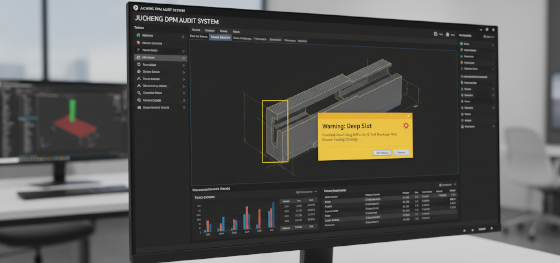
Even the best engineers can miss a detail in a 500-part assembly. That is why Jucheng Precision has built a "Digital Safety Net" into our quoting process. When you upload a file, our systems perform an automated Design for Manufacturability Checklist audit. We use algorithmic geometry recognition to flag thin walls, deep pockets, and internal sharp corners. This isn't just about catching errors; it's about starting a collaborative technical conversation.
Our engineers don't just "hit go" on your file; we look at the results of the digital audit and provide manual feedback based on the hundreds of years of combined experience on our floor. We help you refine your cnc machining design guidelines implementation to ensure that every feature is optimized for the highest yield and lowest cost. When you receive a shipment from JUCHENG, you aren't just getting metal; you are getting a verified engineering solution that has been audited for survival. Whether you are building a revolutionary heart valve or a high-speed satellite mount, our DFM protocols ensure your vision is realized without compromise. Contact Jucheng Precision today for a free DFM review and see how our technical checklist can clarify and elevate your next engineering breakthrough.
| Audit Point | The "Failure" Threshold | The JUCHENG "Safe" Rule |
|---|---|---|
| Internal Corners | Sharp 90-degree angles | Radius > Tool Radius (110%) |
| Wall Thickness | < 0.5mm (Metal) / < 1.0mm (Plastic) | Maintain > 0.8mm (Al) / > 1.5mm (Rigid Plastic) |
| Thread Depth | > 4x Diameter | Optimum at 1.5x - 2.5x Diameter |
| Hole Geometry | Non-standard decimal diameters | Use standard drill sizes (0.5mm increments) |
| Tolerance | < +/- 0.01mm on non-mating faces | Apply ISO 2768-m for general features |

