


Experiencing structural sagging or audible vibration in an autonomous delivery robot chassis reveals a critical failure in the mechanical skeleton. In the world of polyurethane reaction injection molding, the enclosure is no longer just a cosmetic cover; it is a load-bearing asset. Traditional injection molding often forces engineers to sacrifice stiffness to avoid surface sink marks, leading to thin, flimsy parts that require heavy internal metal reinforcements. Achieving the unyielding rigidity required for High Stiffness Structural Plastic without bloating the assembly weight demands a strategic approach to Designing ribs and bosses for RIM parts. This process utilizes low-pressure liquid chemistry to build bionic internal supports that are physically impossible to achieve with high-pressure thermoplastic systems.

Mechanical integrity in large-format enclosures depends on the 1:1 rib-to-wall thickness ratio capability of the RIM process. While standard plastics require ribs to be no thicker than 60% of the wall to prevent surface depressions, RIM polyurethane expands chemically within the mold, exerting outward pressure that ensures a perfectly flat exterior even over massive internal structures. Jucheng Precision addresses these complex structural challenges by providing a free DFM analysis in 24 hours for every project. JUCHENG utilizes its fleet of 150+ CNC machines and 25 5-axis Haas/Mazak units to manufacture the precise aluminum tools that bring these reinforced geometries to life in our Shenzhen factory hub.
Operating under the strict quality mandates of ISO 13485, ISO 14001, and IATF 16949, Jucheng Precision acts as the high-tier engineering partner for global MedTech and robotics OEMs. We transform raw concept CADs into validated, structural hardware with 4-day rapid delivery for initial functional samples. This guide explores the essential RIM molding design guidelines, the logic of gusseting for high-torque bosses, and the void prevention in deep ribs required for manufacturing hardware that survives the high-stress cycles of the modern hospital or industrial floor.
content:
Rib Design Freedom: Why 100% Thickness Works in RIM?
Technical Data: Comparing Rib Performance and Stiffness
Boss Integrity: Sizing and Gusseting for Heavy Actuators
Void Prevention: Managing Resin Flow in Deep Skeletons
JUCHENG Hub: Mastering Bionic Rigidity in the Shenzhen facility
FAQ: Real Answers for Stiffness and Mounting Security
Rib Design Freedom: Why 100% Thickness Works in RIM?
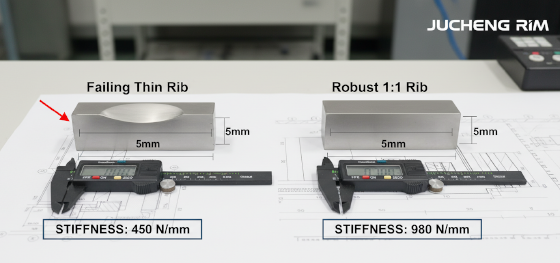
Achieving maximum bending stiffness in a 1.5-meter long panel is the primary driver for Designing ribs and bosses for RIM parts. In standard injection molding, designers must follow the "Thin-Wall Rule" to prevent thermal shrinkage from pulling the outer surface inward, creating an ugly dimple known as a sink mark. The RIM process escapes this limitation because the material is a liquid that expands through an exothermic reaction. This expansion creates internal pressure that counteracts the shrinkage, allowing JUCHENG to produce ribs that are equal to the full thickness of the primary wall. This 100% thickness capability means you can build a prototype robot chassis that is significantly stiffer than any high-pressure molded alternative.
Can RIM ribs replace internal metal frames?
Yes. By designing 10mm thick internal ribs in a "Honeycomb" pattern, JUCHENG creates self-supporting structures that eliminate the need for heavy steel sub-chassis, reducing total weight by up to 40%.
Spacing of the ribs is the secondary focus of successful structural design. JUCHENG recommends a minimum spacing of at least two times the nominal wall thickness to allow the liquid resin to flow freely between the features. During our DFM review, we often suggest "Cross-Ribbing" or "X-Bracing" patterns for large diagnostic console panels. These geometries provide multi-directional torsional rigidity, ensuring that your equipment maintains sub-millimeter sensor alignment even when moving over uneven hospital floors. By delivering High Stiffness Structural Plastic hardware that acts as a single monolithic unit, we ensure your innovation survives the high-vibration environment of [2026] automation.
Corner radii at the base of the ribs are the silent guardians of fatigue life. In Designing ribs and bosses for RIM parts, sharp internal corners act as stress concentrators that lead to sudden brittle failure under impact. JUCHENG recommends a minimum fillet radius of 1.5mm at the intersection of every rib and wall. By distributing the mechanical load over a larger surface area, we prevent the "Unzipping" effect that occurs when a robot fender is struck by a rock or branch. Our Shenzhen facility utilize high-precision 5-axis CNC to machine these fillets into the aluminum mold with absolute consistency, providing the unyielding foundations required for aerospace and defense robotics.
Technical Data: Comparing Rib Performance and Stiffness
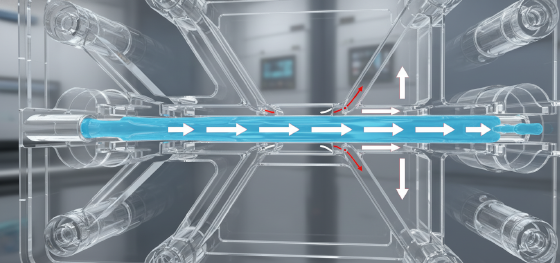
Success in hardware R&D depends on matching the mechanical architecture to the intended load. If your design assumes the limits of standard molding, you are leaving stiffness on the table. Jucheng Precision provides full FEA-ready material data to help your engineering team validate their designs. The following table compares the essential performance metrics of RIM molding design guidelines for structural reinforcement against traditional high-pressure injection molding for the current global market.
| Parameter | Polyurethane RIM | Standard Injection Molding | Engineering Driver |
|---|---|---|---|
| Max Rib Thickness | 100% of Wall | Max 60% of Wall | Zero-Sink Aesthetics |
| Max Rib Height | 5:1 Ratio | 3:1 Ratio | Torsional Stiffness |
| Draft for Ribs | 1.5° - 3.0° | 0.5° - 1.0° | Easy Demolding |
| Gusset Support | Highly Recommended | Optional | Impact Protection |
The ability to use a 5:1 height ratio for ribs allows JUCHENG to produce deep structural members that provide extreme rigidity for 2.5-meter long autonomous tractor hoods. By utilizing High Stiffness Structural Plastic, we achieve a level of dimensional stability that prevents the part from warping during the intense thermal cycles of an outdoor harvest. Our Shenzhen hub manages these variables through 100% CMM verification of all structural nodes, ensuring your Beta fleet arrives in the lab with the geometric precision required for successful autonomy calibration.
Boss Integrity: Sizing and Gusseting for Heavy Actuators

Securing heavy-duty motors and sensors requires mounting points that can handle intense localized torque. In Designing ribs and bosses for RIM parts, the boss—a cylindrical mounting feature—is the primary interface between the plastic shell and the mechanical drive-train. JUCHENG recommends utilized gusseting for high-torque bosses to prevent the feature from "Bending" or shearing off at the base. We typically design three or four support fins that connect the boss to the adjacent ribs or external walls. This distributed load path ensures that a 100kg-payload robot joint remains rigidly fixed to the enclosure through millions of start-stop cycles.
How to prevent boss stripping during assembly?
JUCHENG specializes in the encapsulation with Polyurethane RIM of threaded brass or steel inserts during the molding cycle, providing 4x higher pull-out strength than heat-staking.
Boss height-to-diameter ratios must be managed to prevent part failure during ejection. JUCHENG suggests a maximum height of three times the boss diameter. If a boss is too tall, it becomes a lever that can snap during the demolding process. For designs requiring tall mounting points, we utilize our 25 5-axis Haas/Mazak units to machine the tool with specialized core-pulls or "Removable Inserts." This ensures that the boss is supported until the part is fully separated from the aluminum tool, maintaining the sub-millimeter verticality required for perfect drivetrain alignment in [2026] robotics fleets.
Integrated hardware registration is the final level of boss optimization. JUCHENG often machines "Pilot Features" directly into the bosses that align with the motor's registration diameter. By holding +/- 0.01mm tolerances on these features, we eliminate the need for manual shimming during final assembly. This "Self-Aligning" hardware approach is essential for medical device prototyping, where the concentricity between a diagnostic manifold and its valve seat dictates the clinical accuracy of the device. Our Shenzhen facility provides the technical oversight to ensure your bosses are not just mounting points, but precision geometric references.
Void Prevention: Managing Resin Flow in Deep Skeletons

Internal air entrapment is the primary enemy of structural reliability in large RIM parts. In Designing ribs and bosses for RIM parts, deep features can act as air traps that prevent the resin from fully filling the cavity. This results in "Internal Voids" that significantly weaken the part's bending strength. JUCHENG addresses void prevention in deep ribs through strategic gating and tilt-filling machines. By mounting the aluminum tool on a hydraulic table that tilts during the injection, we use gravity to help the liquid polymer displace the air, ensuring that every structural rib is 100% solid density from top to bottom.
Can voids be detected after the part is molded?
Yes. JUCHENG utilize ultrasonic testing and weight-verification for all high-stakes structural parts to ensure the internal density matches the engineering requirements.
Venting of the skeleton is the secondary defense against porosity. JUCHENG’s mold designers utilize "Porous Metal Inserts" or microscopic venting pins at the base of every deep boss. These pins allow air to bleed out through the tool steel while the thick liquid polyurethane is blocked. By maintaining this constant air-exit path, we ensure that the "Exothermic Kick" happens in a vacuum-like environment, resulting in a mirror-smooth surface and a solid internal structure. This level of process control is what allows JUCHENG to produce 2-meter tall MRI scanner shells that pass the most rigorous IP67 and IP69K sealing audits on the first try.
Laminar flow must be maintained to prevent "Cold Slugs" in the ribs. If the liquid enters a narrow rib too fast, it creates turbulence that folds air back into the part. JUCHENG’s automated RIM mixing heads manage the injection speed in three stages—slow for the ribs, fast for the main panels, and slow for the finish. This "Injection Rhythm" ensures that the polymer matrix is chemically uniform across the entire assembly. By delivering hardware with "Locked-In" structural properties, JUCHENG allows your team to focus on the high-value software integration rather than manual hardware adjustments.
JUCHENG Hub: Mastering Bionic Rigidity in the Shenzhen facility

Dominating the large-format hardware market requires a partner that doesn't just mold plastic, but understands the mechanical physics of bionic rigidity. Jucheng Precision operates with a 24/7 manufacturing mindset in our Shenzhen precision manufacturing hub, delivering high-tolerance RIM components and structural industrial robot parts with industry-leading speed. JUCHENG provides a "Bridge to Production" that allows you to move from a single hand-fitted prototype to a commercial deployment of 5,000 units with consistent metallurgical and dimensional quality. JUCHENG has No MOQ, allowing you to source 1 to 5 units for initial structural validation without the crushing cost of mass-production tools.
Integrating your structural design with JUCHENG’s expertise ensures that your hardware survives the regulatory audit season and moves into mass adoption. JUCHENG offers a free DFM analysis in 24 hours, identifying potential "Sink-Traps" or structural weak spots in your rib design before they become field failures. Whether you are building an autonomous medical assistant or a heavy-duty industrial mobile base, Jucheng Precision provides the rigid, precise, and vented foundations that keep your innovation moving through the high-speed cycles and the years of hard labor.
Our facility is equipped with oversized hydraulic presses and dedicated quality labs, allowing JUCHENG to manage the entire hardware lifecycle in one location. we manage the complexity of multi-material bonding and automotive-grade finishing so your engineering team can focus on the motion control and the AI. By combining Shenzhen's speed with industrial-grade material verification and global ISO 14001 standards, JUCHENG remains the preferred partner for the world's most aggressive Polyurethane Molding Services challenges. Contact us today to start your next project.
FAQ: Real Answers for Stiffness and Mounting Security

What is the ideal rib height for a 50kg robot payload?
We suggest a 4:1 height-to-thickness ratio, providing maximum torsional stiffness without risking part distortion during ejection.
Can JUCHENG machine ribs after the part is molded?
Yes. While molding is primary, we use our 5-axis CNC fleet to add specialized grooves or mounting features that cannot be molded.
How do you handle bosses for micro-robotic joints?
We utilize micro-molding and precision Swiss-lathe inserts to provide unyielding mounting for actuators as small as 10mm.
Does the number of ribs increase the tooling lead time?
Only slightly. Because we use high-speed CNC for aluminum mold making, adding complex rib structures typically adds only 2-3 days to the tool build.
What is the lead time for a structural Beta fleet of 50 units?
Aluminum rapid tools and the first 50 structurally reinforced parts are typically delivered in 15 to 22 business days.
Structural failures and surface sink marks are absolute innovation killers for high-end robotic systems. Partnering with Jucheng Precision ensures that your functional iterations are built with the unyielding polyurethane reaction injection molding and specialized Designing ribs and bosses for RIM parts knowledge the industry demands. Reach out to our Shenzhen manufacturing hub today for a complete DFM review and build the unyielding foundation your autonomous fleet requires.

