


Reviewing a metallurgical datasheet without understanding how those numbers translate to the factory floor is a massive gamble. Procurement teams often select alloys based strictly on the raw ingot price per pound, completely ignoring critical physics. Failing to evaluate baseline die casting materials inevitably results in catastrophic assembly line failures. If your chosen metal shrinks too aggressively during the cooling phase, your mounting holes will drift out of alignment, completely destroying the fitment of your internal electronics. Evaluating the correct die casting material properties is the only way to guarantee your CAD file actually matches the final physical component.

Hardware engineers operating in extreme environments cannot rely on guesswork. Placing a brittle alloy into a heavy-duty vibrating engine bay guarantees the mounting brackets will snap under thermal fatigue. Operating out of our Shenzhen precision manufacturing hub, Jucheng Precision relies entirely on hard data to build your molds.
Matching the physical limits of the liquid metal to your specific commercial requirements prevents massive budget overruns. Let's decode the confusing terminology found on technical datasheets, compare the actual performance of the big three industrial alloys, and explain exactly why downloading our comprehensive engineering chart saves you weeks of redesign labor.
content:
Translating the Data: Shrinkage, Tensile, and Yield Strength
Aluminum Properties: The Thermal and Structural King
Zinc & Magnesium Properties: Precision vs. Weight
Comprehensive Chart of Die Casting Material Properties
JUCHENG Hub: Get Expert DFM Support in Shenzhen
FAQ: Honest Answers About Heat Treatment and Hardness
Translating the Data: Shrinkage, Tensile, and Yield Strength

What is the difference between tensile strength and yield strength on a datasheet?
Tensile strength measures the absolute maximum pulling force required to break the metal entirely, while yield strength tells you exactly when the metal will permanently bend and warp out of shape without breaking.
Engineers designing structural load-bearing hardware must obsess over the yield point. If an automotive suspension arm bends just one millimeter under highway stress and stays bent, the vehicle alignment is permanently destroyed. You must select an alloy with a yield limit far above your expected operating loads.
Shrinkage rate is the silent killer of assembly lines. Every molten metal contracts physically as it cools from a liquid to a solid. If your factory cuts a steel mold to your exact CAD dimensions without mathematically oversizing the cavity to compensate for the specific alloy's shrinkage rate, every single part you receive will be slightly too small.
Aluminum Properties: The Thermal and Structural King

Why do telecommunications companies universally specify aluminum for their base stations?
Because it possesses exceptional thermal conductivity (around 96 W/m-K), acting as a massive natural heatsink that rapidly pulls destructive heat away from internal processing boards without requiring active cooling fans.
Reviewing standard aluminum grades reveals distinct operational advantages. A380 provides the ultimate balance, offering a robust yield strength of 160 MPa while remaining incredibly easy to inject into complex cavities. When designing fluid pumps that cannot leak, engineers immediately shift to A360 due to its superior pressure tightness and higher resistance to saltwater corrosion.
High-volume Asian supply chains rely heavily on ADC12. This specific grade delivers slightly higher fluidity, allowing machines to run faster cycle times with lower scrap rates. However, all these grades share a relatively high melting point, meaning they will subject your expensive tooling steel to severe thermal fatigue over millions of cycles.
Zinc & Magnesium Properties: Precision vs. Weight
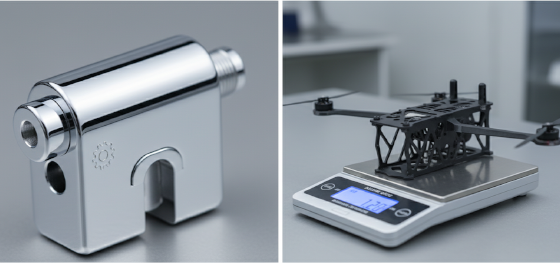
What makes zinc the undisputed champion for luxury cosmetic hardware?
It cures with an incredibly dense, non-porous molecular skin that accepts brilliant chrome and gold electroplating flawlessly, entirely preventing the chemical blistering commonly seen on cheaper metals.
Zamak 3 serves as the industry standard for micro-precision, flowing like water to capture microscopic internal threads that completely eliminate secondary CNC machining. If your locking mechanism requires aggressive impact resistance, upgrading to Zamak 5 increases the copper content, noticeably boosting overall hardness and tensile durability.
Magnesium (specifically AZ91D) operates on the extreme opposite end of the weight spectrum. Weighing thirty-three percent less than standard aluminum, it delivers a massive 150 MPa yield strength. This featherweight density combined with its natural electromagnetic interference (EMI) shielding makes it the mandatory choice for ultra-thin premium laptops and drone gimbals.
Comprehensive Chart of Die Casting Material Properties

Cross-referencing these physical limits ensures you never over-engineer a simple part or under-spec a critical structural component. The benchmark data below highlights the extreme physical divergence between the three primary industrial metals.
| Physical Property | Aluminum (A380) | Zinc (Zamak 3) | Magnesium (AZ91D) |
|---|---|---|---|
| Yield Strength (MPa) | 160 | 221 | 150 |
| Density (g/cm³) | 2.71 (Lightweight) | 6.60 (Very Heavy) | 1.81 (Featherweight) |
| Thermal Conductivity (W/m-K) | 96 (Excellent Heatsink) | 113 (Superior) | 72 (Moderate) |
| Typical Shrinkage Rate | 0.5% to 0.8% | 0.3% to 0.5% | 0.5% to 0.7% |
Notice how Zamak 3 completely dominates the yield strength category while offering the lowest shrinkage rate. This proves exactly why heavy zinc alloys are highly preferred for ultra-precise locking mechanisms, whereas aluminum remains the undisputed choice for massive automotive structures requiring excellent thermal management.
JUCHENG Hub: Get Expert DFM Support in Shenzhen

Why is a professional Design for Manufacturability (DFM) review absolutely critical before cutting steel?
Because simulating the flow of the liquid metal allows engineers to identify exact heat traps, correct wall thickness imbalances, and adjust the mold dimensions mathematically to combat alloy shrinkage before manufacturing begins.
Guessing your material specifications will completely destroy your tooling budget. Inside our Shenzhen precision manufacturing hub, our senior metallurgical engineers run complex software simulations on your CAD models to guarantee the metal you choose physically works with the geometry you designed.
Stop risking your global supply chain on poor material decisions. Send your 3D files to the Jucheng Precision engineering team today. We will provide a completely free DFM analysis, recommend the exact metallurgical grade required, and deliver flawless structural components that pass any rigorous B2B inspection.
FAQ: Honest Answers About Heat Treatment and Hardness

Can I apply a T6 heat treatment to standard aluminum injection castings?
Typically no. Standard injection traps gas porosity inside the part. Exposing these parts to high tempering heat causes the gas to expand, creating massive surface blisters. Vacuum-assisted casting is required for T6 tempering.
Does the hardness of zinc alloys degrade over long periods of time?
This is known as "aging." High-purity commercial Zamak alloys experience very minor dimensional and hardness shifts over decades, which is virtually unnoticeable in standard consumer applications.
Why do manufacturers mix silicon into pure aluminum before injection?
Pure aluminum is extremely gummy and tears easily. Adding precise amounts of silicon drastically increases the liquid fluidity, allowing the metal to fill complex, paper-thin molds without freezing prematurely.
Which specific metal should I choose for the best EMI shielding?
Magnesium (AZ91D) provides exceptional natural electromagnetic interference shielding, completely eliminating the need for engineers to tape internal copper foil inside electronics housings.

