


Watching your assembly line halt because custom metal housings refuse to bolt together creates a massive supply chain nightmare. Procurement teams often blame the CNC machining department when parts arrive slightly too small. Blaming the milling bay completely ignores the brutal thermodynamic reality happening inside the injection press. Every single liquid alloy physically contracts as it freezes into a solid shape. Failing to calculate exact die casting material shrinkage before cutting your expensive steel tooling guarantees your dimensional tolerances will drift completely out of spec.
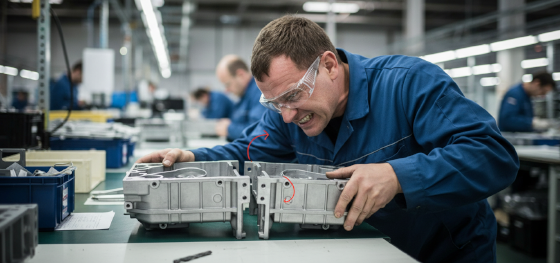
Evaluating baseline die casting materials requires looking past raw strength to understand aggressive thermal movement. Hardware engineers cannot simply send a finished 3D CAD model to a factory and expect perfect physical twins to pop out. If your supplier fails to mathematically oversize the mold cavity to compensate for this natural contraction, your hardware will never assemble correctly.
Securing absolute zero-gap fitment requires partnering with a vendor who understands both thermodynamics and high-precision milling. Let's break down exactly why liquid metals change size, compare the contraction rates of commercial alloys, and explain how advanced CNC post-machining rescues your most critical tolerances.
content:
The Shrinkage Nightmare: Why Do Dimensions Change?
Benchmarking the Metals: Aluminum vs Zinc Metrics
Tooling Compensation: Oversizing the Steel Mold
JUCHENG Hub: CNC Precision to Rescue Tolerances
FAQ: Honest Answers About Wall Thickness and Fitment
The Shrinkage Nightmare: Why Do Dimensions Change?
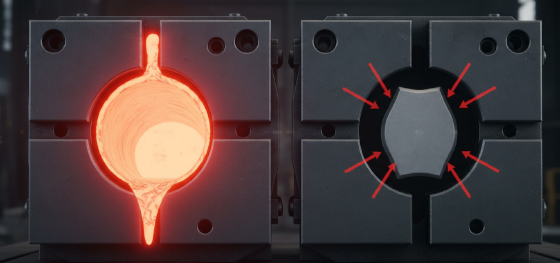
Why does a part measure perfectly inside the hot mold but shrink after ejection?
Metal physically expands when heated to a boiling liquid state; as the chilled internal water lines extract that heat, the molecular structure tightly packs itself together, reducing the overall physical footprint of the component.
Trying to fight this basic law of thermodynamics ruins tooling budgets. When the hydraulic press forces glowing liquid into the steel block, it fills the cavity completely. The exact moment the part begins to freeze, it starts pulling aggressively away from the cavity walls, shrinking inwards toward its own center of mass.
Designing massive parts amplifies this threat exponentially. A shrinkage rate of zero point six percent might seem entirely negligible on a tiny camera gear, but on a two-meter telecom base station, that exact same percentage means the mounting holes will literally be off by several millimeters.
Benchmarking the Metals: Aluminum vs Zinc Metrics
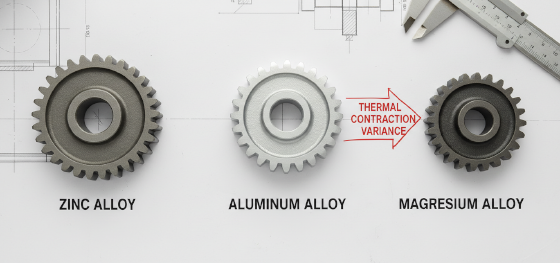
Does every metal contract at the exact same physical speed?
Absolutely not; low-melting-point alloys contract significantly less than high-heat metals, making your initial material selection the most critical factor in achieving strict dimensional stability.
Cross-referencing specific chemistry proves this point instantly. Selecting aluminum die casting provides massive structural strength, but it generally shrinks around 0.5% to 0.8% depending on the specific grade. High-silicon aluminum shrinks slightly less, making it highly preferred for complex electronic enclosures.
Zinc behaves entirely differently under pressure. Because Zamak alloys process at much lower temperatures, their thermal contraction rate sits safely around 0.3% to 0.5%. This incredibly minimal drift explains exactly why luxury hardware brands insist on zinc when they require micro-precision moving parts straight out of the press.
Tooling Compensation: Oversizing the Steel Mold
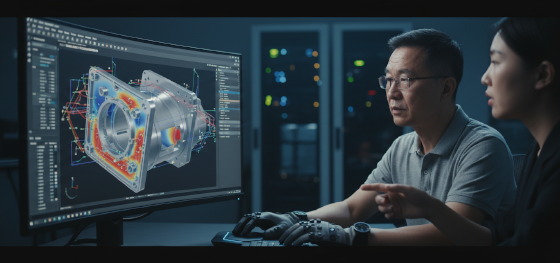
How do tooling engineers prevent these contraction rates from ruining the final product?
By mathematically oversizing the actual steel mold cavity beyond your original CAD dimensions, ensuring that when the hot metal finally cools and shrinks, it lands exactly on your target measurements.
Utilizing advanced factory simulation software prevents expensive guesswork. If you send a CAD file measuring 100 millimeters to our engineering team, we will not cut the steel tool at 100 millimeters. We will aggressively factor in the specific alloy's thermal behavior and cut the cavity slightly larger.
Shrinkage rates are rarely perfectly uniform across complex shapes. Thick structural mounting bosses shrink differently than paper-thin cooling fins on the exact same part. Lazy mold makers ignore these complex internal dynamics, leaving you with twisted geometries that refuse to mate properly with your circuit boards.
JUCHENG Hub: CNC Precision to Rescue Tolerances
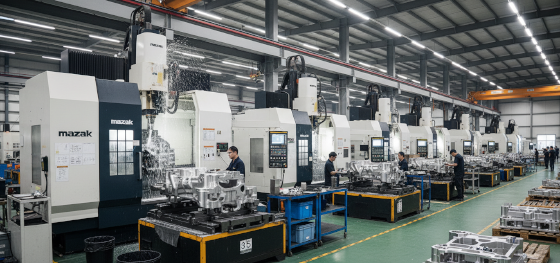
Why must you partner with a factory that owns a massive in-house CNC machining fleet?
Because raw casting alone cannot achieve microscopic O-ring sealing tolerances; secondary face milling is absolutely mandatory to perfect critical mating surfaces after the metal has completely cooled.
Relying solely on mathematical mold compensation is dangerous for extreme high-end aerospace components. Operating our Shenzhen precision manufacturing hub, Jucheng Precision pairs massive injection presses directly alongside 150+ advanced CNC machines to provide an unyielding dimensional safety net.
Stop arguing with third-party machine shops over who ruined the tolerance limits. Send your intricate 3D models to our engineering team today for a complete DFM review. We calculate the exact thermal contraction parameters and deliver absolutely flawless, ready-to-assemble hardware.
FAQ: Honest Answers About Wall Thickness and Fitment

Can changing the cooling water temperature inside the machine affect the final size?
Yes. Severe temperature fluctuations in the factory's chilling system will alter the contraction speed. We strictly use automated fluid chillers to ensure absolute thermal consistency shot after shot.
What happens if the part grips the internal steel cores too tightly as it shrinks?
This causes horrific surface tearing known as soldering. We design the steel cores with precise draft angles, allowing the contracting metal to slide off the tool smoothly during ejection.
Is it possible to cast perfect screw threads without CNC tapping?
For highly fluid zinc alloys, yes. For aluminum and magnesium, thermal contraction makes casting tight internal threads incredibly risky, meaning we highly recommend post-machining those specific features.
Can I run a different alloy into an existing steel mold?
Doing so destroys your dimensional accuracy. Because different metals shrink at vastly different rates, pouring magnesium into a tool specifically compensated for aluminum guarantees your parts will fail inspection.

