


Bulking up metal walls to increase load-bearing capacity destroys your tooling budget immediately. Engineers transitioning from basic CNC machining often falsely assume thicker metal equals a stronger final product. Pushing massive amounts of liquid alloy into a single thick area guarantees horrific thermal sink marks and trapped gas porosity. Relying strictly on a professional die casting design guide forces hardware teams to rethink structural integrity entirely. Executing precise die casting ribs and fillets allows you to slash dead weight while massively multiplying the ultimate torsional rigidity of the component.
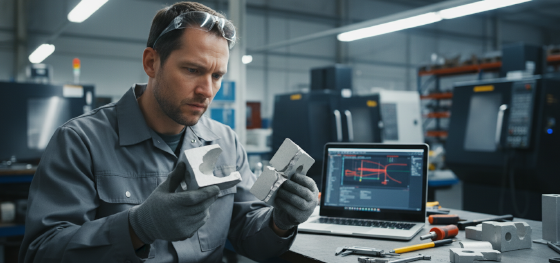
Sharp ninety-degree corners act as microscopic daggers inside the manufacturing press. Force concentrates violently at these harsh intersections during the cooling phase, causing the shrinking metal to tear itself apart physically. Tooling experts despise sharp geometries because they actively destroy expensive H13 steel molds over time through severe thermal fatigue.
Replacing thick, heavy chunks of metal with smart intersecting support walls transforms your commercial unit economics. Let's dissect why sharp edges ruin factory runs, how to calculate optimal support structures, and why rounding your internal corners saves your entire production launch.
content:
Role of Ribs: Strength Without Extra Weight
Best Practices: Engineering Support Webbing
Deadly Intersections: Why Sharp Corners Fracture
JC Rapid Hub: Designing Perfect Fluid Radii
FAQ: Honest Answers About CNC Costs and Aesthetics
Role of Ribs: Strength Without Extra Weight

Why do experienced tooling engineers hollow out thick metal sections aggressively?
Carving out thick masses and replacing them with thin, intersecting support walls provides immense structural stiffness without trapping heat or causing ugly surface depressions during cooling.
Heavy blocks of hot metal shrink violently inward. Hollowed-out chassis designs featuring strategic die casting ribs and fillets completely bypass this thermodynamic nightmare. Liquid alloy flows seamlessly through the thin channels, freezing rapidly and uniformly across the entire geometric footprint.
Slashing raw material usage directly lowers your piece price. Adding intersecting reinforcement webs beneath a flat mounting plate guarantees the platform will never bend under heavy payloads, delivering military-grade stiffness while utilizing fifty percent less raw material.
Best Practices: Engineering Support Webbing
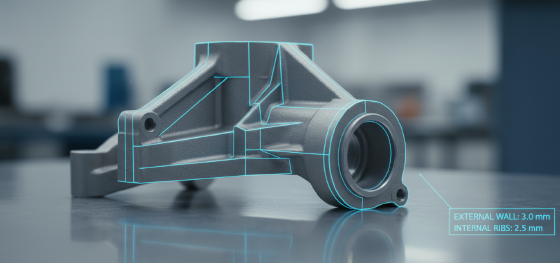
How thick should these internal support walls be compared to the main exterior shell?
Engineers strictly limit support wall thickness to roughly sixty or seventy percent of the primary exterior wall to prevent unsightly thermal sink marks from bleeding through to the visible cosmetic side.
Spacing these reinforcements correctly dictates your ultimate structural success. Placing support channels too close together starves the steel tooling of necessary cooling pathways. Leaving adequate breathing room ensures the liquid alloy fills every crevice without prematurely chilling the steel core.
Getting these deep support channels out of the mold requires mathematical discipline. Applying a precise die casting draft angle to every single vertical face of the web allows the robotic ejectors to push the hot hardware out safely without snapping the fragile metal structures.
Deadly Intersections: Why Sharp Corners Fracture
What causes raw metallic hardware to snap randomly during basic field assembly?
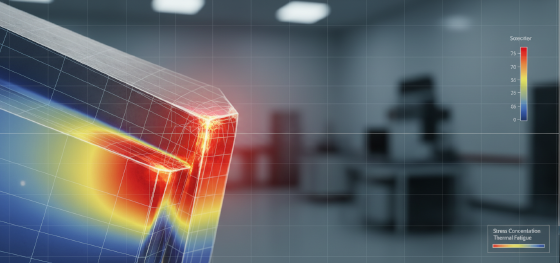
Sharp internal angles focus aggressive mechanical and thermal tension into a single microscopic point, creating an invisible stress fracture that acts exactly like perforated paper during physical impacts.
Liquid alloy fiercely hates changing directions abruptly. Forcing molten metal to navigate a hard, ninety-degree turn causes severe flow turbulence and traps atmospheric oxygen instantly. This chaotic fluid dynamic leaves the corner starved of dense material, guaranteeing a catastrophic failure later.
Tooling steel suffers equally from these harsh intersections. Boiling metal continuously blasting against a sharp steel edge causes that specific point to overheat and crack prematurely. Eliminating sharp corners protects both your commercial hardware and the expensive injection machinery.
JC Rapid Hub: Designing Perfect Fluid Radii
How do expert foundries neutralize these deadly stress concentrations permanently?
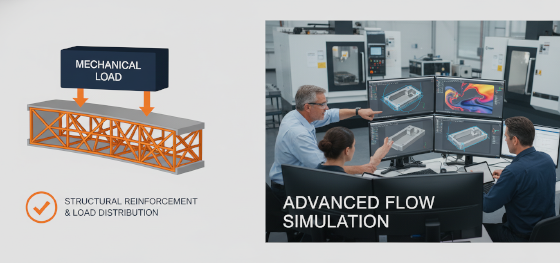
By carving generous, sweeping curves into every single internal and external intersection, forcing the mechanical load to distribute safely across a much wider physical area.
Smoothing out the fluid pathway allows the injected alloy to glide effortlessly throughout the entire steel cavity. JC Rapid heavily scrutinizes your CAD models during our initial DFM audit to ensure every sharp edge is mathematically rounded for optimal molten flow.
Stop risking your heavy-duty hardware on brittle geometric flaws. Send your complex assemblies to our engineering team today for a rigorous structural review. We map the perfect support matrix, erase deadly stress traps, and deliver indestructible commercial components.
FAQ: Honest Answers About CNC Costs and Aesthetics

Does adding extensive internal support webbing increase the secondary CNC machining cost?
No. Because these support features are poured directly into the raw shape simultaneously, they require absolutely zero secondary milling, making them financially free strength upgrades.
Can I place support webbing directly underneath a critical cosmetic faceplate?
Proceed with extreme caution. If the support wall is too thick, it will pull heat unevenly and create a visible, permanent sink mark on the aesthetic side. Proper thickness ratios prevent this disaster.
Do exterior edges require rounded curves just like internal corners?
Radiusing exterior edges is highly recommended. It prevents the sharp metal from cutting assembly workers, significantly reduces paint chipping, and improves the overall premium tactile feel.
Will your engineers automatically round off my sharp CAD corners without asking?
We never modify your geometry without explicit permission. Our DFM report highlights the dangerous stress traps visually, and we provide calculated radius recommendations for your team to approve.

