


Your product needs the speed and cost-effectiveness of Die Casting. Now you face the first, most fundamental choice. Which metal will you use?

Do you need the light weight and thermal conductivity of Aluminum? The incredible detail and finishing ability of Zinc? Or the absolute lightest weight possible from Magnesium?
This is not just a technical choice. It is a decision that will impact your product's performance, its appearance, its weight, and its final cost. Choosing the right diecast material is a strategic act. This guide will help you make that choice with confidence.
content:
Aluminum Alloys: The Versatile Workhorse
Zinc Alloys: The Champion of Detail and Finish
Magnesium Alloys: The Featherweight Champion
Making the Smart Choice
Aluminum Alloys: The Versatile Workhorse

Aluminum is, by far, the most popular diecast material. It offers the best all-around combination of properties and cost.
Its primary advantage is its excellent strength-to-weight ratio. It is lightweight, but also strong enough for a huge range of structural applications. This makes it an ideal choice for the automotive industry, where weight reduction is a constant goal.
Another key superpower is its high thermal conductivity. Aluminum is very good at dissipating heat. This makes it the perfect material for electronic enclosures and heat sinks. The complex fins of a 5G telecom base station housing are almost always made from die cast aluminum.
The most common alloys we work with are A380 and ADC12. They both have excellent fluidity, allowing them to fill large, complex molds easily. A380 is a great general-purpose choice. ADC12 is often chosen for parts with even more intricate detail.
Zinc Alloys: The Champion of Detail and Finish

When your part needs to be a piece of jewelry, you choose zinc. Zinc alloys have a different set of superpowers.
Because zinc has a lower melting point and is extremely fluid, it can be cast into parts with incredible detail and ultra-thin walls. You can achieve sharp corners and fine textures that are impossible with aluminum. This is called "net-shape" casting, meaning the part comes out of the mold almost perfect, requiring very little secondary work.
Zinc's other main advantage is its suitability for finishing. It provides a perfect, smooth surface for a wide range of platings. It is the ideal base metal for a brilliant, mirror-like chrome plating. This is why high-end faucets, handles, and decorative hardware are often made from die cast zinc.
The most common alloy, Zamak 3, offers a great combination of strength and dimensional stability. While zinc is much denser and heavier than aluminum, its ability to create a perfect finish right out of the mold can sometimes make it a more cost-effective choice for small, highly cosmetic parts.
Magnesium Alloys: The Featherweight Champion

When light weight is not just a goal, but an obsession, you choose magnesium.
Magnesium is the lightest of all commonly used structural metals. It is 33% lighter than aluminum and 75% lighter than steel. This is a staggering difference.
This makes it the ultimate choice for applications where every gram counts. Think of the casing for an ultra-premium, lightweight laptop. Or the housing for a professional camera. Or components in the aerospace industry.
Magnesium alloys like AZ91D also have excellent stiffness and a good strength-to-weight ratio. And they are great at EMI/RFI shielding. However, magnesium is more expensive than aluminum and requires a specialized hot-chamber die casting process with a focus on safety. It is a specialist material for projects that demand the ultimate in lightweight performance.
Making the Smart Choice
So, which diecast material is right for you? It is a trade-off.
If you need a good balance of cost, weight, and thermal performance for a large part, Aluminum is your workhorse. If you need incredible detail, ultra-thin walls, and a perfect plating finish for a smaller part, Zinc is your champion. If your only goal is to achieve the lightest weight possible, Magnesium is your hero.
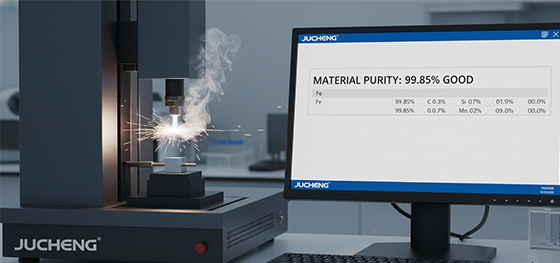
Choosing the right material is a critical first step. Equally important is ensuring the material you receive is correct. At JUCHENG, we take material verification very seriously. We use an in-house spectrometer to analyze the chemical composition of our raw materials. This guarantees that the A380 aluminum you specified is exactly what you get.
This commitment to quality, combined with our expertise across all these materials, makes us the ideal partner to help you make the smartest material choice for your Die Casting project.

