


Signal purity dictates the success or failure of critical diagnostic telemetry. In the hyper-dense electronic environment of a modern hospital operating room, the air is saturated with radio frequency (RF) noise from high-frequency surgical tools, wireless telemetry, and massive MRI magnetic fields. When an engineer transitions a robotic assistant or a life-support monitor from a raw circuit board to a finished product, the plastic exterior housing acts as a thermal and physical barrier but provides zero defense against these invisible electromagnetic waves. Standard polymers are insulators; they allow "electrical noise" to pass through them as easily as light passes through glass, causing microprocessors to crash and pacemakers to malfunction. Navigating this requirement for electronic isolation requires the strategic deployment of EMI shielding for medical enclosures. This specialized secondary operation turns an inert plastic box into a highly conductive "Faraday Cage." Jucheng Precision operates an elite finishing facility in Shenzhen, providing the technical depth to seamlessly integrate these conductive barriers. Within the broader sector of Medical Robotics Manufacturing, we bridge the gap between "aesthetic plastic" and "functional electronic armor," ensuring your devices pass rigorous EMC (Electromagnetic Compatibility) certification on the first attempt.
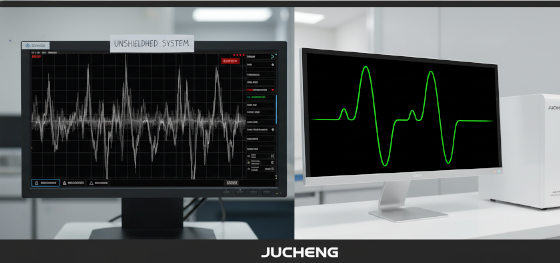
Establishing a resilient electronic defense demands the rejection of fragmented supply chains. Amateurs often mold a medical housing at one facility and ship it across the country to be painted with conductive ink by a third party. This introduces massive logistical delays and the risk of surface contamination (like mold release agents) that prevents the shielding from adhering properly. Jucheng Precision eliminates these "Integration Failures" by enforcing a strict single-source workflow. We mold the precision enclosure, prepare the surface energy, and apply the required decibel-attenuation coatings under one roof. Whether you are developing a portable ultrasound requiring a lightweight copper spray or a heavy diagnostic cart needing vacuum metallization, our facility provides the material science and metrological rigor required for 2026 market entry. This guide deconstructs the physics of wave reflection, the chemistry of conductive paints, and why JUCHENG’s "Seam Continuity" protocol is the mandatory foundation for anyone developing compliance-ready hardware.
Atmospheric Noise: The Physics of Electromagnetic Interference
Conductive Coatings: Applying Silver, Copper, and Nickel Paints
Vacuum Metallization: High-Volume Physical Vapor Deposition
Seam Sovereignty: Managing Leakage with Conductive Gaskets
JUCHENG Protocol: Integrated Molding and Shielding for EMC Compliance
Frequently Asked Questions: EMI and RFI Shielding
Atmospheric Noise: The Physics of Electromagnetic Interference
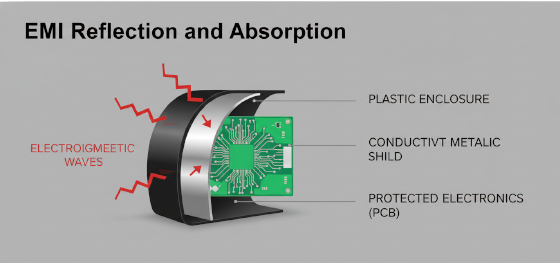
Electronic sabotage occurs when stray waves induce unwanted currents in a circuit. Electromagnetic Interference (EMI) and Radio Frequency Interference (RFI) can either "leak out" of a device and disrupt surrounding hospital equipment (emissions) or "break into" a device and corrupt its internal processors (susceptibility). The physics of shielding relies on two primary mechanisms: Reflection and Absorption. When an electromagnetic wave hits a highly conductive metallic layer, the majority of the wave's energy is instantly reflected away, much like a mirror reflects light. A smaller portion of the wave penetrates the shield but is absorbed and converted to a minute amount of heat. To effectively block these waves, the interior of the plastic housing must be coated with a continuous, low-resistance metallic layer. The effectiveness of this shield is measured in Decibels (dB) of attenuation. Jucheng Precision engineers target a minimum of 60 to 80 dB of attenuation for most medical robotics, which effectively blocks 99.999% of disruptive signal energy, ensuring that your robotic console only reacts to the surgeon’s commands, not the ambient noise of the room.
Conductive Coatings: Applying Silver, Copper, and Nickel Paints

Chemical integration is the most agile method for creating a Faraday Cage on complex 3D geometries. For low-to-mid volume manufacturing, applying conductive paint is the undisputed champion. This process utilizes standard robotic or manual spray equipment to apply an acrylic or polyurethane base paint heavily loaded with metallic particles. Silver paint offers the absolute highest conductivity and oxidation resistance, making it ideal for military or life-support medical hardware, but it carries a significant cost premium. Copper paint provides excellent, cost-effective shielding across a wide frequency range but can oxidize over time if not sealed properly. Nickel paint is the "Industrial Workhorse," offering strong magnetic shielding and excellent corrosion resistance. Jucheng Precision manages the "Dry Film Thickness" with surgical precision, ensuring the coating is typically 25 to 50 microns thick. We verify the coating's success using digital ohmmeters, requiring the surface resistance to be consistently below 0.05 Ohms per square. This ensures the entire interior acts as a unified electrical ground.
Vacuum Metallization: High-Volume Physical Vapor Deposition
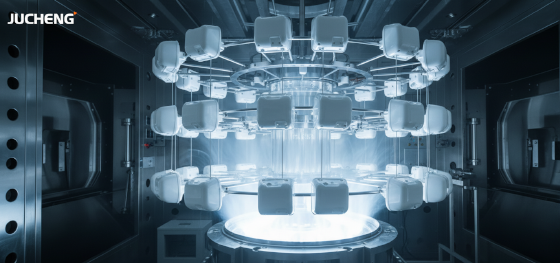
Scaling to thousands of units demands a shift from liquid chemistry to vaporized physics. For high-volume production of medical diagnostic housings, Jucheng Precision utilizes Vacuum Metallization (also known as Physical Vapor Deposition or PVD). In this process, the plastic enclosures are placed inside a massive vacuum chamber. A pure aluminum wire is heated until it vaporizes; the aluminum gas then condenses uniformly onto the cold plastic surfaces. Because it occurs in a vacuum, the resulting metal film is incredibly pure, highly conductive, and microscopically thin (often less than 5 microns). This thinness ensures that tight-tolerance snap-fits and mounting bosses are not dimensionally altered by the coating process. While the setup and tooling (custom masking fixtures) for vacuum metallization are more expensive than spray painting, the per-part cost drops drastically at high volumes. We turn "raw polymer" into "aluminum-armored" components, providing a highly repeatable, eco-friendly shielding solution that doesn't rely on volatile organic compounds (VOCs).
Seam Sovereignty: Managing Leakage with Conductive Gaskets
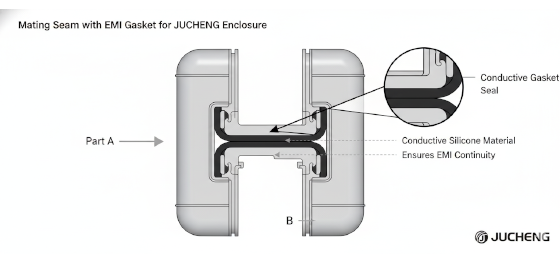
A Faraday Cage is only as strong as its weakest joint. If you perfectly coat the front and back halves of a robotic enclosure but fail to establish electrical continuity where the two halves meet (the parting line seam), high-frequency waves will "leak" through the microscopic gap. This "Slot Antenna Effect" ruins the entire EMC compliance effort. Jucheng Precision engineers eliminate this "Leakage Crisis" by focusing on the mating surfaces during the DFM review. We design specific overlapping joints (like a tongue-and-groove) that maximize the contact area for the conductive paint. Furthermore, for high-stakes medical robots, we integrate specialized Conductive Silicone Gaskets. These elastomeric seals, impregnated with silver-plated aluminum or nickel particles, are compressed between the two housing halves during assembly. They serve a dual purpose: they provide an IP67 waterproof seal while simultaneously guaranteeing 360-degree electrical continuity across the seam. We don't just shield individual parts; we engineer a cohesive defensive system.
JUCHENG Protocol: Integrated Molding and Shielding for EMC Compliance
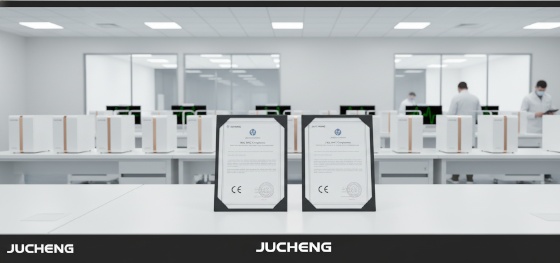
Manufacturing excellence at Jucheng Precision is built on the foundation of single-source accountability. We don't believe you should manage one vendor for your complex injection molding and another for your critical EMI coatings. Our facility, housing over 150 CNC machines, elite injection bays, and specialized robotic painting lines, is optimized for the agile middle-ground of MedTech. When you upload a CAD file to our facility, our veteran engineers perform a comprehensive "Signal Integrity Audit." We suggest masking strategies to keep paint off critical mounting bosses while ensuring maximum coverage on the main walls. We provide full material lot traceability and cross-hatch adhesion reports for every shielded batch, ensuring your project meets the strict requirements of FCC and CE Mark auditors. Stop gambling your electronic launch on fragmented suppliers who don't understand the physics of high-frequency noise. Leverage our decade of manufacturing mastery to validate rapidly and scale profitably.
Frequently Asked Questions: EMI and RFI Shielding
Question: How thick is the conductive paint layer on a medical enclosure?
Answer: Our standard application of copper or nickel conductive paint ranges from 25 to 50 microns (0.001 to 0.002 inches) in thickness. This provides 60+ dB of attenuation without interfering with standard assembly tolerances.
Question: Does JUCHENG use custom masking fixtures during the shielding process?
Answer: Yes. We utilize our in-house CNC and 3D printing capabilities to create custom "Masking Jigs." This ensures the conductive coating only hits the designated interior walls and never oversprays onto the cosmetic exterior faces.
Question: Can you mold parts directly from conductive plastic resin instead of painting them?
Answer: Yes, we can process highly specialized resins filled with stainless steel fibers or carbon nanotubes. However, this is generally more expensive than conductive painting and can make the parts brittle and prone to cosmetic flow marks on the A-side surface.

