


Regulatory rejection is the most expensive manufacturing defect a MedTech company can encounter. When an engineering team transitions a surgical robot joint or an implantable device from a functional prototype to a clinical-trial batch, the physical accuracy of the part is only half the deliverable. The other half is the "Paper Trail." In the high-stakes environment of healthcare innovation, a perfectly machined component is legally worthless if its manufacturing history cannot be proven. Navigating this bureaucratic minefield requires the strategic deployment of ISO 13485 compliant CNC machining. This specialized discipline within the Medical Robotics Manufacturing sector is not about how to cut metal; it is about how to control risk. It demands a Quality Management System (QMS) that actively prevents material mix-ups, documents every tool change, and guarantees that part #500 is a biological and dimensional clone of part #1. Jucheng Precision operates as a regulatory fortress in the Shenzhen precision manufacturing hub. We don't just supply medical hardware; we supply the documented certainty required to survive FDA 510(k) and CE Mark audits, ensuring your clinical launch is anchored by unshakeable compliance data.

Establishing a resilient clinical supply chain demands the absolute rejection of standard "Job Shop" mentality. Amateurs often purchase generic 316L stainless steel from unverified brokers, unaware that slight variations in chemical composition can cause a surgical instrument to rust after its first autoclave cycle. Jucheng Precision eliminates these "Contamination Crises" by enforcing an unbroken chain of custody. We operate dedicated medical-only machining bays to prevent cross-contamination from industrial metals or toxic coolants. This guide deconstructs the necessity of Heat Lot traceability, the mechanics of process validation, and why JUCHENG’s "Audit-Ready Protocol" is the mandatory foundation for anyone developing life-critical hardware for 2026 deployment.
Material Sovereignty: The Mandate of Heat Lot Traceability
Process Validation: Eliminating Variance via IQ/OQ/PQ
Metrological Truth: First Article Inspection (FAI) Rigor
Systemic Improvement: Navigating the CAPA Protocol
JUCHENG Protocol: Your Defense Against FDA Audit Failure
Frequently Asked Questions: ISO 13485 Machining
Material Sovereignty: The Mandate of Heat Lot Traceability
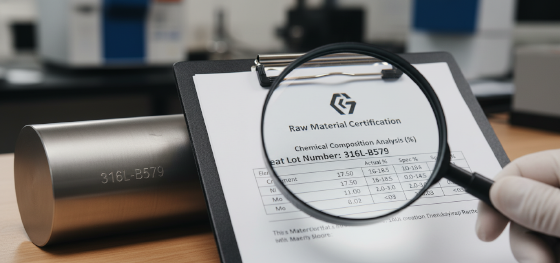
Biological compatibility is a legal promise, not a manufacturing assumption. The core tenet of ISO 13485 compliant CNC machining is absolute material traceability. If a surgical drill bit fails during an operation, investigators must be able to trace that specific instrument back to the exact vat of molten metal from which it was forged. Jucheng Precision guarantees this through "Heat Lot Number" tracking. Every billet of Titanium Grade 5 or Medical PEEK entering our facility must be accompanied by a Material Test Report (MTR). This document proves the chemical composition, tensile strength, and hardness match the regulatory standard. We log this Heat Lot into our digital ERP system and laser-etch a corresponding batch code directly onto your finished parts. This ensures that if a raw material recall ever occurs at the mill level, you can instantly identify and quarantine only the affected components, rather than scrapping your entire inventory. We turn "raw stock" into "certified medical assets," protecting your company from devastating liability.
Process Validation: Eliminating Variance via IQ/OQ/PQ

Consistency across a medical production run cannot rely on operator intuition. The FDA mandates that manufacturing processes be "Validated"—proven to consistently produce a result that meets predetermined specifications. Jucheng Precision executes this through the rigid IQ/OQ/PQ framework. Installation Qualification (IQ) ensures our 5-axis CNC machines are installed and calibrated correctly. Operational Qualification (OQ) tests the "edges" of the machining parameters (spindle speed, feed rate) to find the safe processing window where burr-free cuts occur. Finally, Performance Qualification (PQ) runs a test batch under normal conditions to prove the process is stable and repeatable over time. By locking down these variables, we ensure that the cutting force and thermal expansion remain identical for every part. This rigorous validation is why our surgical robot joints assemble with zero backlash on the first attempt and the ten-thousandth.
Metrological Truth: First Article Inspection (FAI) Rigor

Dimensional sovereignty is verified, never assumed. In the context of ISO 13485 compliant CNC machining, a "First Article Inspection" (FAI) is a mandatory milestone. Before mass production begins, Jucheng Precision utilizes our advanced metrology lab—equipped with ruby-tipped Coordinate Measuring Machines (CMM) and optical comparators—to measure every single dimension, radius, and GD&T callout on the engineering drawing. We generate an exhaustive AS9102-style FAI report (often spanning dozens of pages) that cross-references the physical part against the digital CAD intent. This report provides the definitive proof that the manufacturing process is capable of holding your +/- 0.005mm tolerances. We do not proceed to the main batch until this FAI is signed off by our Quality Manager and approved by your engineering team, ensuring zero scrap and absolute alignment with clinical requirements.
Systemic Improvement: Navigating the CAPA Protocol

Perfection is an ongoing systemic effort. When an anomaly occurs—such as a tool breaking prematurely or a microscopic burr passing through an early inspection—a standard shop simply throws the part away. An ISO 13485 facility initiates a CAPA (Corrective and Preventive Action). Jucheng Precision treats anomalies as data points for process improvement. We halt the line, utilize "5 Whys" and "Fishbone" root-cause analysis, and implement a permanent mechanical or procedural fix to ensure the defect can never happen again. This documented loop of continuous improvement is exactly what FDA auditors look for during a facility inspection. We don't hide mistakes; we engineer them out of existence. By partnering with JUCHENG, you inherit a mature QMS that actively strengthens your supply chain resilience rather than merely reacting to it.
JUCHENG Protocol: Your Defense Against FDA Audit Failure
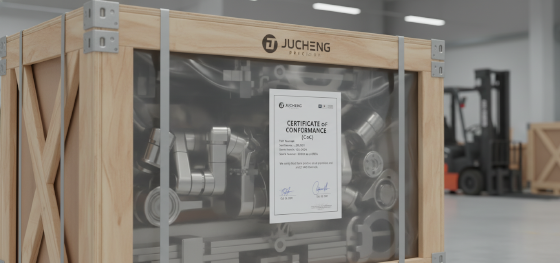
Manufacturing excellence at Jucheng Precision is built on the foundation of single-source accountability. We don't just "cut metal"; we provide a comprehensive Device History Record (DHR). When you upload a medical CAD file to our facility, our regulatory team ensures that every stage of production—from the initial 5-axis roughing pass to the final cleanroom packaging and ultrasonic passivation—is documented. We provide the Certificate of Conformance (CoC) that guarantees your hardware journey is lean, predictable, and legally defensible. Stop gambling your venture funding on fragmented suppliers who lack the necessary QMS framework. Leverage our decade of Medical Robotics Manufacturing mastery to validate rapidly, launch early, and scale profitably. Contact our technical team today for a free DFM review and see how we can turn your digital surgical intent into a compliant, indestructible physical reality.
Frequently Asked Questions: ISO 13485 Machining
Question: Why is an ISO 9001 certification not enough for medical robotics?
Answer: While ISO 9001 focuses on general quality and customer satisfaction, ISO 13485 specifically mandates rigorous risk management, strict regulatory compliance, and comprehensive material traceability tailored for the safety-critical medical device industry.
Question: How does JUCHENG prevent cross-contamination between medical and industrial parts?
Answer: Our Shenzhen precision manufacturing hub operates dedicated "Medical-Only" CNC bays. These machines utilize specific, bio-safe cutting fluids and separate tooling to ensure industrial heavy metals (like lead or zinc) never contaminate a surgical implant.
Question: Does JUCHENG provide passivated surgical tools?
Answer: Yes. We perform in-house passivation (nitric or citric acid) for all 316L and 17-4PH stainless steel components. We provide the corresponding ASTM A967 compliance certificates to prove the restoration of the chromium-oxide anti-rust layer.

