


Manufacturing for the food and pharmaceutical industries is a discipline defined by what you don't add to the part. While standard industrial polymers are built for mechanical strength, FDA Grade PTFE Machining is built for absolute biological neutrality. In these high-stakes sectors, a single microscopic particle of mineral oil or a trace of metallic dust embedded in a seal can lead to a million-dollar product recall or a compromised medical device. PTFE, by its nature, is the ideal candidate for these environments due to its extreme chemical resistance, but the material's purity is only as good as the facility that shapes it.
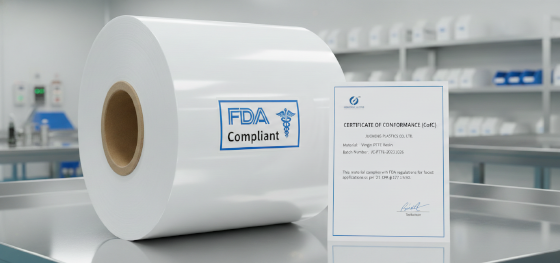
At Jucheng Precision, we recognize that ptfe teflon cnc machining for food-contact applications requires a fundamental quarantine of the manufacturing process. It is not enough to simply buy the right resin; the manufacturer must serve as the guardian of that purity from the moment the material enters the dock to the moment it is vacuum-sealed for shipment. Whether you are developing components for a high-speed bottling line or a diagnostic instrument, understanding the technical boundaries of "FDA Grade" is essential. This guide details the rigorous contamination-control protocols JUCHENG employs to ensure every Teflon part meets the strictest global safety mandates.
Purity in machining is a matter of documented integrity. It requires a facility that understands the difference between an industrial seal and a food-grade gasket. Let us explore the molecular and operational strategies that define professional FDA-compliant manufacturing.
content:
The Virgin Standard: Why Fillers are Banned
Contamination Control: The Clean Machine Protocol
The Dry-First Strategy: Preventing Chemical Leaching
Hygienic Surface Integrity: Preventing Bacterial Growth
Lifecycle Traceability: The Paper Trail of Safety
The Virgin Standard: Why Fillers are Banned
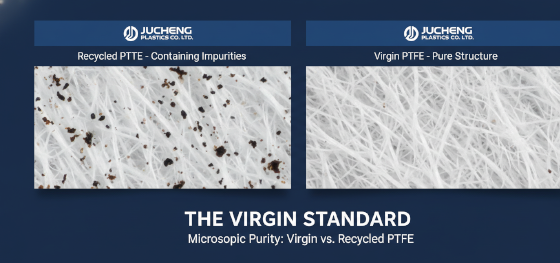
The first step in FDA Grade PTFE Machining is the verification of the raw material "DNA." Standard industrial PTFE is often modified with fillers—glass fibers, carbon, bronze, or molybdenum disulfide—to improve its mechanical stiffness or wear resistance. While these additives are excellent for industrial pumps, they are strictly prohibited in food-contact applications. Fillers can leach out of the material over time, contaminating the food or pharmaceutical product. Furthermore, recycled or "repro" PTFE can contain traces of hazardous chemicals from its previous lifecycle.
At Jucheng Precision, we exclusively utilize 100% Virgin PTFE for all FDA-compliant projects. Virgin PTFE is produced directly from the primary resin without any added scrap or fillers. It is naturally "water-white" in appearance and possesses the highest level of chemical purity. We verify the material through comprehensive Mill Test Reports (MTRs) and certificates of conformance (CofC) that explicitly state the resin meets FDA 21 CFR 177.1550 requirements. This technical baseline ensures that the material is not only non-toxic but also possesses the extreme hydrophobicity (water-repellence) needed to prevent the absorption of flavors, odors, or bacteria. By starting with a pure foundation, we eliminate the primary risk of chemical migration in your processing equipment.
Contamination Control: The Clean Machine Protocol
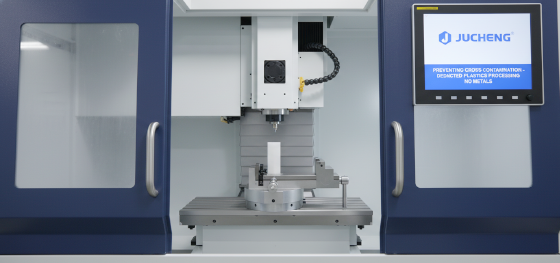
The most common failure in ptfe teflon cnc machining for high-purity sectors is not the choice of material, but the environment of the shop floor. Most CNC machines are saturated with sulfur-based oils and metallic dust from previous jobs. PTFE is a soft material; as the cutting tool moves, it can easily press microscopic shards of steel or copper into the surface of the plastic. This cross-contamination is often invisible to the naked eye but will be detected during a medical audit or food safety inspection.
JUCHENG operates under a "Quarantine Protocol" for all FDA Grade PTFE Machining runs. Before an FDA project begins, the machine enclosure is stripped, deep-cleaned, and inspected for any residual metal fines. We utilize dedicated workholding fixtures—often made from high-density polyethylene or the PTFE material itself—to ensure that no metal-to-plastic contact occurs on critical surfaces. Our tools are segregated; we never use a drill bit on an FDA part if it has previously cut metal. This obsessive level of isolation ensures that the "virgin" state of the material is maintained throughout the entire manufacturing cycle, providing you with parts that are chemically as pure as the resin they were born from.
The Dry-First Strategy: Preventing Chemical Leaching
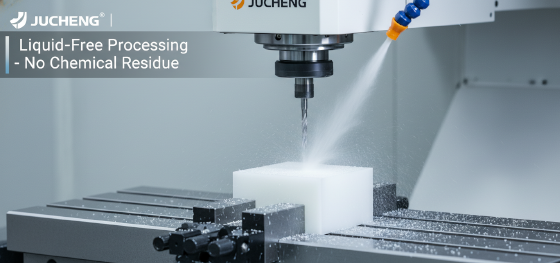
Standard CNC coolants are a primary source of contamination. Even "water-soluble" oils contain biocides and chemical stabilizers that can penetrate the surface of PTFE. Because PTFE is slightly porous at the microscopic level, these chemicals can become trapped within the part, only to "leak" out later when the part is exposed to steam or hot cleaning fluids in a food plant. For FDA Grade PTFE Machining, the only safe strategy is to eliminate liquid coolants entirely.
At Jucheng Precision, we utilize high-pressure, filtered cold air guns to manage thermal energy. The air is filtered to remove all traces of compressor oil and moisture. This air blast serves two critical functions: it keeps the tool tip below the material's softening point and physically clears the "waxy" PTFE chips away from the hole or pocket before they can be re-cut. Dry machining is technically more difficult—it requires perfectly sharp tooling and carefully managed feed rates to prevent the material from melting—but it is the only way to guarantee a chemically inert final product. By removing the risk of liquid absorption, we ensure that your seals and valve seats won't compromise the sterility of your pharmaceutical or food-grade production lines.
Hygienic Surface Integrity: Preventing Bacterial Growth
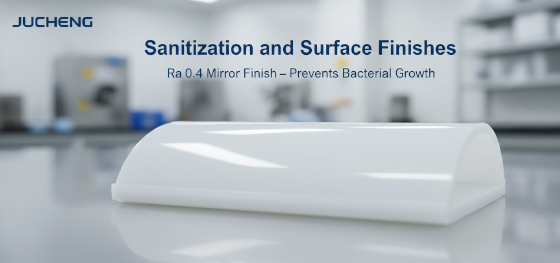
In food and medical equipment, the "roughness" of a part is a safety parameter. Microscopic valleys and tool marks are the perfect breeding ground for bacteria (biofilms). If a surface is too rough, standard CIP (Clean-In-Place) procedures won't be able to reach the microbes hiding in those grooves. Therefore, achieving a superior surface finish is a mandatory requirement for FDA Grade PTFE Machining.
JUCHENG engineers optimize our tool paths to achieve Ra 0.8 µm or better directly off the mill. We avoid traditional hand-sanding or polishing with abrasive pads, as these can embed grit into the soft PTFE surface. Instead, we utilize high-speed diamond-polished carbide tools that slice the plastic fibers so cleanly they leave a mirror-like finish. We also pay close attention to the geometry of internal corners. We design all pockets and transitions with generous radii—avoiding sharp 90-degree internal corners where food particles could get trapped. This focus on "Hygienic Design" ensures that your components are as easy to sanitize as they are precise, helping you meet the most stringent USDA and FDA sanitation requirements.
Lifecycle Traceability: The Paper Trail of Safety
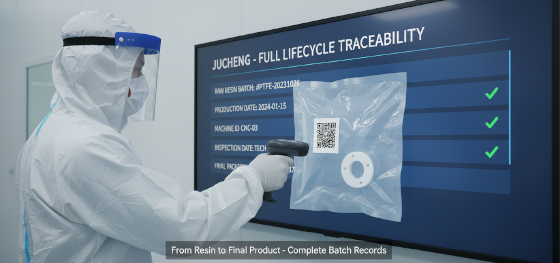
The final hallmark of a professional FDA supplier is the ability to prove everything. In a regulatory audit, if a process isn't documented, it didn't happen. Jucheng Precision provides a comprehensive "Quality Data Package" with every FDA project. This includes the primary Mill Certificate from the resin manufacturer, our internal machining log, and a certificate of conformance signed by our quality manager.
We maintain full "Heat Number" traceability. This means if a batch of resin is ever found to have a defect, we can tell you exactly which parts were made from that batch and when they were shipped. This transparency is essential for global brands in the beverage, dairy, and medical device sectors. Our ptfe teflon cnc machining workflow is designed to pass the most rigorous customer audits, providing you with the peace of mind that your supply chain is secure and compliant. When you choose Jucheng Precision, you aren't just buying a component; you are buying the engineered assurance of food-grade purity. Contact our team today for a full technical review of your next FDA-compliant project.

