


Machining Polytetrafluoroethylene, the material famously known as Teflon, is an exercise in managing a "solid liquid." For engineers, PTFE is a miracle of chemical inertness and low friction. But for the machinist, it is a dimensionally unstable ghost that resists every conventional rule of manufacturing. The struggle to maintain consistent Machining PTFE Tolerances is the primary reason many shops refuse to quote complex Teflon components. The material is so soft that it deforms under the weight of a micrometer, and it possesses a thermal expansion rate that can turn a "passing" part into a "failure" just by moving it from a cold workshop to a warm assembly line.
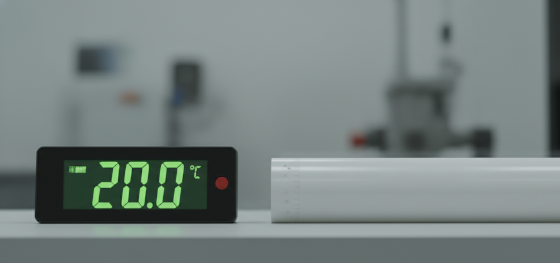
At Jucheng Precision, we don't treat Teflon like a standard plastic. We treat it as a temperature-sensitive engineering challenge. Success in ptfe teflon cnc machining requires a mastery of thermodynamics and specialized workholding that most generalist shops lack. Whether you are designing high-voltage insulators or chemically resistant seals for the semiconductor industry, understanding the forces that cause your dimensions to drift is the only way to ensure your product survives the field. This guide explores the engineering rigor JUCHENG employs to stabilize the "unstable" and deliver tolerances that others deem impossible for this slippery polymer.
Precision in PTFE is not born on the machine spindle; it is born in the metrology lab and the climate control system. Moving beyond the "close enough" mindset is essential when your assembly depends on a perfect seal. Let us dive into the technical strategies that define world-class Teflon manufacturing.
content:
The Softness Paradox: Measuring Without Deforming
Thermodynamic Shift: The 19-Degree Transition
The Sharpness Mandate: Slicing the Slippery
Clamping the Unclampable: Stress-Free Workholding
JUCHENG’s Metrology: Verification in the Cold
The Softness Paradox: Measuring Without Deforming
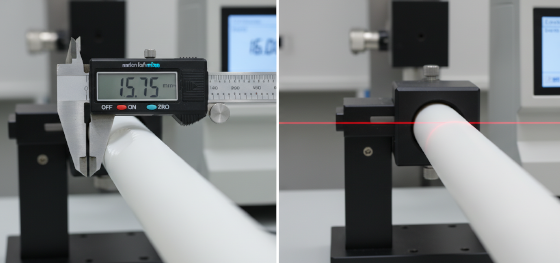
The first obstacle to achieving tight Machining PTFE Tolerances is the act of measurement itself. PTFE has a very low modulus of elasticity, meaning it is incredibly easy to compress. If a quality inspector uses a standard hand micrometer and applies even a slight amount of "feel" to the thimble, the pressure of the tool can actually compress the material by 0.02mm or more. The inspector thinks the part is undersized, when in reality, they are physically changing the dimension as they measure it. This creates a false data loop that ruins production consistency.
Jucheng Precision solves this "Softness Paradox" by utilizing non-contact metrology for all high-precision Teflon projects. We employ high-resolution optical comparators and vision systems that use light, rather than physical probes, to verify dimensions. When physical contact is unavoidable, we utilize "low-force" digital indicators calibrated specifically for polymers. By eliminating the operator's "touch" from the equation, we provide an objective, accurate baseline for our ptfe teflon cnc machining. We understand that you cannot reach a tolerance you cannot accurately measure, and our investment in non-contact inspection is the first step in guaranteeing the integrity of your seals and gaskets.
Thermodynamic Shift: The 19-Degree Transition
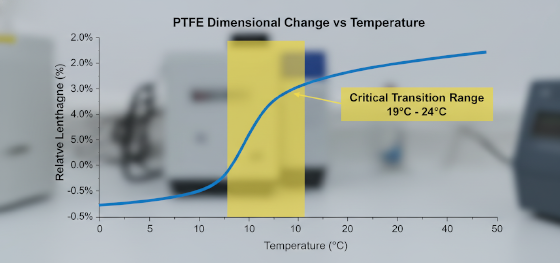
PTFE behaves unlike almost any other plastic due to a unique phase transition that occurs near room temperature. Between 19°C and 24°C (66°F to 75°F), the crystalline structure of PTFE undergoes a dramatic shift, resulting in a volume change of approximately 1%. This might seem small, but in a part requiring a +/- 0.05mm tolerance, this 1% expansion is a disaster. If a part is machined at 18°C and then installed in a facility at 25°C, it will no longer fit. This thermal instability is the primary culprit behind the "drifting dimensions" that plague most ptfe teflon cnc machining suppliers.
To combat this, Jucheng Precision operates a strictly climate-controlled manufacturing environment. We stabilize our entire production floor and inspection lab at a constant temperature, avoiding the critical 19°C-24°C transition zone during the machining process. More importantly, we perform "Thermal Mapping" for our clients. If we know the part will operate in a high-heat chemical reactor, we calculate the expansion and machine the part "undersized" at room temperature so that it expands into the correct tolerance during service. This proactive thermodynamic approach ensures that the Machining PTFE Tolerances we deliver are functional in the real world, not just on a cold inspection table. We don't fight the expansion; we engineer for it.
The Sharpness Mandate: Slicing the Slippery
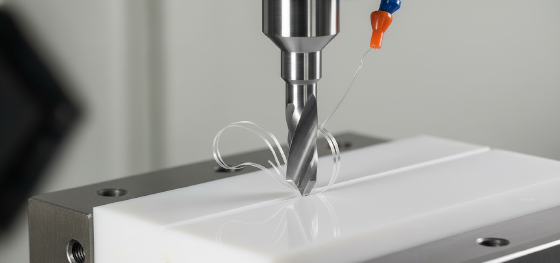
PTFE is notoriously slippery, which means a dull tool won't cut the material—it will simply skate over it, creating frictional heat and localized stress. If a tool "pushes" the plastic rather than shearing it, the material will experience "elastic recovery." The part will look correct while the tool is engaged, but once the pressure is released, the material will spring back, causing a hole to shrink or a diameter to swell. This behavior makes achieving consistent Machining PTFE Tolerances impossible with standard metalworking tools.
At Jucheng Precision, we follow the "Sharpness Mandate." We utilize specialized carbide tooling with extremely high positive rake angles and polished flutes. These tools are designed to act like a razor blade, slicing through the PTFE chains with virtually zero cutting force. By reducing the force, we reduce the heat and the deformation. We also utilize high-helix flutes to ensure that the light, "waxy" chips are evacuated instantly. If PTFE chips are re-cut, they smear and fuse back onto the part, destroying the surface finish and the tolerance. Our commitment to using only virgin, high-grade cutting edges for every precision Teflon run is what enables us to achieve Ra 0.8 finishes and tight tolerances that other shops consider "metal-only" territory.
Clamping the Unclampable: Stress-Free Workholding
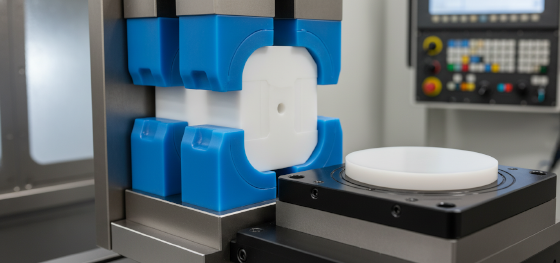
How do you hold a material that is designed to be a lubricant? Clamping is the most common source of error in ptfe teflon cnc machining. If you tighten a standard vice on a PTFE block, you will crush it. The material will cold-flow around the jaws, and once you release the pressure, the part will warp into a completely different shape. The stress induced by traditional clamping is a silent killer of Machining PTFE Tolerances.
JUCHENG engineers utilize "Stress-Free Workholding" techniques to protect the material. We design custom "Soft Jaws" that wrap 360 degrees around a part, distributing the clamping force across the maximum possible surface area to prevent localized deformation. For thin-walled parts or large plates, we utilize high-flow vacuum tables or specialized adhesive fixtures that hold the material without any compressive force at all. By minimizing the internal stress during the machining cycle, we ensure that the part doesn't "relax" into a non-conforming shape after it is removed from the machine. This attention to the physics of fixturing is what allows us to produce large-diameter Teflon seals that remain perfectly round and flat.
JUCHENG’s Metrology: Verification in the Cold
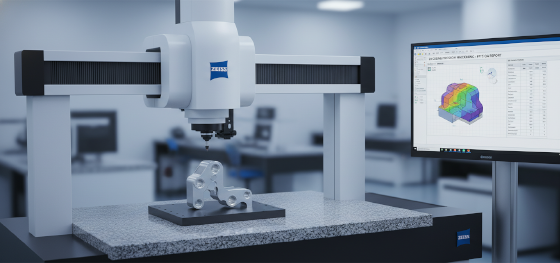
The final hallmark of a professional plastic manufacturer is the ability to prove the work. In the world of high-end semiconductor and pharmaceutical equipment, an unverified tolerance is a liability. Jucheng Precision recognizes that Machining PTFE Tolerances must be backed by a transparent and rigorous validation process. Every high-precision Teflon component we manufacture undergoes a stabilized inspection cycle.
We utilize multi-sensor CMMs that combine optical imaging with low-force touch probes to generate a complete dimensional map of your part. We provide our clients with detailed inspection reports that include thermal data, ensuring you know exactly at what temperature the part was measured. This level of transparency is essential for global supply chains where parts might be machined in Asia and assembled in Europe. When you partner with JUCHENG, you aren't just buying a piece of Teflon; you are buying the engineered certainty that your components will perform under pressure, in harsh chemicals, and across varying temperatures. Don't risk your critical seals with a shop that doesn't understand the complex thermodynamic soul of PTFE. Contact Jucheng Precision today for a full DFM review and experience the precision that specialized ptfe teflon cnc machining can bring to your next project.

