


Selecting a material for extreme environments often feels like a collision between two different laws of physics. In one corner, you have the ultimate chemical shield; in the other, the ultimate structural titan. This is the definitive showdown of PTFE vs PEEK. These two polymers represent the pinnacle of thermoplastic engineering, but they serve vastly different industrial masters. Choosing the wrong one can lead to a component that either melts under load or dissolves in chemicals.
At Jucheng Precision, we specialize in the technical nuances of ptfe teflon cnc machining and high-performance PEEK fabrication. We understand that "expensive" does not always mean "best." PEEK offers incredible strength and rigidity, while PTFE provides a level of slipperiness and chemical immunity that no other material on earth can match. This guide moves beyond the basics to explore the atomic, mechanical, and thermal divides between these two "kings" of the plastic world, ensuring your project achieves the perfect balance of performance and budget.
True engineering excellence is found in the trade-offs. Whether you are building a subsea valve that must resist aggressive acids or a medical implant that must bear human weight, the decision between PTFE and PEEK is where your design's success is decided. Let us dive into the technical pillars that define professional material selection for the 21st century.
Molecular Foundations: Fluorine vs. Aromatic Rings
Mechanical Combat: Load Capacity and Stiffness
Chemical Immunity: Where Even PEEK Fails
Thermodynamic Stability: Managing the Cold Flow
Machining Philosophies: Soft Slicing vs. Rigid Milling
JUCHENG's Decision Matrix: The Final Verdict
Molecular Foundations: Fluorine vs. Aromatic Rings
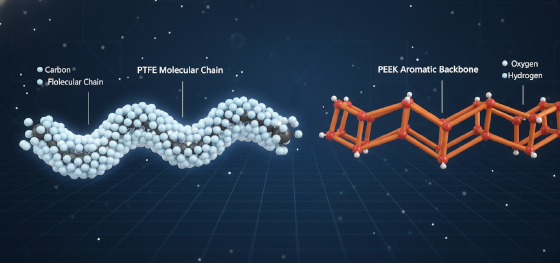
The performance gap in the PTFE vs PEEK comparison begins at the atomic level. Polytetrafluoroethylene (PTFE) is a carbon backbone entirely surrounded by fluorine atoms. These fluorine atoms act as a dense, impenetrable shield. The carbon-fluorine bond is one of the strongest in organic chemistry, making it nearly impossible for other chemicals to attack the chain. However, these chains are long and slippery; they lack the cross-linking needed for structural rigidity. This is why PTFE feels waxy and soft—it is a material designed for non-reactivity, not for holding a shape under pressure.
Polyetheretherketone (PEEK) is a semi-crystalline polymer with a backbone built of aromatic rings linked by ether and ketone functional groups. These rings provide immense structural stiffness. Imagine the difference between a loose pile of slick rope (PTFE) and a rigid, interconnected scaffolding (PEEK). PEEK’s molecular structure is designed for high-energy absorption and mechanical stability. It maintains its crystalline order even at temperatures that would cause other plastics to turn into liquids. At Jucheng Precision, we recognize that this atomic divide is the primary driver of all downstream manufacturing decisions. We treat PEEK as a "plastic metal" and PTFE as a "solid lubricant," tailoring our ptfe teflon cnc machining protocols to respect these diverging molecular souls.
Mechanical Combat: Load Capacity and Stiffness
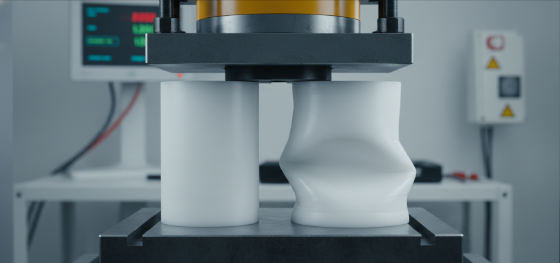
When it comes to raw strength, there is no contest. PEEK is a mechanical giant. It possesses a tensile strength of approximately 100 MPa (14,500 psi) and a flexural modulus that approaches that of some cast metals. It can bear heavy structural loads, resist fatigue across millions of cycles, and maintain tight dimensional tolerances under stress. In medical implants or aerospace brackets, PEEK is specified because it doesn't bend when the weight is applied. It is a material that stands its ground.
PTFE, conversely, is mechanically weak. Its tensile strength is roughly 25 MPa—about one-quarter that of PEEK. Its most significant mechanical flaw is "creep" or cold flow. If you put a heavy weight on a PTFE seal, it will slowly deform and "ooze" out of its seat over time, even at room temperature. However, this weakness is also its superpower. This ability to deform allows PTFE to conform to imperfect mating surfaces, creating a "perfect seal" that a rigid material like PEEK can never achieve. In the PTFE vs PEEK battle for mechanical parts, you must ask: Do I need the part to hold the load (PEEK), or do I need the part to fill the gap (PTFE)? JUCHENG engineers analyze these load profiles to ensure your material choice doesn't result in a structural collapse or a leaky system.
Chemical Immunity: Where Even PEEK Fails
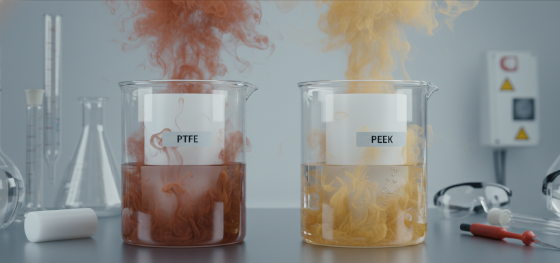
PEEK is often called "chemically resistant," but that title is relative. While PEEK survives in oils, fuels, and many mild acids, it has several critical vulnerabilities. It is aggressively attacked by concentrated sulfuric acid, nitric acid, and certain halogens. If your part lives in a semiconductor etching chamber or a high-concentration chemical reactor, PEEK will eventually soften, discolor, and fail. Its aromatic rings, while strong, can be broken by specific aggressive reagents.
PTFE is the undisputed King of Chemical Immunity. Due to its fluorine shield, it is essentially inert to almost everything. It is one of the few materials that can survive constant exposure to fuming acids, aggressive bases, and volatile solvents without any change in mass or mechanical properties. In the PTFE vs PEEK comparison for the chemical industry, PTFE is the "safe harbor." At Jucheng Precision, we frequently produce PTFE components for laboratory equipment and fluid handling systems where PEEK has already failed. We understand that in the world of aggressive chemistry, PEEK is a participant, but PTFE is a bystander—untouchable and unchanging. If your application involves "Unknown" or "Extreme" chemicals, our ptfe teflon cnc machining service provides the ultimate insurance policy against corrosion.
Thermodynamic Stability: Managing the Cold Flow

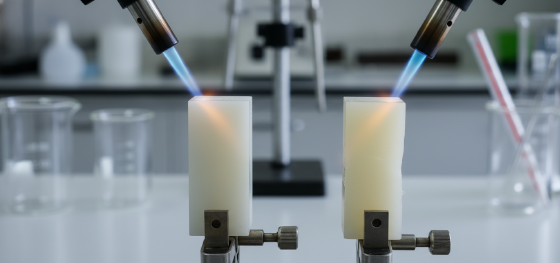
Both PTFE and PEEK are rated for a continuous service temperature of 260°C (500°F), which is incredible for thermoplastics. However, they behave very differently as they approach this limit. PEEK remains a rigid solid up to its glass transition temperature (~143°C) and stays functionally strong until it reaches its melting point (~343°C). It is a thermally stable structural material. You can build a high-temperature engine mount out of PEEK and trust it to hold the weight even as the air gets hot.
PTFE does not have a glass transition temperature in the traditional sense; it remains flexible down to cryogenic temperatures (-260°C). But at high temperatures, the "cold flow" problem of PTFE becomes an "acute flow" disaster. As the material warms, the polymer chains slide past each other with even less resistance. If a PTFE gasket is over-tightened at 200°C, it will simply migrate out of the flange. Jucheng Precision manages this thermodynamic reality by suggesting glass-filled or bronze-filled PTFE grades when heat and load must coexist. By adding a rigid filler to the slippery PTFE matrix, we can reduce the creep rate while keeping the chemical resistance. This "alloying" approach is the secret to successful high-temp sealing that JUCHENG brings to the ptfe teflon cnc machining table.
Machining Philosophies: Soft Slicing vs. Rigid Milling

The PTFE vs PEEK choice changes the very heartbeat of our CNC workshop. Machining PEEK is a joy for our technicians. It is a stable, "crisp" material that produces consistent chips and allows for incredibly tight tolerances (+/- 0.01mm). It feels like machining a high-grade aluminum. We can push PEEK to produce mirror-like surface finishes and intricate 3D features because the material is rigid enough to resist the pressure of the tool.
Machining PTFE is a high-wire act of delicacy. Because it is so soft and has a massive coefficient of thermal expansion, it is a "moving target." The material wants to deflect away from the tool rather than being cut. If your fixture is too tight, you crush the part; if it's too loose, the part vibrates and ruins the finish. Our ptfe teflon cnc machining strategy involves razor-sharp, polished tooling and non-contact inspection to ensure we don't deform the part while we measure it. We treat PTFE with the same gentleness you would use for a piece of soft fruit, ensuring the final dimensions are locked in at a stabilized 20°C. This difference in machining philosophy is why JUCHENG can deliver a PTFE seal that fits perfectly and a PEEK manifold that holds high pressure—two different skills for two very different materials.
JUCHENG's Decision Matrix: The Final Verdict

To finalize your selection, Jucheng Precision provides a clear decision tree. We don't just look at the part; we look at the mission. Cost is often the final hurdle—PEEK is significantly more expensive than PTFE—but the cost of a failed part in the field is always higher.
Choose PTFE if:
• The part is a dynamic seal, gasket, or O-ring that must conform to a surface.
• The environment involves aggressive chemicals that attack other polymers.
• You need the lowest possible coefficient of friction (the "slipperiest" surface).
• The application operates in cryogenic temperatures (below -100°C).
Choose PEEK if:
• The part is a structural bracket, housing, or manifold that must hold a load.
• Tight dimensional tolerances and rigidity are the primary requirements.
• The part must resist wear and abrasion over millions of cycles.
• The application requires high-pressure steam sterilization (autoclaving).
Jucheng Precision maintains a vast inventory of both materials, from virgin PTFE to glass-reinforced and medical-grade PEEK. Our 5-axis ptfe teflon cnc machining centers are calibrated for the specific thermal and mechanical personalities of these plastics, ensuring that your high-performance designs are delivered with absolute integrity. Don't leave your critical components to chance. Contact our engineering team today for a comprehensive DFM review and let us help you choose the polymer that will win your next industrial showdown.

