


Designing a prototype robot or a diagnostic console for a modern hospital in [2026] brings you face-to-face with the most rigid legal barrier in hardware: fire safety. In high-stakes medical and IT environments, an enclosure that melts or drips during an electrical short is a liability that can end a company. While the reaction injection molding process is prized for its ability to create massive, structural parts, standard polyurethane is naturally flammable. Achieving the gold standard of UL94 V-0 compliance requires specialized Flame retardant Polyurethane RIM systems that stop fire in its tracks without turning your parts into brittle, low-quality plastic.
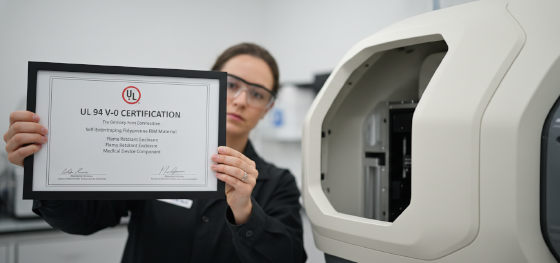
Safety compliance in Medical Device Prototyping is not just about checking a box; it is about protecting the patient and the expensive AI electronics inside the shell. Traditional flame-retardant plastics often sacrifice impact strength to achieve fire ratings, leading to enclosures that crack during simple transport. Jucheng Precision addresses these engineering trade-offs by providing high-tier Polyurethane Molding Services that utilize liquid-phase additive technology. 我们 deliver hardware that is both "Fire-Safe" and "Field-Tough," ensuring your Beta fleet passes the most aggressive UL and CE safety audits on the first try.
Operating within the Shenzhen precision manufacturing hub, JUCHENG serves as the regulatory partner for global OEMs. We transform complex engineering requirements into validated, fire-rated hardware in as fast as 15 business days. This guide is a down-to-earth look at how we achieve UL94 V-0 ratings, which additives work best for large parts, and how to maintain mechanical integrity in Flame retardant Polyurethane RIM systems to ensure your innovation is legal, safe, and unyielding in the field.
Safety Standards: Why UL94 V-0 is the Only Choice for MedTech?
Technical Data: Comparing Fire Ratings and Material Drip Rates
Formulation Secrets: How to Achieve Fire Protection in Liquid Resins?
Mechanical Check: Does Fire Proofing Make Your Parts Brittle?
JUCHENG Hub: Validating Your Fire-Rated Enclosures in Shenzhen
FAQ: Real Answers for Fire Ratings and Safety Logistics
Safety Standards: Why UL94 V-0 is the Only Choice for MedTech?
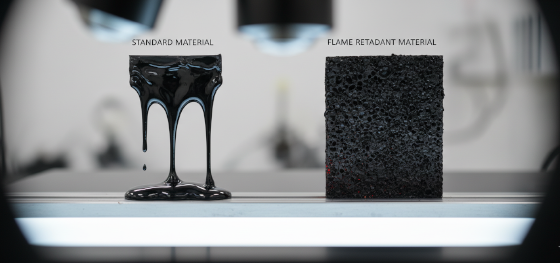
If your medical diagnostic scanner lives in a hospital room, it is legally required to be a "Self-Extinguishing" device. In the context of Flame retardant Polyurethane RIM systems, the UL94 V-0 rating is the ultimate benchmark. This test involves a vertical flame application; for a part to pass V-0, it must stop burning within 10 seconds and, most importantly, it must not produce any flaming drips that could ignite a hospital floor. Standard RIM polyurethane will burn like a candle, but JUCHENG’s V-0 formulations create an instant "Char Layer"—a carbon barrier that chokes the fire and protects the structural core of the part.
What is the difference between V-0 and V-2 ratings?
V-0 requires the fire to stop instantly and forbids flaming drips, whereas V-2 allows for some dripping, which is often a safety failure for medical equipment enclosures.
The "Drip Factor" is the most dangerous failure in plastic fires. When standard thermoplastics melt, they become liquid fire, spreading the disaster to adjacent equipment or patients. JUCHENG’s Polyurethane Molding Services solve this through thermoset chemistry. Because RIM parts are cross-linked at the molecular level, they do not melt back into a liquid state when heated. Instead, they undergo pyrolysis, turning into a stable solid char. This physical behavior is why RIM is often preferred over injection-molded ABS for large server rack components and surgical robot bases where high-voltage arcing is a potential risk in [2026].
Regulatory scrutiny is increasing for data-center and logistics robotics. As these machines carry massive lithium-ion battery packs, the risk of a "Thermal Runaway" is real. JUCHENG integrates halogen-free flame retardants into our RIM formulations to meet these evolving safety standards. These additives react with the heat to release water vapor and inert gases, effectively "drowning" the fire at the source. By delivering hardware with "Integrated Firewalls," we help our clients secure the safety certifications required to operate in high-density human environments like warehouses and clinics.
Technical Data: Comparing Fire Ratings and Material Drip Rates

Choosing the right fire rating for your Beta trial depends on the power density of your internal electronics. A low-voltage sensor pod might only need HB (Horizontal Burn) rating, but a main compute chassis requires V-0. Jucheng Precision provides technical consultations to help you navigate these safety tiers. The following table compares the essential performance metrics of Flame retardant Polyurethane RIM systems against standard industrial plastics for the [2026] market.
| Safety Standard | Standard RIM PU | JUCHENG V-0 FR-RIM | Engineering Impact |
|---|---|---|---|
| UL94 Rating | HB (Flammable) | V-0 (Self-Extinguishing) | Mandatory for Medical/IT |
| Max Extinguish Time | > 60 Seconds | < 10 Seconds | Prevents Fire Spread |
| Drip Characteristic | High (Flaming Drips) | Zero Drip | Safe for Carpet/Floors |
| Smoke Toxicity | Moderate | Low (Halogen-Free) | Safe for Confined Spaces |
The "Halogen-Free" standard is the secondary requirement for modern Medical Device Prototyping. Older flame retardants used bromine or chlorine, which release toxic, acidic smoke during a fire. JUCHENG utilizes phosphorus-based and mineral-based additives that are significantly safer for human respiration. This level of chemical foresight ensures that even in the unlikely event of a hardware fire, the smoke produced will not damage the sensitive lungs of patients or the delicate optics of nearby robotic surgical systems in your Shenzhen-tested Alpha units.
Formulation Secrets: How to Achieve Fire Protection in Liquid Resins?
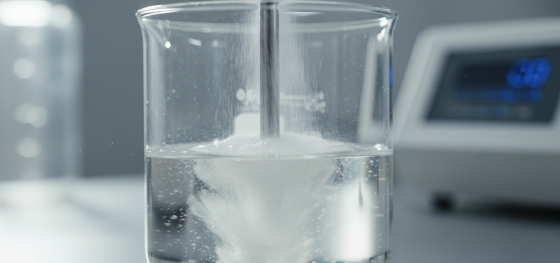
Unlike solid plastics that are hard to modify, Flame retardant Polyurethane RIM systems allow JUCHENG to "pre-mix" safety directly into the liquid Side B (Polyol). This is the "formulation secret" that allows us to maintain high surface quality. We utilize liquid-phase flame retardants that stay in suspension during the high-pressure impingement mix. This ensures that every square millimeter of a 1.5-meter long MRI shell has the exact same fire rating. In traditional molding, additives often "clump," creating areas that are fire-rated and areas that are not. JUCHENG’s automated mixing heads eliminate this "Safety Lottery."
Can I add fire protection to any RIM material?
Yes. We can formulate both rigid structural RIM and flexible elastomeric RIM to meet UL94 standards, protecting everything from hard consoles to soft robotic bumpers.
Intumescent additives are the second secret of JUCHENG’s high-performance hardware. These chemicals respond to extreme heat by expanding into a thick, insulating foam. When a fire hits a JUCHENG-molded part, the surface "puffs up," creating a thermal barrier that prevents the heat from reaching the internal electronics for several minutes. This extra time is critical for autonomous drones or robots to execute an emergency shutdown and for human staff to respond, providing a "Mechanical Grace Period" that can save millions of dollars in technology assets.
Synergistic mineral fillers like Alumina Trihydrate (ATH) are used for heavy-duty enclosures that require both fire protection and increased rigidity. These minerals release water vapor when heated, physically cooling the part down. JUCHENG utilize specialized high-abrasion pumps in our Shenzhen hub to handle these mineral-loaded resins. By combining fire safety with structural reinforcement, we deliver parts that act as both a skeleton and a firewall, simplifying your prototype robot design and reducing the total part count for mass production in [2026].
Mechanical Check: Does Fire Proofing Make Your Parts Brittle?
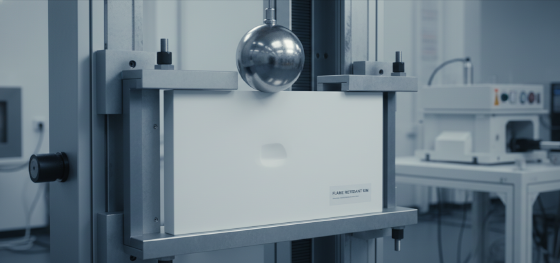
The biggest fear for engineers in Flame retardant Polyurethane RIM systems is "Additive Embrittlement." In cheap fire-rated plastics, the high concentration of powder additives ruins the polymer chain’s flexibility, leading to parts that shatter like glass during a drop test. JUCHENG addresses this by utilizing "Reactive Flame Retardants"—molecules that don't just sit in the plastic, but actually become part of the polyurethane chain. This molecular integration ensures that your fire-rated medical housing maintains 90% of the impact toughness of a non-rated part, providing the "Drop-Proof" reliability needed for mobile hospital equipment.
How to ensure parts don't crack during field trials?
Utilize reactive chemistry rather than dry fillers to ensure the polymer matrix remains ductile and absorbs energy during a collision.
Surface finish is the secondary victim of fire-proofing additives. Standard flame retardants often create a "grainy" or "matte" surface that is impossible to paint. JUCHENG’s Polyurethane Molding Services include a specialized "Skinning" cycle, where the liquid polymer forms a dense, smooth outer layer while the fire-rated additives congregate in the core. This results in an enclosure that is UL94 V-0 safe on the inside but possesses a Class-A automotive finish on the outside. You get the safety of an industrial component with the beauty of a high-end consumer product, which is vital for winning market share in [2026].
Dimensional stability is the final mechanical win. Because JUCHENG’s fire-rated RIM parts cure at low pressures and moderate temperatures, they possess zero internal stress. Unlike high-pressure fire-rated injection molding, which often warps due to the high filler content, our RIM parts stay perfectly flat. This ensures that the intricate snap-fits and gasket seals of your diagnostic console remain airtight and aligned, preventing the "Seam-Gaps" that can compromise both the aesthetics and the EMI shielding of your device. By delivering hardware that is "Statistically Stable," JUCHENG allows your assembly team to focus on the high-value AI integration.
JUCHENG Hub: Validating Your Fire-Rated Enclosures in Shenzhen
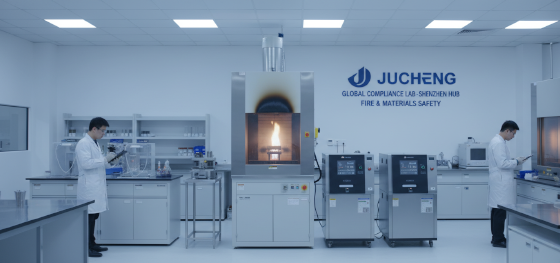
Dominating the large-format hardware market requires a partner that doesn't just promise safety, but proves it. Jucheng Precision operates with a 24/7 manufacturing mindset in our Shenzhen precision manufacturing hub, delivering high-tolerance Flame retardant Polyurethane RIM systems and structural industrial robot parts with industry-leading speed. We provide a "Bridge to Production" that ensures your innovations move from a CAD file to a safety-certified Beta fleet of 1,000 units with consistent chemical and mechanical quality.
Integrating your secure design goals with JUCHENG’s expertise ensures that your hardware survives the "Regulatory Audit Season" and moves into mass adoption. We offer comprehensive DFM reviews within 24 hours, identifying potential fire-trap zones or "mechanical weak spots" in your design before they become field failures. Whether you are building an autonomous blood-analyzer or a multi-part MRI housing, Jucheng Precision provides the rigid, precise, and *fire-safe* foundations that keep your innovation moving through the high-stakes cycles and the years of hard labor.
Our facility is equipped with 150+ CNC machines and dedicated ISO 13485 certified quality labs, including a vertical burn chamber for in-house UL-pre-testing. We manage the complexity of fire-rated chemistry and structural integrity so your engineering team can focus on the clinical outcomes and the AI. By combining Shenzhen's speed with industrial-grade material verification and global quality standards, JUCHENG remains the preferred partner for the world's most aggressive MedTech hardware challenges. Contact us today to start your next project.
FAQ: Real Answers for Fire Ratings and Safety Logistics
Can JUCHENG provide a UL yellow card for the material?
Yes. We work with certified material suppliers and provide full documentation for the resins used in your production run.
Does fire protection increase the lead time for parts?
No. Because we mix the additives in-house, the manufacturing cycle remains the same as our standard RIM process.
What is the typical thickness required for a V-0 rating?
Most of our fire-rated RIM formulations achieve V-0 at a wall thickness of 3.0mm to 4.0mm.
Is the fire protection permanent or does it wear off?
The protection is a permanent chemical part of the polymer matrix; it will not leach out or lose effectiveness over time.
Can fire-rated RIM parts be painted?
Yes. Our FR-RIM parts possess excellent adhesion for automotive-grade 2K paints, even with high additive loads.
Fire failure in a clinical or industrial setting is an absolute innovation killer. Partnering with Jucheng Precision ensures that your functional iterations are built with the self-extinguishing reaction injection molding process and specialized Flame retardant Polyurethane RIM systems the industry demands. Reach out to our Shenzhen manufacturing hub today for a complete DFM review and build the safe, unyielding foundation your autonomous fleet requires.

