


Tactile feedback is an under-engineered dimension of modern hardware. In the vast catalog of 3D printing materials, we often obsess over the rigidity of titanium or the heat resistance of PEEK, forgetting that the human interface requires a material that can yield, absorb, and return. This is the sophisticated world of the flexible 3d print. It is a sector that replaces traditional overmolding and rubber casting with the agility of additive manufacturing. Whether it is a vibration dampener for a high-speed drone or a soft-touch grip for a life-saving surgical instrument, flexible polymers allow engineers to design for compliance rather than just resistance. Achieving success in this arena requires a move away from the "hard-part" mindset and an embrace of the laws of viscoelasticity.
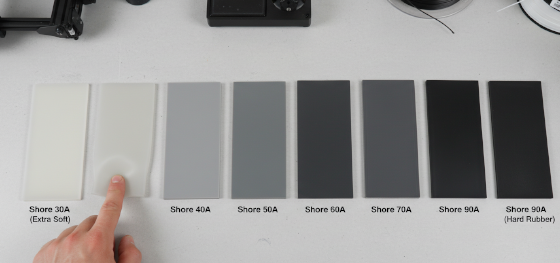
At Jucheng Precision, we recognize that an industrial-grade elastomeric component is defined by its material memory. If a seal fails to return to its original shape after compression, or if a wearable housing cracks under repeated flexing, the prototype is a failure. We have engineered our production lines to handle the unique rheology of TPU powders and the sensitive curing cycles of flexible photopolymers. This guide moves past the basic visual mockups to explore the technical pillars of Shore hardness, the molecular logic of thermoplastic polyurethanes, and why JUCHENG’s focus on high-fidelity lattice engineering allows you to control the "squish" of your design with mathematical precision.
Efficiency in flexible manufacturing is a struggle against friction and nozzle pressure. You aren't just stacking layers; you are managing a material that wants to compress while it is being built. Let us examine the technical pillars of industrial elastomers and see how they redefine the tactile soul of your next functional project.
The Shore Hardness Scale: Measuring the Give
TPU Powders: The Industrial Standard for Dynamic Seals
Flexible Resins: Achieving High-Detail Ergonomics
Designing for Deformation: The Physics of the Lattice
JUCHENG’s Functional Standard: Wearables and Gaskets
The Shore Hardness Scale: Measuring the Give
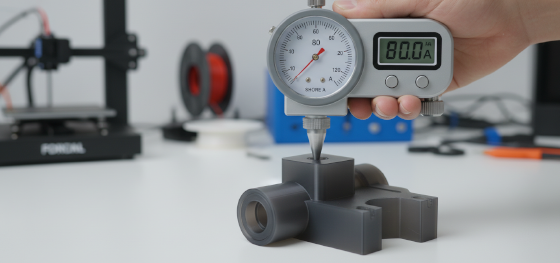
In the world of the flexible 3d print, the primary technical specification is not tensile strength, but Shore hardness. This scale measures the resistance of a material to indentation. For most industrial applications, we work within the Shore A and Shore D ranges. Shore 30A feels like a soft pencil eraser or a silicone gel—ideal for medical cushions and shock-absorbing pads. As we move up the scale, Shore 80A to 90A mimics the feel of a car tire or a high-performance shoe sole. This hardness determines how the material will interact with the human hand and how it will seal against mating surfaces.
At Jucheng Precision, we help our clients navigate this scale to ensure their functional requirements match the material's behavior. A seal that is too soft will extrude out of its groove under pressure; a seal that is too hard won't conform to the surface, leading to leaks. We also account for the "Rebound Resilience"—the speed at which the material returns to its shape. Low-rebound materials are excellent for energy absorption and dampening, while high-rebound elastomers are better for dynamic hinges. By aligning the Shore value with your mechanical load-case, we transform a visual model into a predictable engineering component. We treat these ratings as rigid technical boundaries, ensuring your "flexible" part behaves exactly as the simulation predicted.
TPU Powders: The Industrial Standard for Dynamic Seals

Thermoplastic Polyurethane (TPU) processed through MJF or SLS is the heavy artillery of flexible manufacturing. Unlike filaments, which are prone to delamination under bending stress, TPU powders are fused into a porous but isotropic solid. This molecular fusion ensures that the strength is consistent in all directions, a vital trait for high-pressure gaskets and bellows that must expand and contract millions of times. TPU offers a unique blend of high elongation (up to 500%) and excellent abrasive wear resistance. It is the only 3D material that can survive the constant rubbing of a conveyor guide or the chemical exposure of an industrial pump seal.
The technical challenge of TPU powder is its porosity. Because it is built from sintered grains, a raw TPU part is not naturally airtight. JUCHENG solves this through integrated post-processing. We utilize automated vapor smoothing to melt the outer skin of the TPU, effectively sealing the pores and creating a smooth, liquid-resistant finish. This makes the parts suitable for food processing equipment and medical fluid handling where bacteria traps must be eliminated. By managing the surface integrity of the powder-bed output, we deliver TPU components that possess the mechanical "memory" of vulcanized rubber but with the geometric freedom of additive manufacturing. It is the definitive solution for low-volume production of functional seals that must survive in the oil and gas or automotive sectors.
Flexible Resins: Achieving High-Detail Ergonomics
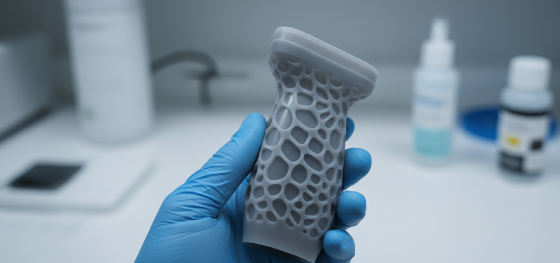
When a project requires the resolution of a light-cured resin combined with the touch of an elastomer, we pivot to SLA. Flexible resins are engineered photopolymers that maintain a high degree of "give" after UV curing. Unlike the industrial ruggedness of TPU, flexible resins are the masters of ergonomics and high-detail aesthetics. We utilize these materials to produce prototypes for wearable electronics, overmolded handles, and complex medical probes where a 0.1mm feature must be sharp but soft to the touch.
The secret to high-fidelity resin elastomers is the "Post-Cure Strategy." If a flexible resin is under-cured, it will stay tacky and lose its shape; if it is over-cured, it becomes brittle and cracks. At Jucheng Precision, we use specialized UV-staged chambers to lock in the exact cross-linking density required for your design. This ensures that the soft-touch buttons on your next handheld device have the correct "springiness" and won't degrade when exposed to skin oils. We bridge the gap between hard plastic housings and soft human interfaces, providing the multi-material realism needed for consumer focus groups and high-end clinical testing. In the world of 3D printing materials, flexible resins provide the "silken glove" finish that communicates premium quality.
Designing for Deformation: The Physics of the Lattice

The most revolutionary aspect of a flexible 3d print is that you can engineer the stiffness through geometry, not just material choice. By using "Lattice Structures"—complex, skeletal internal patterns—we can make a hard material feel soft, or a soft material act with progressive resistance. This is "Digital Foam." Instead of rely on a single foam density for a protective helmet liner or a robotic bumper, we can vary the lattice thickness across the part. This allows for localized energy absorption tailored to specific impact zones.
At JUCHENG, our DFM team analyzes your "Deformation Curve." We help you select the right lattice cell—whether it is an Auxetic structure that grows thicker when stretched or a Gyroid structure that offers uniform crushing resistance. This geometric engineering is vital for lightweighting; we can replace a solid rubber block with a lattice that weighs 70% less but offers identical structural support. By controlling the physics of the void, we allow you to design "Mechanical Meta-materials" that go beyond the limits of natural rubber. This capability is a core pillar of our work for the aerospace and athletic equipment industries, where weight and responsiveness are the primary metrics of success.
JUCHENG’s Functional Standard: Wearables and Gaskets

Choosing a partner for flexible parts is a move of engineering trust. Most shops treat elastomers as "unstable" and accept sloppy tolerances. Jucheng Precision operates with a different standard. We treat every flexible 3d print project with the same technical rigor as our 5-axis CNC department. We understand that in a high-speed assembly line, a gasket that is 0.5mm too small is a total system failure.
Our facility is equipped with precision tensile and compression testers to verify that the "Stretch" of your part matches the datasheet specifications. We provide full material traceability and documented Shore hardness checks for every batch. Whether you are building the next generation of ruggedized smartwatches or a high-pressure seal for a deep-sea submersible, JUCHENG has the material expertise and the manufacturing capacity to deliver. We don't just "print rubber"; we engineer compliant solutions that stabilize your design cycle and accelerate your path to market. Contact our engineering team today for a technical DFM review and see how our flexible additive protocols can clarify and elevate your next ergonomic breakthrough.

