


Light is the most honest critic of manufacturing. In the digital vacuum of a CAD environment, "clear" is a simple checkbox, but in the physical landscape of 3D printing materials, achieving true transparency is a brutal struggle against the laws of refraction. Most engineers are disappointed by their first attempt to 3d print clear components; what arrived as a crystal model on screen often emerges from a machine as a milky, translucent object that scatters light like a frosted window. This haze is not a material failure, but a failure of process. Transparency is not an inherent property of the resin alone—it is an engineered outcome that requires the removal of every microscopic layer line and internal void that could trap a photon.

At Jucheng Precision, we recognize that a light pipe or a medical manifold is only functional if it is invisible. We have spent years mastering the delicate synergy between high-purity photopolymers and advanced post-processing to deliver components that rival the clarity of injection-molded glass. We understand that success in the optical 3D printing process is found in the final five microns of surface refinement. Whether you are validating a new automotive headlight design or an intricate microfluidic chip, the path to "water-white" clarity demands a facility that respects the physics of the refractive index. This guide moves past the basic tutorials to explore the technical pillars of SLA optics, the labor-intensive reality of mechanical buffing, and why JUCHENG’s integrated finishing protocols ensure your designs are seen through, not just seen.
Efficiency in clear manufacturing is a matter of managed surface energy. You aren't just building a part; you are creating an interface for light. Let us break down the technical pillars of transparent additive manufacturing and see how JUCHENG transforms hazy prints into optical masterpieces.
Refractive Sovereignty: Why SLA Dominates Clear Optics
Mechanical Leveling: The Multi-Stage Sanding Ladder
Chemical Alchemy: Vapor Polishing and Its Limits
Translucency Trap: The Physics of FDM Clear Filaments
Photometric Validation: Prototyping for Automotive Lighting
JUCHENG’s Integrated Standard: Preserving the Optical Soul
Refractive Sovereignty: Why SLA Dominates Clear Optics

If you want a part you can read text through, you must eliminate internal scattering. This is why Stereolithography is the undisputed leader in the quest to 3d print clear hardware. The technology uses a liquid vat of photopolymer resin, which ensures a nearly 100% dense structure. Unlike powder-bed or filament-based methods, there are no microscopic air pockets trapped between layers. These air pockets are the primary source of internal refraction; as light passes from a solid plastic into a tiny air void and back into plastic, it bends at dozens of random angles, creating a hazy appearance.
At Jucheng Precision, we utilize specialized clear resins specifically formulated for low-yellowing and high UV stability. During the build, we adjust the laser’s "Cure Depth" to ensure the bond between layers is chemically and physically seamless. This creates an isotropic block of material where the refractive index is consistent throughout the entire volume. This "Refractive Sovereignty" is the foundation of high-end optical manufacturing. However, even the best SLA print comes off the build plate with a matte surface due to the pixelation of the laser or the DMD chip. While the internal structure is clear, the exterior is still a "diffuser." Turning this raw print into a transparent lens requires a transition from the machine to the polishing bench, where the real transformation begins.
Mechanical Leveling: The Multi-Stage Sanding Ladder
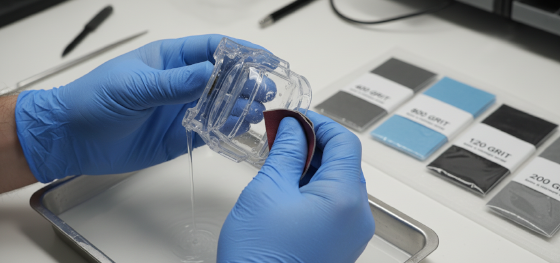
The road to clarity is paved with abrasive paper. Many shops attempt to jump directly to a buffing wheel, but this only creates a "shiny haze"—a surface that reflects light but is still distorted by the tool marks beneath the gloss. Successful 3d print clear finishing is an exercise in technical patience. JUCHENG technicians move through a rigorous, documented ladder of wet-sanding stages. We start with 400 grit to remove the primary layer lines, then move systematically through 600, 800, 1200, and finally 2000 grit.
Each step must completely erase the scratch pattern of the previous one. We use water as a constant lubricant to prevent the resin from clogging the paper and generating frictional heat, which can "smear" the plastic. By the time a part reaches the 2000-grit stage, it should have a smooth, satin-like translucency. This mechanical leveling is the most labor-intensive part of the process, but it is the only way to ensure that the final polishing stage results in a distortion-free view. For our medical and aerospace clients, this precision is mandatory; a distorted view through a transparent manifold could hide a critical air bubble or a crack in a fluid line. We treat the sanding phase as a study in surface topography, preparing the part for the final leap into transparency.
Chemical Alchemy: Vapor Polishing and Its Limits

When a part features intricate internal channels or deep, unreachable bores, mechanical sanding is a physical impossibility. This is where chemical vapor polishing provides a technical workaround. By exposing certain transparent polymers to a solvent vapor—typically a specialized blend suited for the specific resin chemistry—we can achieve a non-contact leveling of the surface. The vapor condensed on the surface causes the top few microns of the plastic to melt and flow into the microscopic valleys of the tool marks.
However, JUCHENG engineers provide a critical warning: chemical polishing is not a universal cure. It can introduce internal stresses that lead to "crazing"—microscopic cracks—if the part is later exposed to alcohol or temperature shifts. Furthermore, vapor polishing can slightly round off sharp edges, which might be a problem for parts requiring precise mechanical interlocks. At Jucheng Precision, we often use a hybrid approach: mechanical buffing for the primary exterior surfaces to maintain dimensional truth, and vapor polishing for the internal "hidden" geometries. This ensures your 3d print clear project maintains its sharp industrial lines while achieving the internal clarity needed for functional fluid or light passage. We bridge the gap between aesthetics and stability by selecting the finishing method that respects the geometry of your design.
Translucency Trap: The Physics of FDM Clear Filaments

We must address a frequent point of confusion for our clients: "Can I use FDM to 3d print clear parts?" Filaments like Clear PETG or Polycarbonate are marketed as "transparent," but in reality, they exist in a "Translucency Trap." Because FDM works by extruding a round bead of plastic, there are always microscopic triangular air gaps between the rows and layers. These millions of air pockets act as light-scattering prisms. No matter how much you sand the outside of an FDM part, the interior will remain foggy because the light is being destroyed by the internal structure.
FDM is an excellent tool for light *diffusion*. If your goal is a lampshade or an indicator cover where you want the light to be soft and spread out, clear PETG is a cost-effective choice. But if your goal is visibility—seeing through a lens or guiding a laser beam—FDM is the wrong tool. At Jucheng Precision, we are honest about these physical limits. We steer clients who need true vision toward our industrial SLA lines. By understanding that "clear material" does not equal "clear part," we help you avoid the frustration of spending a budget on a technology that is physically incapable of reaching your optical goals. We match the physics of the process to the mission of your part.
Photometric Validation: Prototyping for Automotive Lighting

The most demanding proving ground for 3d print clear components is the automotive lighting lab. Before a headlight design moves to a million-dollar production mold, the prototype must undergo "Photometric Testing." This involves measuring the exact beam pattern and luminous intensity to ensure it meets road safety regulations. If the prototype lens has even a 5% deviation in transparency or a slight internal cloudiness, the light bench data will be useless.
JUCHENG specializes in these high-fidelity prototypes. We utilize ultra-clear Somos resins and 5-axis finishing to create lenses that are indistinguishable from production polycarbonate. We understand that in the automotive sector, transparency is a safety parameter, not a decorative one. Our light pipes and lens prototypes allow designers to verify their "Light Signature" in real-time, accelerating the development of the next generation of LED systems. By providing parts that are optically true to the production design, we ensure that your R&D data is a reliable roadmap for final assembly. We don't just print light; we control its path.
JUCHENG’s Integrated Standard: Preserving the Optical Soul

The final hallmark of a professional manufacturing partner is the ability to prove the clarity. Transparency is a measurable metric, and Jucheng Precision has invested in the metrology needed to validate it. Our quality control team utilizes light transmission meters to ensure that your 3d print clear parts meet the required percentage of efficiency—typically 88% to 92% for high-end resins. We also perform "UV Ageing" simulations for our outdoor clients to verify that the clear parts won't turn yellow after a month in the sun.
We understand that a transparent part is a fragile asset. After the final polish, our parts are handled only with lint-free silk gloves and are immediately protected with anti-static films and vacuum packaging to prevent even a single microscopic scratch during transit. Whether you are building an innovative heart-pump chamber or a high-performance light guide, JUCHENG provides the technical rigor and the finishing expertise to bring your vision into the light. We don't just cut and print; we engineer the light path that defines your product's quality. Contact Jucheng Precision today for a technical DFM review and see how our transparent 3D protocols can clarify and elevate your next breakthrough.

