


Mechanical leverage in high-dexterity robotics relies on an intentional violation of classical gear physics. When an engineer designs a bipedal walking mechanism or a surgical assistant arm, traditional planetary gearboxes fail the strict requirements for weight reduction and positioning accuracy. In the uncompromising landscape of 2026, the demand for high torque in ultra-compact spaces necessitates the deployment of "Strain Wave Gearing." This mechanism achieves "Zero Backlash" by forcing a flexible steel cup to constantly deform and mesh with a rigid outer ring. Because the system relies on elastic deformation rather than simple sliding friction, the manufacturing tolerances are pushed to the absolute edge of atomic reality. A single misaligned gear tooth or a surface finish that is 0.002mm out of specification will cause the entire actuator to bind, vibrate, or catastrophically shear under load. Navigating this requirement for extreme concentricity requires the strategic deployment of Harmonic drive component machining. Jucheng Precision operates as a high-fidelity metallurgical sanctuary in the Shenzhen precision manufacturing hub, providing the exotic subtractive depth needed to conquer these notoriously difficult assemblies. As the pinnacle of humanoid robot parts development, we deliver the custom wave generators and splines that serve as the indestructible movement centers for your AI-driven hardware.
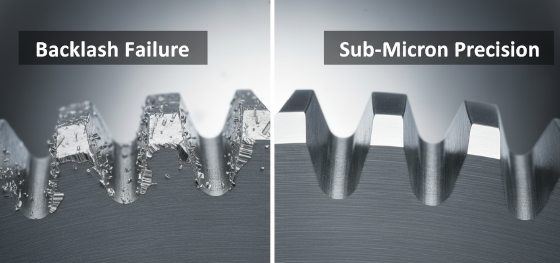
Establishing a resilient actuator supply chain demands the rejection of standard CNC milling. Amateurs often attempt to machine these dynamic components from soft, pre-annealed steels, only to realize that the intense torque of a robotic joint will instantly strip the teeth. Jucheng Precision eliminates these "Kinematic Failures" by enforcing a strict "Hard-Cut" protocol. We don't machine the metal and then heat-treat it; we heat-treat the steel to its maximum Rockwell hardness first, and then deploy specialized ceramic cutters and electrical discharge technology to carve the final geometry. This ensures zero thermal distortion occurs after the part is finished. This guide deconstructs the tripartite anatomy of the drive, the violent physics of milling HRC 50+ steel, and why JUCHENG’s Wire EDM laboratory is the mandatory foundation for anyone building custom gearboxes for the global robotics market.
What Makes Harmonic Drives Difficult? The Tripartite Anatomy of Elasticity
Hard Milling: Machining Hardened Tool Steels (HRC 50+) for Drive Components
Wire EDM (Electrical Discharge Machining): Micron-Level Accuracy for Gear Teeth Profiles
The JUCHENG Angle: Premier Contract Manufacturing for Custom Gearboxes
Frequently Asked Questions: Harmonic Drive Components
What Makes Harmonic Drives Difficult? The Tripartite Anatomy of Elasticity

Kinetic elasticity is the primary driver of manufacturing difficulty. The genius of a harmonic drive lies in its three ultra-precise components: the Wave Generator, the Flexspline, and the Circular Spline. The Wave Generator is an elliptical cam plug inserted into a flexible bearing. The Flexspline is a thin-walled steel cup with external gear teeth. The Circular Spline is a rigid steel ring with internal teeth. The magic—and the machining nightmare—happens because the Flexspline has two fewer teeth than the Circular Spline. As the elliptical Wave Generator rotates, it forces the flexible cup to deform into an oval shape, pushing its external teeth into mesh with the rigid outer ring only at two opposite points. For every full rotation of the generator, the flexible cup rotates exactly two teeth backward. If the wall thickness of the Flexspline cup varies by even a few microns, it will not deform symmetrically, causing "Torque Ripple" (vibration) or catastrophic fatigue failure. We machine these thin-walled cups to exacting specifications, ensuring the "Elastic Bending Stress" is perfectly distributed across the entire circumference of the steel.
Hard Milling: Machining Hardened Tool Steels (HRC 50+) for Drive Components
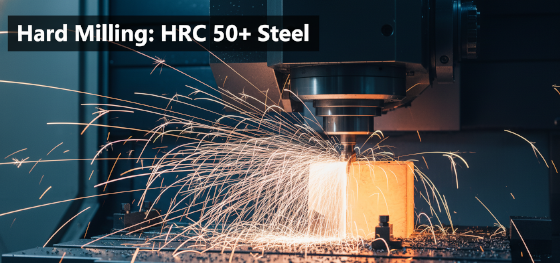
Subtractive violence is exponentially increased when cutting hardened metallurgy. Because harmonic drives rely on a relatively small number of teeth engaged at any given moment to transfer massive payloads, the metal must possess extreme surface hardness and core toughness. Standard practice involves machining "soft" steel and then heat-treating it, but this inevitably causes the circular splines to warp out of round. Jucheng Precision engineers utilize a "Hard Milling" protocol. We purchase premium alloy steels—such as 42CrMo4 or specialized Maraging steels—and harden them to HRC 50+ *before* the final machining passes. Cutting steel this hard is essentially "grinding with a mill." We utilize rigid 5-axis CNC centers equipped with Cubic Boron Nitride (CBN) or ceramic-coated carbide end mills. We run extremely shallow, high-speed tool paths to "peel" the hardened steel away without generating the localized heat that causes the tool to shatter. This ensures the final bearing seats and mounting flanges are perfectly concentric, eliminating the dimensional drift that ruins gear mesh accuracy.
Wire EDM (Electrical Discharge Machining): Micron-Level Accuracy for Gear Teeth Profiles

Micro-geometric precision cannot be achieved with physical cutting tools. The gear teeth on the Flexspline and Circular Spline are incredibly fine, often featuring unique "Involute" or custom tooth profiles designed to maximize surface contact during deformation. A standard CNC end mill is simply too large to cut the sharp internal "roots" of these gear teeth. Jucheng Precision transitions to Electrical Discharge Machining (Wire EDM) for this critical task. In our temperature-controlled EDM laboratory, a hair-thin, electrically charged brass wire is fed through a bath of dielectric fluid. As it approaches the hardened steel ring, microscopic blue sparks jump the gap, vaporizing the metal atom by atom without ever physically touching the part. Because there is zero cutting force or mechanical friction, we can cut the intricate internal teeth of a Circular Spline with an accuracy of +/- 0.002mm (2 microns). We don't just "cut gears"; we erode the negative space with light, ensuring every tooth profile is mathematically perfect and free of the microscopic burrs that cause premature wear.
The JUCHENG Angle: Premier Contract Manufacturing for Custom Gearboxes
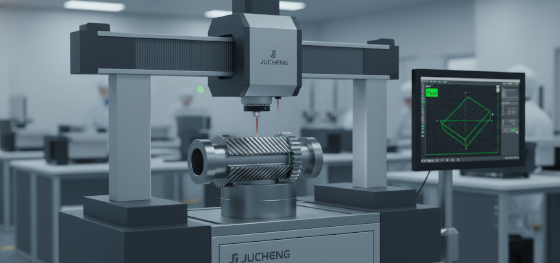
Manufacturing excellence at Jucheng Precision is built on the foundation of the "Build-to-Print" mandate. While we do not design the drives—leaving the complex kinematic math to your robotic engineers—JUCHENG acts as the premier contract manufacturer for robotics companies, providing the Hard Milling and EDM capacity needed to build custom gearboxes. Our facility, housing over 150 machines, is optimized for the aggressive production of these high-wear components. We recognize that an actuator component without a pedigree is a liability. We utilize highly sensitive Coordinate Measuring Machines (CMM) equipped with specialized gear-measuring software to scan the involute profile of every tooth, providing full dimensional inspection reports for every batch. Stop gambling your robot's agility on generic machine shops that lack the specialized equipment for hardened alloys. Leverage our decade of metallurgical mastery to validate rapidly, scale responsibly, and launch your next automated breakthrough profitably. Contact our technical team today for a free DFM review.
Frequently Asked Questions: Harmonic Drive Components
Question: Why can't the Flexspline be 3D printed from titanium or steel?
Answer: Additive manufacturing creates microscopic porosity and a crystalline structure that lacks the necessary fatigue strength. The Flexspline must constantly bend millions of times; it must be machined from a solid, forged billet of specialized fatigue-resistant alloy steel to survive.
Question: What surface finish is required for the Wave Generator cam?
Answer: The elliptical cam must be polished to a mirror finish (often Ra 0.2 µm or better) to minimize friction against the flexible bearing. Jucheng Precision achieves this through precision cylindrical grinding after the Hard Milling phase.
Question: How does JUCHENG prevent the thin walls of the Flexspline from collapsing during machining?
Answer: We utilize specialized internal expansion mandrels and custom vibration-damping fixtures. We take whisper-thin cuts at extremely high spindle speeds to eliminate the "cutting pressure" that would normally crush a 0.5mm steel wall.

