


Thermal collapse and mechanical binding are the silent executioners of autonomous movement. In the hyper-agile landscape of 2026, engineers designing advanced bipeds or robotic arms face a brutal packaging paradox: cramming maximum torque into the smallest possible physical footprint. High-torque frameless motors and harmonic drives generate immense friction and electrical heat. If this energy is trapped within the joint, the magnetic coils will degrade, and the thermal expansion of the metal will cause the delicate internal gears to bind and fail. Navigating this demand for extreme heat dissipation combined with absolute mass reduction requires the strategic deployment of Robotic actuator housing manufacturing. This highly specialized subtractive discipline transforms raw metal into a thermodynamic heat sink that also serves as a high-precision structural cage. Jucheng Precision operates as an elite manufacturing sanctuary in the Shenzhen precision manufacturing hub, providing the 5-axis CNC depth needed to conquer the "Thin-Wall Paradox." As a core capability within our humanoid robot parts portfolio, we deliver actuator shells that protect your sensitive stators while slashing the inertial mass of your robotic limbs.

Establishing a resilient actuator supply chain demands the rejection of standard "rough machining" practices. Amateurs often attempt to machine an actuator housing like a standard pipe fitting, ignoring the immense internal residual stresses of the raw aluminum billet. When they aggressively cut the walls down to 1mm, the material "springs back," pulling the bearing bores completely out of concentricity. Jucheng Precision eliminates these "Dimensional Disasters" by enforcing a strict thermodynamic management system before, during, and after the CNC cycle. Whether you are developing a collaborative robotic wrist or a high-speed SCARA arm, our facility provides the metallurgical and metrological rigor required for 2026 market entry. This guide deconstructs the physics of heat transfer, the geometric danger of 1mm walls, and why JUCHENG’s "Stress-Relief Protocol" is the mandatory foundation for anyone engineering frameless motor enclosures.
Thermal Management: What is the role of the housing in dissipating heat from frameless motors?
Thin-Wall Machining: What is the challenge of machining aluminum housings with walls as thin as 1mm without warping?
Concentricity for Bearings: How do we ensure bearing bores align perfectly for stator/rotor integration?
The JUCHENG Angle: How do our stress-relieving techniques and high-speed CNC capabilities produce warp-free actuator shells?
Frequently Asked Questions: Actuator Housings
Thermal Management: What is the role of the housing in dissipating heat from frameless motors?
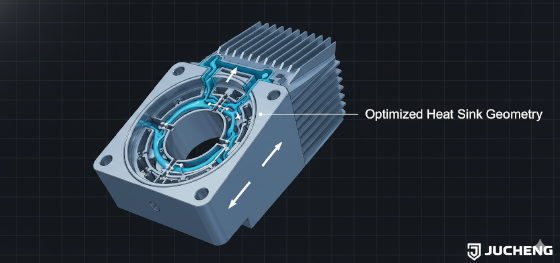
Kinetic performance is strictly throttled by the inability to shed heat. Frameless motors—which consist only of a stator and rotor with no protective casing—are directly integrated into the robot's joint to save space. Consequently, the external actuator housing must act as the primary heat exchanger. If the housing fails to conduct heat away from the stator coils, the motor will suffer from "Thermal De-rating," losing significant torque capacity as temperatures climb past 85°C. Jucheng Precision engineers utilize 7075-T6 or 6061-T6 Aluminum alloys specifically for their exceptional thermal conductivity (upwards of 160 W/m·K). We don't just machine a smooth cylinder; we frequently CNC-mill complex external cooling fins or integrate internal micro-channels for active liquid cooling. This turns a simple "cover" into a high-efficiency radiator. By maximizing the surface area of the housing, we allow your frameless motors to run at peak continuous torque without crossing the critical thermal threshold that destroys neodymium magnets.
Thin-Wall Machining: What is the challenge of machining aluminum housings with walls as thin as 1mm without warping?
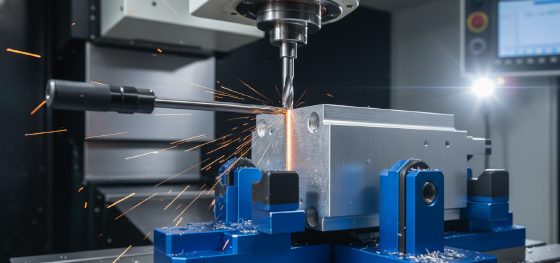
Mass reduction reaches its physical limit at the 1.0mm barrier. To minimize the "Moment of Inertia" in a robotic limb, designers constantly push to thin out the walls of the actuator housing. However, cutting a solid billet of aluminum down to a 1mm shell is a violent subtractive process. The friction of the CNC cutter induces intense localized heat, while the sheer force of the tool causes the thin wall to vibrate or "Chatter." More dangerously, as the bulk material is removed, the internal residual stresses "frozen" inside the raw aluminum billet are released, causing the part to warp like a potato chip the moment it is unclamped from the machine. Jucheng Precision combats this "Geometric Rebellion" by utilizing specialized, low-pressure custom work-holding fixtures (often using vacuum chucks or wax encapsulation) that support the delicate walls during machining. We utilize high-speed spindles (upwards of 30,000 RPM) with minimal "Step-over" to take whisper-thin cuts, reducing the physical force exerted on the material and ensuring the 1mm wall remains perfectly cylindrical.
Concentricity for Bearings: How do we ensure bearing bores align perfectly for stator/rotor integration?
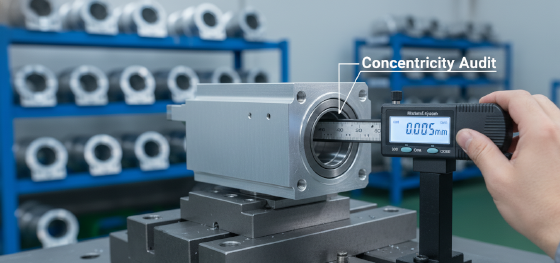
Rotational efficiency is a byproduct of perfect spatial alignment. In a frameless motor assembly, the "Air Gap" between the spinning rotor and the stationary stator is often less than 0.3mm. If the bearing bores on either end of the housing are not perfectly concentric (sharing the exact same centerline), the rotor will wobble, causing fatal "Rubbing" or catastrophic bearing failure. Robotic actuator housing manufacturing requires an absolute rejection of multi-setup turning operations. Jucheng Precision achieves this by utilizing advanced Mill-Turn CNC centers. We machine both the front and rear bearing seats in a single, uninterrupted operation without ever unclamping the part. This "Single Setup" strategy eliminates the "Fixture Drift" that plagues amateur shops. We routinely hold concentricity and cylindricity tolerances to +/- 0.005mm (0.0002 inches), guaranteeing that your cross-roller bearings drop in perfectly and your motor spins with zero parasitic drag.
The JUCHENG Angle: How do our stress-relieving techniques and high-speed CNC capabilities produce warp-free actuator shells?
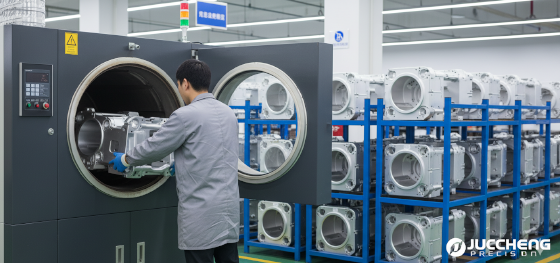
Manufacturing excellence at Jucheng Precision is built on the foundation of thermodynamic disarmament. We recognize that you cannot force a stressed piece of metal to stay round. To combat the warping inherent in 1mm thin walls, we highlight our mandatory stress-relieving techniques. Before the final, high-precision finishing passes, we place the "Rough-Machined" aluminum housings into digitally controlled thermal ovens. We slowly bake the parts to a specific temperature and cool them gradually. This "Thermal Annealing" relaxes the polymer chains (in plastics) and the crystalline grain boundaries (in metals), effectively "resetting" the internal tension to zero. When the part returns to our high-speed CNC turning/milling centers for the final cut of the bearing seats, the material is perfectly stable. JUCHENG produces warp-free, ultra-light actuator shells that pass the most rigorous CMM audits, ensuring your bionic joints assemble perfectly on the first attempt. Stop gambling your robotics venture on shops that don't respect the physics of thin metal. Contact our technical team today for a free DFM review.
Frequently Asked Questions: Actuator Housings
Question: What is the best material for Robotic actuator housing manufacturing?
Answer: Aluminum 7075-T6 is the industry standard for 2026 designs due to its high yield strength (500 MPa), exceptional thermal conductivity, and lightweight nature, making it perfect for high-torque frameless motor enclosures.
Question: Does JUCHENG provide surface treatments for aluminum housings?
Answer: Yes. We highly recommend Type III Hard Coat Anodizing. This process creates a ceramic-hard layer of aluminum oxide on the surface, providing excellent wear resistance for bearing interfaces and improved thermal radiation (emissivity).
Question: How thin can you reliably machine a robotic joint housing wall?
Answer: Utilizing our rigorous stress-relief annealing protocols and custom vibration-damping fixtures, we routinely machine non-structural side walls down to 0.8mm - 1.0mm in aluminum while maintaining perfect circularity.

