


Thermal collapse is the ultimate judge of engineering integrity. Hardware designers often encounter a "Melting Point Crisis" when transitioning from visual mockups to functional engine-bay or electronics-soak testing. Standard 3D printing resins and common filaments begin to lose their structural modulus at temperatures as low as 50°C, turning a precise enclosure into a sagging, warped failure within minutes of operation. When your project demands a physical surrogate that can survive 120°C continuous use or withstand the localized heat of a power transformer, the only viable engineering solution is high temp polyurethane casting. This specialized domain of polyurethane vacuum casting utilizes advanced thermoset resins with elevated Glass Transition (Tg) points to ensure your prototypes maintain their dimensional sovereignty under extreme thermal stress. Jucheng Precision operates as a high-heat materials sanctuary, delivering cast parts that possess the thermal spine and mechanical endurance of final production-grade materials like Glass-Filled Nylon or PPS.
Navigating the trade-offs of high-temperature replication requires more than just a hot oven; it requires a surgical understanding of polymer cross-linking. High-heat resins are notoriously difficult to process due to their aggressive exothermic reactions and inherent brittleness. Jucheng Precision eliminates the "Thermal Trap" by utilizing premium chemical systems from leaders like Hei-Cast, ensuring that your test data is 100% predictive of mass-production behavior. This guide deconstructs the physics of Heat Deflection Temperature (HDT), the necessity of stabilized post-curing cycles, and why our technical advisory is the mandatory choice for automotive and aerospace hardware teams.
Decoding the HDT: The Physics of Thermal Deflection
Molecular Resilience: The Science of High-Heat Resins
Electronics Sovereignty: Managing Localized Heat Soaks
Post-Cure Stabilization: The Secret to Zero-Drift Geometry
Mechanical Trade-offs: Balancing Heat and Impact Resistance
JUCHENG Advisory: Engineering for Extreme Environments
Decoding the HDT: The Physics of Thermal Deflection
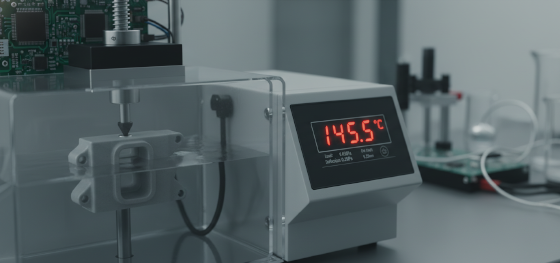
Heat Deflection Temperature (HDT) is the most critical metric on any technical data sheet, yet it is often the most misunderstood. It represents the specific temperature at which a polymer sample deforms under a specified load (usually 0.45 MPa or 1.82 MPa). In high temp polyurethane casting, we target resins that can push this threshold into the 120°C to 150°C range. For an automotive engineer testing a sensor housing near a radiator, an HDT of 60°C is a death sentence; the part will sag under its own weight before the vehicle even reaches operating temperature. Jucheng Precision provides exact HDT mapping for our resin library. We understand that "Thermal Stiffness" is a combination of polymer chemistry and geometry. If your design features thin walls (under 1.5mm), the thermal load is felt more aggressively. We assist in calculating the necessary rib reinforcements to ensure that the material's Tg (Glass Transition) isn't breached during high-heat environmental cycles, delivering functional surrogates that stay straight when the temperature rises.
Molecular Resilience: The Science of High-Heat Resins
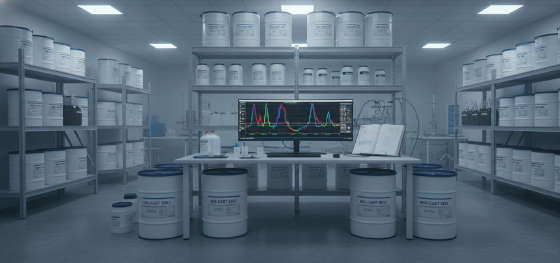
Reaching 150°C in a prototype requires abandoning generic urethanes in favor of specialized chemical systems. Jucheng Precision utilizes elite resins such as the Hei-Cast 8263 series, which are specifically engineered for under-the-hood automotive applications. These resins operate on the logic of "Dense Cross-Linking." During the polyurethane vacuum casting process, the A and B components form a three-dimensional grid that is chemically permanent. Once cured, this grid refuses to slide or melt, unlike the linear chains of a thermoplastic. However, processing these high-performance liquids is a high-stakes operation. These resins exhibit a violent exothermic peak; if the volume of the part is too large, the internal heat can cause the part to char or develop internal stress fractures. Our technicians utilize "Mass Management" strategies—such as staged pouring and thermal sinks—to control this chemical energy. We ensure that the molecular bonds lock correctly, providing a rock-solid part that mirrors the heat resistance of production-grade Glass-Filled Nylon.
Electronics Sovereignty: Managing Localized Heat Soaks
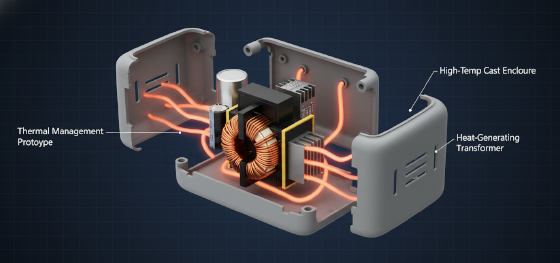
Modern electronics development is a battle against "Hot Spots." High-performance server racks, drone power distribution boards, and rapid-charging power adapters generate intense localized heat. Validating the fit of these components requires high temp polyurethane casting to ensure the enclosure doesn't deform and cause a short circuit or a cooling fan failure. Jucheng Precision works with electronics firms to produce "High-HDT Assemblies" that can survive 48-hour burn-in tests at peak power. Standard 3D prints would fail these tests, leading to false negative data regarding your design's airflow and thermal management. Our cast parts provide a stable enclosure that allows your engineers to measure real-world thermistor data, ensuring your venting slots and heat-sink clearances are technically sound. We provide the material certainty that your prototype won't become a safety hazard in the lab.
Post-Cure Stabilization: The Secret to Zero-Drift Geometry
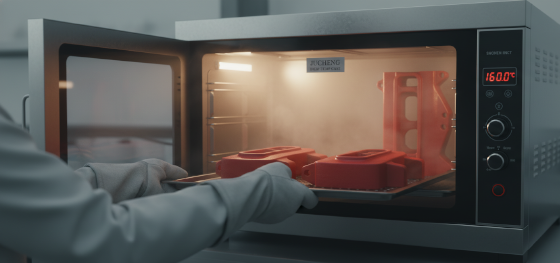
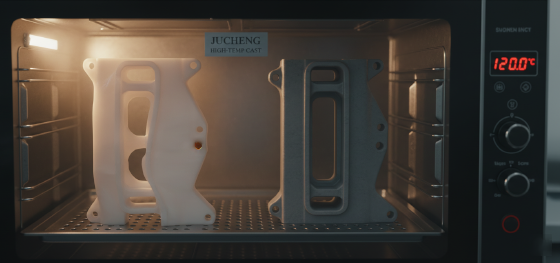
High-temperature performance is "earned" in the oven, not just the vacuum chamber. A part pulled fresh from a silicone mold has only reached about 80% of its mechanical potential. Reaching the final HDT spec requires a rigorous "Post-Curing" protocol. Jucheng Precision utilizes digitally controlled industrial ovens to subject your parts to a specific "Ramp-and-Soak" cycle. We gradually increase the temperature—for example, moving from 60°C to 80°C to 120°C over several hours. This prevents "Thermal Shock" and allows the remaining unreacted molecules to find their cross-linking partners. Skipping this step is what causes parts from inferior shops to warp the moment they hit the field. We document these oven cycles for our IATF 16949 automotive clients, ensuring that every high temp polyurethane casting batch is dimensionally stable and chemically complete. This stabilization ensures that your tenth part is as dimensionally accurate as your first, even after being subjected to intense environmental stress.
Mechanical Trade-offs: Balancing Heat and Impact Resistance
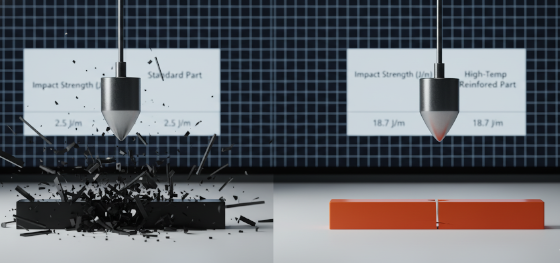
Engineering is the art of the compromise. In the world of high-heat polymers, there is an inescapable physics trade-off: as HDT goes up, impact resistance typically goes down. The denser the molecular cross-linking, the more "brittle" the material becomes. An ultra-high-temp resin might survive 160°C but shatter like a dinner plate if dropped from waist height. Jucheng Precision engineers act as your "Material Navigators" in this space. We don't just sell you the highest HDT resin; we analyze your functional requirements. If your part needs to survive a 100°C soak *and* a snap-fit assembly, we might recommend an impact-modified resin that targets 110°C instead of 150°C. We provide the Izod Impact and Elongation-at-Break data you need to make an informed decision. We ensure that you don't procure a part that is "too hot to handle" or too brittle to assemble, balancing thermal sovereignty with mechanical survival.
JUCHENG Advisory: Engineering for Extreme Environments
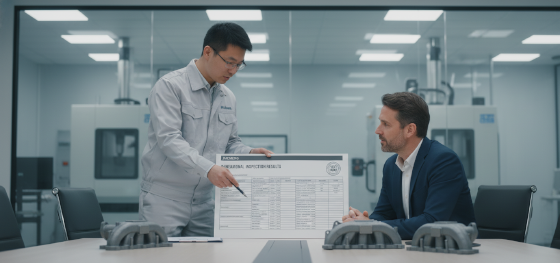
Manufacturing prototypes for extreme environments leaves zero room for vendor error. Jucheng Precision combines a massive fleet of 5-axis CNC machines for master-pattern precision with the industry's most advanced high-temp casting cleanrooms. We provide full material lot traceability and CMM inspection reports for every batch of high temp polyurethane casting, ensuring that your hardware validation data is defensible during regulatory or executive audits. Stop compromising your project's safety with mockups that melt. Leverage our decade of thermal engineering expertise to validate rapidly and launch confidently. Contact our technical team today for a free DFM review and let us determine the exact resin chemistry needed to armor your next hardware breakthrough against the heat.

