


Engineering decisions are only as robust as the data that informs them. In the fast-paced transition from digital CAD intent to physical field validation, a single miscalculation regarding material behavior can result in a catastrophic program delay or a total safety failure. While visual mockups serve to align stakeholder aesthetics, the true technical contract of a prototype is defined by its mechanical and thermal limits. Professional polyurethane vacuum casting survives as the premier bridge to mass production because it offers "Molecular Mimicry"—the uncanny ability to simulate the structural spine of production plastics through engineered thermoset chemistry. Jucheng Precision recognizes that our clients require more than just "plastic parts"; they require a documented physical surrogate that mirrors the tensile modulus and impact resistance of their final injection-molded bill of materials. This guide provides a 1500-word forensic breakdown of polyurethane casting material properties, empowering your engineering team to select the exact resin cocktail needed to survive the stress of the laboratory and the rigors of the market.
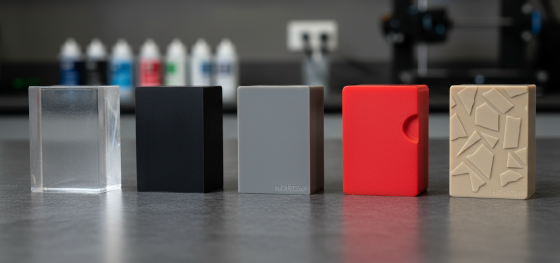
Navigating the vast material library of industrial urethanes requires moving beyond marketing labels like "tough" or "clear." It demands an interrogation of the Technical Data Sheet (TDS). Every MPa of tensile strength and every percentage of elongation-at-break carries a specific functional implication for your assembly. Jucheng Precision operates as a high-fidelity metrology and materials hub, utilizing premium systems from Hei-Cast and Axson to ensure your prototypes are dimensionally stable and chemically consistent. The following analysis deconstructs the primary mechanical metrics, provides a comprehensive performance matrix, and explores the physics of shrinkage and environmental resilience that dictate prototype success.
Interpreting the TDS: Decoding MPa, Modulus, and Elongation
The Performance Matrix: A Comparative Side-by-Side Analysis
Shrinkage Dynamics: Managing Volumetric Change and Drift
Thermodynamic Sovereignty: Tg and Heat Deflection
Environmental Resilience: Chemical Defense and UV Aging
JUCHENG Advisory: Precision Material Selection Protocol
Interpreting the TDS: Decoding MPa, Modulus, and Elongation

Technical Data Sheets (TDS) are the physical contracts between the resin manufacturer and the design engineer. However, these numbers are often generated under idealized ISO or ASTM laboratory conditions that may not reflect the complex stresses of your specific part geometry. Understanding polyurethane casting material properties begins with "Tensile Strength"—measured in Megapascals (MPa). This indicates the maximum stress the material can withstand while being pulled before failing. A high-rigidity ABS-like polyurethane typically hits 75-80 MPa, whereas a production ABS might range from 40-50 MPa. This "Over-Engineering" in urethanes is necessary because thermosets behave differently under impact. "Flexural Modulus" is equally critical; it defines the material's stiffness or resistance to bending. If your part features a cantilevered mounting arm, the Modulus dictates whether it will remain rigid or sag under load. Finally, "Elongation at Break" tells the story of ductility. A material with 5% elongation is "Brittle" and will snap suddenly. A resin with 35% elongation is "Ductile," allowing for living hinges and snap-fits to deform elastically and return to their original shape without white-stressing or fracturing. Jucheng Precision technicians cross-reference these metrics for every project, ensuring the resin's mechanical spine supports your design intent.
The Performance Matrix: A Comparative Side-by-Side Analysis
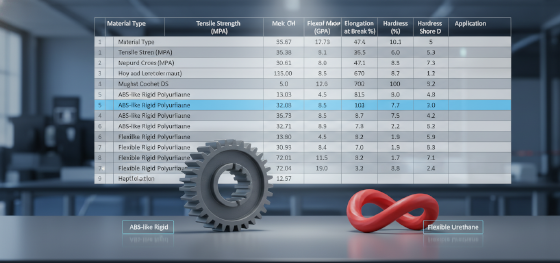
Selecting a resin from a library of fifteen options requires a comparative lens. Below is a foundational matrix used by our engineers to guide clients through the polyurethane casting material properties spectrum. These values represent typical averages across the industry's leading chemical systems:
| Property | Rigid ABS-Like | Optical Clear (PC-Like) | High-Temp (150°C) | Flexible (Shore 60A) |
|---|---|---|---|---|
| Tensile Strength | 75 - 85 MPa | 60 - 70 MPa | 80 - 95 MPa | 15 - 25 MPa |
| Flexural Modulus | 2,400 MPa | 2,100 MPa | 3,000 MPa | N/A (Elastic) |
| Elongation at Break | 10 - 20% | 5 - 10% | 2 - 5% | 350 - 500% |
| Shrinkage Rate | 0.15% | 0.2% | 0.3% | 0.5 - 0.8% |
Observing these numbers reveals a critical engineering trade-off: high heat resistance and high tensile strength often correlate with lower elongation. In short, the stiffer the material, the more brittle it becomes. Jucheng Precision navigates this compromise by offering hybrid resins and post-curing adjustments that can "soften" or "stiffen" a particular grade to meet your assembly requirements. We act as your manufacturing navigator, ensuring you don't choose a resin that is too rigid to assemble or too flexible to support its own internal hardware.
Shrinkage Dynamics: Managing Volumetric Change and Drift
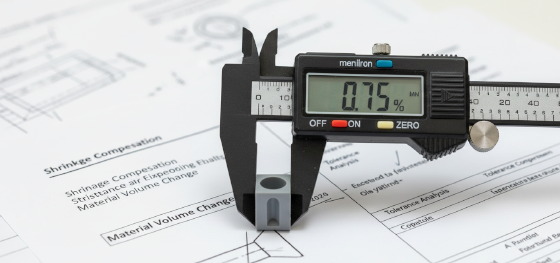
Dimensional precision is the byproduct of anticipation. Liquid resins inherently shrink as they transition from a liquid monomer to a solid polymer network during the exothermic curing phase. In the polyurethane vacuum casting process, typical shrinkage rates hover between 0.15% and 0.3%. While this is significantly lower than the 2% shrinkage found in some injection-molded Nylons, it remains a critical factor for assemblies involving press-fit bearings or gasket grooves. Jucheng Precision manages this volumetric change through "Oversize Compensation." When we CNC-machine your master pattern, our engineers apply a global and sometimes local scaling factor to account for the resin’s specific shrinkage coefficient. Furthermore, we recognize that shrinkage is not perfectly linear. Thick sections shrink more than thin ribs. By managing the thermal profile of our curing ovens and utilizing multi-stage degassing, we stabilize the volumetric change, delivering parts that fall within a tight +/- 0.1mm tolerance window. This dimensional sovereignty ensures that your prototype assembly fits together perfectly on the first attempt, preventing the frustration of manual rework.
Thermodynamic Sovereignty: Tg and Heat Deflection
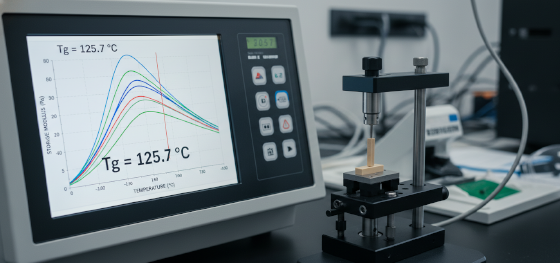
Thermal collapse often occurs long before a material reaching its melting point. The "Glass Transition Temperature" (Tg) represents the specific thermal threshold where the polymer chains begin to slide past one another, transitioning the part from a rigid "glassy" state to a flexible "rubbery" state. For automotive engine-bay components or medical devices requiring heat sterilization, the Tg is the most important among all polyurethane casting material properties. Most standard urethanes exhibit a Tg around 60°C to 70°C. Jucheng Precision provides specialized high-heat resins that push this limit to 150°C. However, reaching these values requires a rigorous "Post-Curing" protocol. We subject our high-temp parts to stabilized, multi-hour "Ramp-and-Soak" cycles in industrial ovens to fully lock the molecular cross-links. This thermal engineering ensures that your parts maintain their flexural modulus and geometric precision even in the most hostile operating environments, providing functional data that you can rely on for safety certification.
Environmental Resilience: Chemical Defense and UV Aging
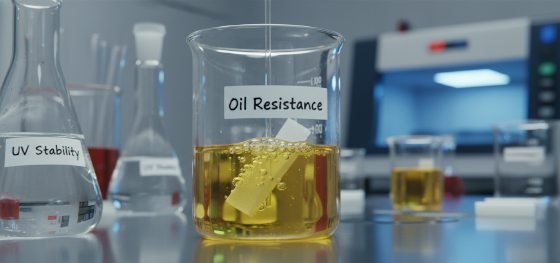
Field survival depends on the material's ability to resist environmental degradation. Many prototypes look perfect in a climate-controlled office but fail when exposed to the oils of a human hand, the Isopropyl Alcohol (IPA) used for medical sterilization, or the UV radiation of a solar-soak test. polyurethane casting material properties are inherently varied in their chemical defense. Jucheng Precision offers resins that are specifically formulated for "High-Environmental Armor." We utilize UV-stabilized optical resins that resist amber yellowing for years. We provide elastomers that exhibit zero "Swelling" when exposed to hydraulic fluids or fuels. Understanding your product’s "Chemical Life" allows our engineers to recommend the correct resin grade before the first silicone mold is poured. We ensure that your hardware validation data is not corrupted by premature material degradation, providing the structural and cosmetic longevity required for successful user-experience (UX) audits.
JUCHENG Advisory: Precision Material Selection Protocol

Manufacturing excellence at Jucheng Precision is built on the foundation of advisory engineering. We don't just "fill molds"; we optimize mechanical performance. When you submit your project, our technical team analyzes your Production Bill of Materials (BOM) to map your injection-molding requirements to our comprehensive polyurethane resin library. We provide full material lot traceability and dimensional inspection reports for every batch, ensuring that your prototype validation is a certified engineering asset. Stop gambling with "generic" prototyping plastics. Leverage our decade of chemical replication mastery to secure prototypes that behave with the mechanical soul and thermal spine of your final product. Contact our engineering team today for a free DFM review and let us determine the exact polyurethane casting material properties needed to armor your next breakthrough for the real world.

