


Tactile integrity defines user trust in the first five seconds of interaction. When a surgeon grips a new handheld diagnostic tool or a construction worker engages a high-torque power wrench, the interface between their hand and the device is the primary conduit for quality perception. If the soft-touch grip feels loose, displays unsightly gaps, or begins to peel at the edges, the engineering credibility of the entire hardware program evaporates. Traditional prototyping often relies on topical adhesives or manual gluing of separate components—methods that invariably fail during rigorous ergonomic audits. Achieving a monolithic, retail-ready multi-material part requires the strategic deployment of polyurethane overmolding casting. This sophisticated branch of polyurethane vacuum casting utilizes a dual-stage chemical process to bond disparate durometers into a single functional unit. Jucheng Precision operates as an elite laboratory for multi-resin integration, delivering prototypes that possess the exact mechanical spine and tactile soul of mass-produced "dual-shot" injection molded hardware.
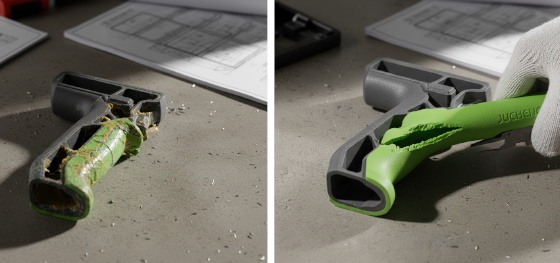
Interface sovereignty dictates the survival of complex hardware in high-stress environments. Overmolding is not merely about "placing rubber over plastic"; it is about managing the molecular transition between a high-modulus rigid core and a low-durometer flexible skin. Jucheng Precision eliminates the "Delamination Crisis" by utilizing engineered chemical cross-linking protocols that turn two liquid pours into a permanent molecular assembly. Whether you are validating a waterproof IP68 seal or an ergonomic vibration-damping grip, our technical team ensures your physical test data is 100% robust and predictive of production-grade behavior. This guide deconstructs the "Two-Hit" manufacturing sequence, the necessity of mechanical interlocks, and why our specialized mold design is the mandatory choice for elite product developers.
Two-Hit Dynamics: Mastering the Sequential Pour
Molecular Fusion: Engineering the Chemical Interface
Geometric Sovereignty: Designing Mechanical Interlocks
Flash Suppression: The Difficulty of Secondary Sealing
Haptic Validation: Simulating Production Dual-Shot
JUCHENG Protocol: Zero-Failure Multi-Material Casting
Two-Hit Dynamics: Mastering the Sequential Pour
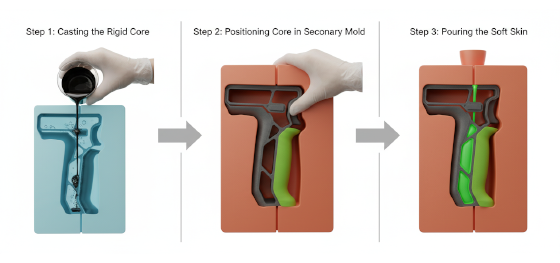
Simulating a multi-thousand-dollar dual-shot injection mold in a prototype lab requires a rhythmic, two-stage manufacturing protocol. The polyurethane overmolding casting process begins with the "First Hit"—the creation of the rigid substrate or internal chassis. At Jucheng Precision, we typically cast this core using a high-modulus, ABS-like resin to provide the structural foundation. Once this core has achieved its initial "Green Strength" and is dimensionally stable, it is removed from its primary tool and meticulously cleaned of any residual release agents. The "Second Hit" involves placing this pre-cast rigid core into a larger, more complex secondary silicone mold. This secondary tool features a specific "overmold cavity" that defines the geometry of the soft-touch skin. The second resin—usually a Shore 40A to 80A elastomer—is then poured under deep vacuum, flowing around the pre-cast core to fill the void. This sequential approach requires extreme precision; if the rigid core is misaligned by even 0.1mm within the second mold, the soft skin will be uneven, leading to assembly failure or cosmetic rejection.
Molecular Fusion: Engineering the Chemical Interface
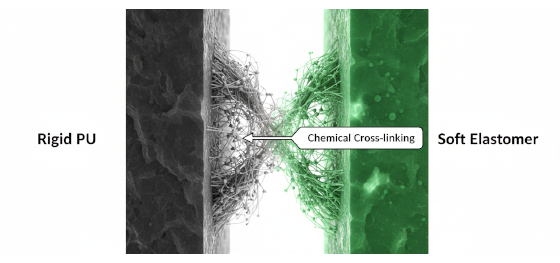
Adhesion failure is the most common pitfall in amateur multi-material prototyping. Simply pouring liquid rubber onto solid plastic does not guarantee a bond. True polyurethane overmolding casting relies on the physics of "Chemical Cross-linking." Jucheng Precision manages this by controlling the "Open Window" of the polymer reaction. We ideally perform the second pour while the first resin is still chemically active, allowing the molecular chains of the soft elastomer to intertwine and bond with the rigid core. If the core has fully cured and become inert, we utilize specialized surface-energy modifiers and chemical primers to reactivate the interface. Our material library includes specific "Primer-Free" resin combinations that are chemically pre-disposed to seek a covalent bond with one another. This ensures that during a rigorous "Peel Test," the material itself will tear (cohesive failure) before the bond between the two layers gives way. We provide the material science required to ensure your wearable straps and ergonomic handles survive years of human contact without delaminating.
Geometric Sovereignty: Designing Mechanical Interlocks
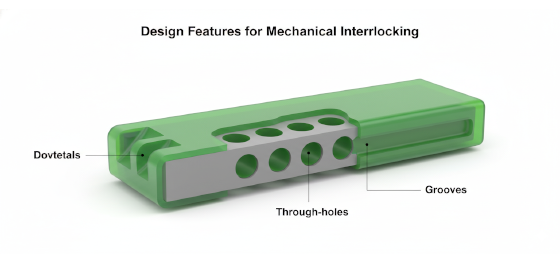
Relying purely on chemical adhesion is a risky engineering strategy for ruggedized hardware. High-performance polyurethane overmolding casting utilizes "Geometric Insurance" in the form of mechanical interlocks. During our complimentary DFM review, Jucheng Precision engineers often recommend adding "Through-Holes," "Dovetail Grooves," or "Undercut Wraps" to your rigid core design. These features allow the liquid elastomer to flow *through* or *under* the rigid chassis during the second pour. Once cured, the soft material is physically trapped within the rigid geometry, making it impossible to remove without destroying the part. This is particularly vital for high-torque applications like power tool grips or medical instruments that undergo intense lateral stress. By combining molecular fusion with mechanical anchoring, we deliver prototypes that possess the structural permanence of a factory-line product, allowing your team to perform destructive audits with 100% confidence in the assembly's integrity.
Flash Suppression: The Difficulty of Secondary Sealing
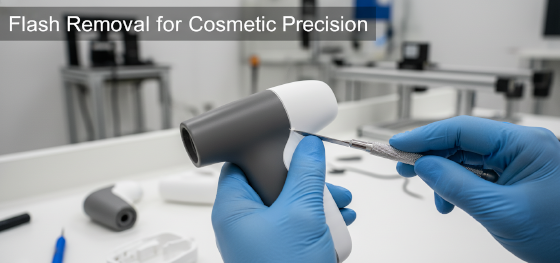
Manufacturing "Seam Discipline" is the hallmark of a master mold maker. The most difficult aspect of polyurethane overmolding casting is preventing the soft resin from leaking onto the "clean" areas of the rigid core—a defect known as "overmold flash." In an injection mold, this is prevented by the clamping force of steel. In a soft silicone tool, the seal relies on the perfect fit between the flexible cavity and the pre-cast part. Jucheng Precision utilizes "Compression Sealing" techniques, where the secondary mold is designed slightly undersized at the shut-off areas. This forces the silicone to "pinch" the rigid core tightly, creating a hermetic barrier against the liquid resin. Our master technicians then perform surgical-level manual finishing to ensure the transition between the two materials is razor-sharp. This attention to detail is why our overmolded prototypes are routinely mistaken for high-end mass-production units, providing the visual authority needed for marketing photography and investor demos.
Haptic Validation: Simulating Production Dual-Shot
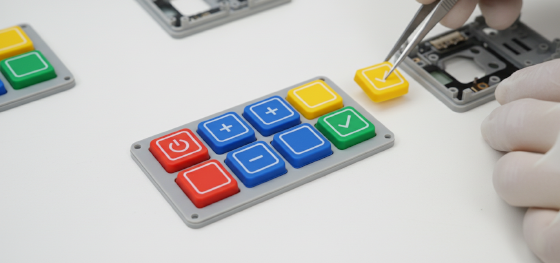
Validating the "Click-Feel" and "Grip-Texture" of a multi-material assembly requires a surrogate that doesn't just look the part, but behaves with the correct modulus. Consumer electronics firms rely on JUCHENG’s polyurethane overmolding casting to verify the actuation force of button membranes and the damping qualities of vibration-resistant seals. By pouring a specific Shore 50A elastomer over a rigid base, we can simulate the exact tactile response of a high-end smartphone case or a wearable fitness tracker. We can even achieve multi-color overmolding, where different colors of soft resin are cast onto separate areas of the same rigid chassis, providing a level of aesthetic sophistication that 3D prints cannot replicate. This haptic fidelity allows your human-factors team to conduct valid "Blind Tests" with users, ensuring the product's ergonomic soul is perfected before you authorize a fifty-thousand-dollar dual-shot production tool.
JUCHENG Protocol: Zero-Failure Multi-Material Casting
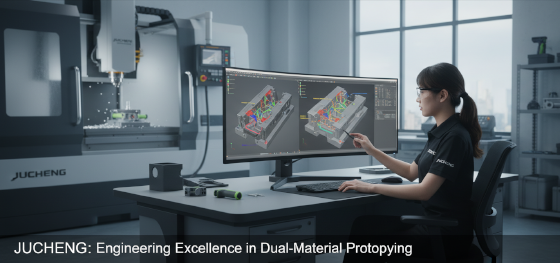
Manufacturing sovereignty in the overmolding sector is built on the foundation of integrated process control. Jucheng Precision eliminates the friction of multi-vendor assembly by housing our elite CNC machine shop, 3D printing bay, and dedicated casting cleanrooms under a single roof. We don't just "pour rubber"; we engineer an integrated assembly. Our quality control lab audits every overmolded batch using high-precision durometers to ensure the Shore hardness is consistent across the entire part. We provide the material lot traceability and dimensional inspection reports required for medical and aerospace hardware validation. Stop gambling your R&D budget on glued-together mockups that fall apart in the boardroom. Leverage our decade of multi-resin replication mastery to validate comfortably and launch profitably. Contact our technical team today for a free DFM review and let us show you how we can anchor your design's tactile future with the mechanical certainty of professional overmolding.

