


Financial hemorrhage in hardware development is rarely the result of high labor rates; it is the direct consequence of geometric over-specification. In the high-stakes environment of thermoplastic production, your invoice is not written by the factory accountant—it is written by your mechanical engineer at the CAD workstation. Every undercut, every thick wall, and every mirror-polished surface acts as a permanent "tax" on your project’s profitability. Navigating the variables of Injection molding cost requires moving beyond simple vendor negotiations and entering the realm of value-engineering. If you are struggling with a budget-busting quote, the solution is not to switch to a cheaper, lower-quality supplier. The solution is to optimize the physics of your part. Jucheng Precision operates as a strategic manufacturing consultant, utilizing our dual-threat expertise in tooling and processing to show you exactly how to reduce injection molding costs without sacrificing a single ounce of functional integrity.
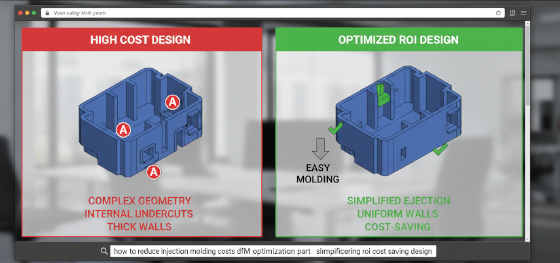
Establishing a lean manufacturing roadmap begins with a dispassionate audit of "Tooling Debt" versus "Cycle Time Overhead." Amateurs focus on the piece price while ignoring the six-figure anchor of a complex mold. At Jucheng Precision, we advocate for "Design for ROI." By making minor adjustments to your geometry—often modifications that take less than an hour in SolidWorks—we can frequently slash your tooling investment by 30% and reduce your cycle time by half. This guide deconstructs five actionable DFM maneuvers used by elite hardware teams to armor their projects against cost overruns. We provide the manufacturing insurance needed to ensure your market launch is profitable from the first batch to the last.
Geometric Simplification: Eliminating the Slider Tax
Thermodynamic Savings: Coring Out Thick Sections
Cosmetic Discipline: Standardizing Surface Specs
Parting Line Sovereignty: Shifting the Mold Split
JUCHENG Protocol: Free Expert DFM Audits
Geometric Simplification: Eliminating the Slider Tax
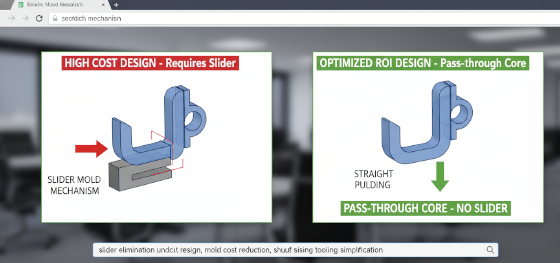
Mechanical complexity is the primary driver of initial capital expenditure. If your design features an undercut—a hole, notch, or protrusion that sits perpendicular to the mold opening—it cannot be ejected by a simple two-plate tool. These features demand "Side-Actions" such as sliders and lifters. A single slider can add $2,000 to $5,000 to your tooling invoice. If you are researching how to reduce injection molding costs, the most effective maneuver is the "Bypass Design." Jucheng Precision engineers often suggest using "Pass-Through Cores" or "Sliding Shut-offs." For a snap-fit latch, we can often create a small hole in the base of the part that allows a stationary core from the opposite mold half to form the undercut. This simple geometry change transforms a complex dynamic mold into a robust, straight-pull tool. By eliminating just three sliders, you can save enough capital to fund an entire second prototype run. We prioritize "Static Tooling" whenever possible, ensuring your mold is reliable, fast-cycling, and significantly cheaper to build.
Thermodynamic Savings: Coring Out Thick Sections
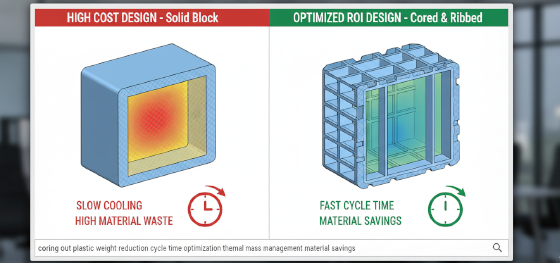
Thermal mass is the silent enemy of low unit prices. Many designers mistakenly use solid thick walls to add "perceived weight" or strength to a part. In the injection room, this is financial arson. Plastic is an insulator; a 4mm wall takes nearly four times longer to cool than a 2mm wall. Since machine-hour rates are a dominant component of Injection molding cost, doubling your cooling time effectively doubles your labor and overhead expense per unit. Furthermore, thick sections lead to "Sink Marks" and "Internal Voids," which increase scrap rates. Jucheng Precision advocates for the "Cored-Out" philosophy. We recommend replacing solid sections with a thin nominal wall supported by a network of structural ribs. If the rib thickness is maintained at 50-60% of the wall, you achieve identical rigidity with 40% less material and a 50% faster cycle time. Shaving 15 seconds off a cycle for a 100,000-unit run translates to tens of thousands of dollars in direct savings. We optimize for "Cooling Velocity," ensuring your parts are as light on your budget as they are in your hand.
Cosmetic Discipline: Standardizing Surface Specs
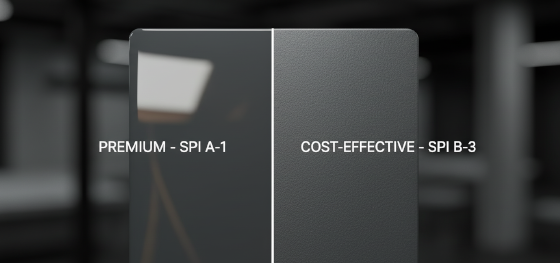
Over-specification of surface finishes is a common pitfall for inexperienced procurement teams. Mandating an SPI A-2 mirror polish on every square millimeter of a part is a guaranteed way to inflate your quote. Mirror finishes require dozens of hours of manual labor, as a technician must hand-sand and buff the tool steel using progressively finer diamond pastes. If you are looking for how to reduce injection molding costs, you must apply "Cosmetic Rationing." Jucheng Precision recommends high-gloss finishes only for critical "A-side" surfaces that the consumer will touch or see. Internal structural components, mounting brackets, or hidden ribs should remain at an "As-Machined" (B-3 or C-1) finish. This eliminates unnecessary bench time for the toolmaker, reducing the mold price and lead time. We help you identify the "Minimum Viable Aesthetic," ensuring your capital is spent on functional performance rather than invisible polish.
Parting Line Sovereignty: Shifting the Mold Split
Seam complexity dictates the difficulty of CNC mold machining. A flat, planar parting line is the most cost-effective solution because it allows the toolmaker to face-mill the mold halves quickly. However, designers often inadvertently create "3D Parting Lines" that wind and dip around complex features. These non-planar seams require multi-axis CNC time and meticulous manual "spotting" to ensure they don't leak plastic (flash). One of our top tips for how to reduce injection molding costs is to simplify the split. Jucheng Precision engineers analyze your STEP files to see if shifting the part's orientation in the mold can flatten the parting line. By rotating a part 10 degrees, we can often transform a complex, stepped parting line into a simple flat one. This maneuver reduces the "Tooling Risk," lowers the machine-hour requirement for the mold, and ensures a cleaner part with less aesthetic "mismatch." We prioritize "Geometric Straightness," keeping your tool design lean and your production yields high.
JUCHENG Protocol: Free Expert DFM Audits
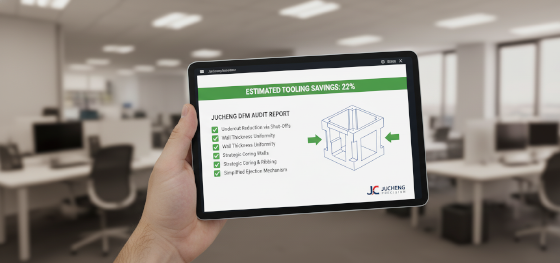
Manufacturing excellence at Jucheng Precision is built on the foundation of transparency. We don't just "accept" an expensive design; we actively hunt for ways to save you money. Our facility, housing over 150 CNC machines and elite injection bays, is optimized for value-engineering. When you upload a CAD file to our facility, our veteran engineers perform a comprehensive audit. We identify the "Slider Traps" and "Thermal Hot Spots" that are driving up your quote. We provide a red-lined design report with specific suggestions on how to reduce injection molding costs before you ever commit to a purchase order. Stop guessing about your manufacturing budget. Not sure if your wall thickness is uniform or your parting line is optimal? Upload your 3D CAD file to JUCHENG today for a Free DFM Review. Our experts will catch tooling inefficiencies before they cost you money, ensuring your transition from prototype to mass production is as profitable as it is precise.

